
The European Commission has approved Italy’s proposal to establish the first European strategic storage hub for critical raw materials, placing the country at the centre of a new initiative designed to strengthen the continent’s industrial supply security.
Developed by Italy in cooperation with the Netherlands, the project will be centred on Porto Marghera, near Venice, and supported by an integrated network of ports, logistics facilities and industrial infrastructure across northeastern Italy.
Why it matters: The initiative addresses a growing concern for European economic security: ensuring that critical materials remain available to manufacturers even during supply disruptions or geopolitical crises.
- Strategic stockpiling can provide an additional layer of resilience alongside efforts to diversify suppliers, expand domestic processing capabilities and strengthen recycling.
- For Italy, the Commission’s approval also represents an opportunity to position its industrial and logistics infrastructure within a broader European framework for securing strategic supply chains.
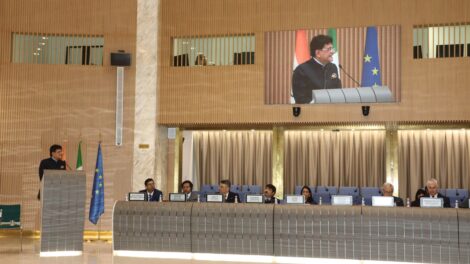
What Rome says: Italian Minister of Enterprises and Made in Italy Adolfo Urso welcomed the decision as an important recognition of Italy’s role in European industrial policy.
- “An important recognition for Italy, which is taking the lead in a major European project to safeguard the business sector,” Urso said.
- “Now everyone’s commitment is needed to turn it into a major driver of productive activity,” he added.
- The initiative was developed by the Ministry of Enterprises and Made in Italy (Mimit), working with state-backed financial institution Cassa Depositi e Prestiti (CDP) and other relevant ministries.
A strategic logistics network. Rather than relying on a single storage facility, the project envisages an interconnected system of infrastructure capable of serving European industrial supply chains.
- Porto Marghera will act as its central hub, supported by Verona’s Quadrante Europa freight terminal, a major road and rail logistics centre.
- The network will also include the port of Trieste, which provides access to Central and Eastern European markets, and Ravenna, an important facility for handling bulk cargo.
- The system could eventually incorporate privately operated infrastructure, including the Tassullo dolomite mine in Trentino’s Val di Non.
- Together, these facilities would provide a geographically distributed logistics platform connecting maritime trade routes, inland transport networks and industrial production centres.
Rare earths and tungsten first. The initial phase will focus on rare earth elements and tungsten, two categories of materials considered strategically important for European manufacturing.
- Their applications extend across several industries, including automotive, electronics, aerospace and defence.
- The project aims to ensure that these materials remain accessible to European companies during periods of market instability or interruptions in international supply chains.
- Its effectiveness will depend on the development of operational arrangements capable of translating storage capacity into reliable access for industrial users.
Beyond stockpiling. The Italian proposal also seeks to stimulate investment in critical raw material processing, refining and recycling.
- These activities could strengthen domestic and European value chains by connecting strategic reserves with industrial capabilities further downstream.
- The initiative therefore has implications beyond emergency preparedness. It could support the development of a broader industrial ecosystem around the handling and transformation of strategically important materials.
- However, the Commission’s approval concerns the project itself. The scale and timing of future investments, as well as the hub’s operational arrangements, will depend on subsequent implementation.
The big picture: The project fits within the European Union’s broader efforts to reduce vulnerabilities associated with critical raw materials, particularly through the Critical Raw Materials Act.
- The legislation seeks to strengthen European capabilities in extraction, processing and recycling while encouraging more diversified and resilient supply chains.
- The cooperation between Italy and the Netherlands adds a cross-border dimension to these efforts, bringing together countries with significant industrial and logistics capabilities.
- The Commission’s approval follows months of discussions between Mimit and European institutions. In June, European Commission Executive Vice-President Stéphane Séjourné visited Porto Marghera and Verona’s freight terminal alongside Urso to examine the project’s potential.
- Urso thanked Séjourné for the sustained dialogue that helped secure the European endorsement, describing the initiative as a pillar of EU critical raw materials policy.
The bottom line: The Commission’s decision gives Italy a leading role in a European initiative aimed at strengthening industrial resilience through strategic storage and more secure access to critical materials.
- The next challenge will be turning the approved project into functioning infrastructure, attracting investment across the value chain and ensuring that European manufacturers can benefit from greater supply security.