

The Italian government’s concern over Ukraine’s strikes against Russian naval assets in Benghazi reflects legitimate national security considerations. The prospect of the confrontation between Moscow and Kyiv becoming entangled with Libya’s internal divisions, deepening existing fractures and further undermining efforts to stabilise the country, directly affects Italian interests. Yet the political response to these developments risks producing an inversion of strategic priorities: attention to the consequences of Ukraine’s actions appears to overshadow the Russian military presence in the central Mediterranean, which helped create the conditions for the current escalation.
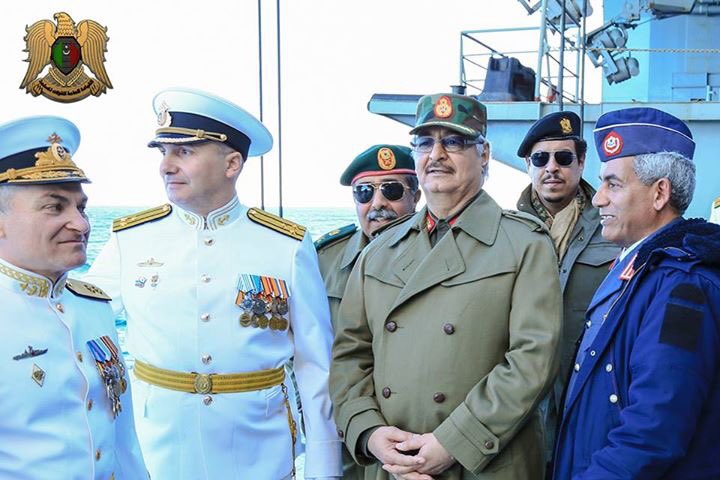
When Khalifa Haftar boarded the Russian aircraft carrier Admiral Kuznetsov off Tobruk on 11 January 2017, we had already identified the strategic significance of that rapprochement in the pages of Formiche. Moscow saw Libya’s fragmentation as an opportunity to replicate, with appropriate adjustments, the model of strategic penetration it had developed in Syria. Supporting eastern Libya’s strongman offered the Kremlin a means of acquiring leverage over Mediterranean affairs. Nearly a decade later, the scale of Russia’s military presence in Libya also reflects the inadequacy of Western responses to a development whose strategic implications were discernible from the outset.
Cyrenaica has since become a logistical platform through which Moscow sustains its military activities across the Sahel and sub-Saharan Africa. Russian support for the military juntas in Mali, Burkina Faso and Niger forms part of a broader architecture of influence in which security cooperation generates political and economic dividends, opportunities for access to natural resources and leverage over supply chains, including those involving critical minerals. Moscow’s ambitions in Sudan and the Horn of Africa give this projection an increasingly Indo-Mediterranean dimension, with implications for European strategic interests and, particularly, Italy’s ambitions under the Mattei Plan for Africa.
In July 2024, following the seizure at the Italian port of Gioia Tauro of Chinese military equipment bound for eastern Libya, Karim Mezran explained to Formiche how Haftar could act as a custodian of equipment subsequently available for Russian operations. Mezran had previously drawn attention to the possibility of Moscow using Libya to open another front of strategic pressure against NATO.
- Against this background, Ukraine’s efforts to exert asymmetric pressure on Russian military interests beyond the European theatre should hardly come as a surprise. A country resisting Russian aggression has a clear strategic rationale for seeking to increase the costs of Moscow’s international military projection, subject, of course, to the constraints of international law. The Benghazi strikes demonstrate how foreseeable it was that Russia’s expanding military footprint would eventually expose the central Mediterranean to the consequences of the war.
It would nevertheless be unfair to suggest that Italy and Europe have remained entirely passive. The evolution of the EU’s naval operation Irini offers an encouraging example. In an interview with Decode39, the mission’s commander, Rear Admiral Marco Casapieri, explained how changes in the operational environment required a broader scope of activities, reflecting the growing interconnectedness of hybrid threats, critical infrastructure security and opaque maritime traffic.
- The subsequent extension and expansion of Irini’s mandate until 2029, including a contribution to countering Russia’s shadow fleet, reflects a growing European awareness of the strategic convergence between military activities, opaque commercial networks, sanctions evasion and instruments of hybrid pressure, notwithstanding their distinct legal and operational characteristics.
The developments in Benghazi also raise two questions that warrant particular attention from Italian diplomacy.
- The first concerns Turkey. Ankara’s military presence in western Libya has a different political origin from Russia’s in Cyrenaica. A NATO member, Turkey intervened between 2019 and 2020 in support of the UN-recognised government backed by Italy. This distinction does not dispose of Western concerns over certain aspects of Turkish regional policy, but it places Ankara’s involvement within a different strategic framework. Given the reported connection between the Ukrainian operations and Misrata, where Turkey has extensive political, military and intelligence ties, how much did Ankara know? There is no established evidence of Turkish involvement or tacit approval. The question nevertheless deserves consideration in the context of Turkey’s strategic interests in any potential weakening of Russia’s Mediterranean position.
- The second concerns the United States. Efforts to bring Libya’s competing military structures closer together, promoted by US Africa Command, alongside the political initiative pursued by President Donald Trump’s envoy Massad Boulos, involve the Haftar family — Moscow’s principal interlocutor in Libya.
- Washington’s ability to offer eastern Libya alternative political, economic and security partnerships could gradually erode the dependencies underpinning Russia’s presence. The experience of post-Assad Syria, despite the substantial differences between the two countries, illustrates how a reconfiguration of international relationships can alter the terms of Moscow’s access to Mediterranean military infrastructure. Indeed, uncertainty over the future of Russian military assets in Syria may itself have accelerated Moscow’s efforts to consolidate its position in Libya.
The bottom line: Italy, drawing on the relationships it has cultivated on both sides of Libya’s political divide, has a considerable interest in shaping these developments, including through a more purposeful European engagement.
- Ultimately, the question is what constitutes stability. A temporary absence of military confrontation can coexist with a structural deterioration in Mediterranean security and Italy’s national interests. It is under such circumstances that diplomatic prudence risks slipping into strategic acquiescence.
- Nearly a decade after Haftar’s visit to the Kuznetsov, Italy and its European partners should ask themselves whether, in seeking to preserve Libya’s stability, they risk protecting the very status quo that has allowed Russia to establish, only a few hundred kilometres from Italian shores, one of the principal platforms for its military and geoeconomic power projection across Africa.