
Ukrainian President Volodymyr Zelensky on Monday claimed responsibility for the November 22 attacks against two Russian vessels in Benghazi, where the Russian corvette Merkury was reportedly sunk and the cargo ship MV Angara was struck.
The operation marks a significant escalation in the geographical reach of the Russian-Ukrainian confrontation, bringing its military consequences into an area of immediate strategic interest to Italy.
Speaking to Decode39, Libyan analyst Ahmed Zaher, Brigadier General and military and strategic expert Adel Abdelkafi, and Libya-focused commentator Reda Shaaban identify different dimensions of a common risk: the further internationalization of the Libyan crisis.
Why it matters: The Benghazi operation highlights the increasingly complex relationship between Libya’s domestic fragmentation and the strategic competition among external powers.
- For Kyiv, targeting Russian military and logistical assets beyond the Black Sea is consistent with an asymmetric strategy aimed at increasing the costs of Moscow’s war effort. Demonstrating the vulnerability of Russia’s overseas military presence also carries political and reputational implications for the Kremlin and its international partners.
- In Libya, however, these operations have consequences that extend beyond the bilateral confrontation. Foreign military partnerships designed to guarantee the security of competing Libyan authorities may increasingly become a source of instability for the country itself.
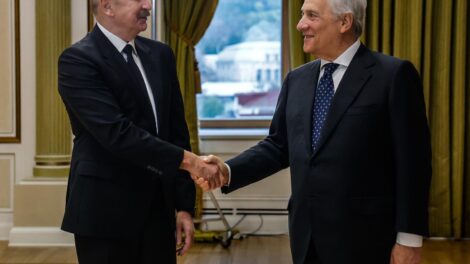
The Italian angle. The attacks have raised concerns within the Italian government. Speaking in Baku on Monday, Deputy Prime Minister and Foreign Minister Antonio Tajani stressed the need to prevent the war from spreading into the Mediterranean, safeguard freedom of navigation and preserve Libya’s stability. He also expressed concern about Russia’s military presence in the region.
- Rome faces a delicate strategic equation. Italy’s support for Ukraine coexists with its interest in preventing military escalation along Europe’s southern flank.
- Italy has developed a strategy of parallel engagement with Tripoli and Benghazi, combining security cooperation and energy investments. The emergence of another dimension of military confrontation in Libya could complicate that approach.
Zoom in: Haftar’s succession. For Zaher, the immediate implications concern the credibility of the power structure built by Khalifa Haftar. The General Command has based part of its legitimacy on its ability to guarantee security and mobilize international support.
- The incident comes at a particularly delicate moment, as the progressive transfer of authority from Khalifa Haftar to his son Saddam is reshaping the leadership of eastern Libya. According to Zaher, inheriting military positions does not necessarily mean inheriting the personal relationships, loyalties and capacity for mediation that underpin the existing system.
- A perception of growing vulnerability could encourage military figures and previously marginalized social and tribal groups in Cyrenaica and Fezzan to renegotiate their relationship with the General Command. In this context, Saddam Haftar’s references to assistance from friendly countries also serve a political purpose: reassuring the military establishment and signaling that international support remains available.
Russia’s military footprint. Moscow’s growing military presence in Libya has become a significant component of its Mediterranean and African projection.
- Recent Russian military shipments to eastern Libya underscore the importance Moscow attaches to maintaining its logistical and operational capabilities in the country. Libya provides Russia with strategic depth in the Mediterranean and a platform for its engagement across Africa.
- According to Abdelkafi, Russia maintains approximately six military bases or installations in Libya, alongside a naval presence around Benghazi and Tobruk. Although the precise extent of this military infrastructure remains difficult to establish independently, the attacks have exposed its vulnerabilities. “From a military point of view, the Russian presence has become a target,” Abdelkafi said.
- The general’s concern is that the confrontation between Moscow and Kyiv could increasingly extend into Libyan territory and waters. Reports of Ukrainian military cooperation with forces aligned with the Tripoli-based government of Prime Minister Abdul Hamid Dbeibeh reinforce these concerns. Questions remain, however, regarding the precise nature of that cooperation and the possible involvement of other international actors in the Benghazi operation.
The big picture: Shaaban places the incident within the broader evolution of American engagement in Libya. In his assessment, Washington is moving beyond its traditional support for international mediation towards more direct involvement in political, economic and security affairs.
- The Trump administration’s initiatives, spearheaded by Massad Boulos, reflect an attempt to build influence across multiple domains through engagement with both eastern and western Libya.
- Washington’s growing engagement with Saddam Haftar introduces a further geopolitical complexity. The United States is cultivating relations with an actor whose military establishment has benefited extensively from Russian support, while Ukraine is increasingly challenging Moscow’s presence in the country.
- Europe, meanwhile, struggles to translate its considerable interests into a coherent strategic approach. Italy, France and Germany have pursued different priorities and instruments, limiting their collective ability to shape developments.
Between the lines: Libya remains deeply divided despite repeated international efforts to restore institutional unity and political stability.
- The emerging Ukrainian presence in western Libya, juxtaposed with Russia’s established military footprint in Cyrenaica, risks reinforcing the country’s existing territorial and political fragmentation.
- The danger is that Libya’s unresolved domestic conflict becomes structurally connected to the Russian-Ukrainian war. Such a development could strengthen the incentives for competing Libyan factions to seek external military support, further reducing the space for national reconciliation.
- “Libya must not become the arena in which the United States and Russia clash,” Abdelkafi warned.
The bottom line. The Benghazi attacks expose a structural vulnerability in Libya’s reliance on foreign military partnerships. International backing can sustain competing power structures while weakening the security and autonomy of the country as a whole.
- For Italy and Europe, preventing the consolidation of a new theatre of the Russian-Ukrainian confrontation along the Mediterranean’s southern shores adds another strategic imperative to the stabilization of Libya.