
Repression under blackout. The Islamic Republic has imposed a total shutdown of internet and telephone networks, effectively isolating the country.
- Shahin Modarres, Iran Team Lead at ITSS Verona, stresses that “for five days we have had no clear and verifiable picture of what is happening inside Iran.”
- Even alternative connectivity tools such as Starlink have been partially neutralised through state interference. Within this information vacuum, security forces continue to fire on demonstrators, while families are reportedly forced to pay the equivalent of several thousand euros to recover the bodies of those killed and get permission to bury them.
Crimes against protesters. Modarres describes a pattern of violence that goes beyond public order enforcement.
- Testimonies from Tehran indicate that wounded protesters have been shot in the head to “finish the job,” and that security forces have entered hospitals to arrest or kill injured demonstrators.
- “These are war crimes and crimes against humanity,” he argues, pointing to violations of the Geneva Conventions and the Rome Statute. The reported figure of at least 12,000 deaths, which Modarres considers a conservative estimate, suggests the real toll may be far higher.
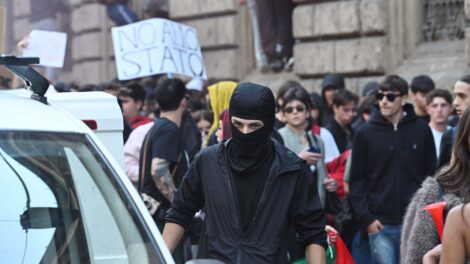
Nationwide unrest. The protests extend well beyond Tehran and reflect the broad social base of the uprising. What began in Tehran’s bazaar with economic grievances expanded to include university students and striking workers in the North-West, particularly in Tabriz and Iranian Azerbaijan.
- Demonstrations have also taken place in Mashhad and Qom, two cities traditionally seen as pillars of regime support. At the same time, reliable information from sensitive regions such as Iranian Kurdistan and Baluchistan remains scarce due to the blackout.
External intervention debate. A crucial psychological factor, according to Modarres, was the statement by the U.S. President Donald Trump suggesting that the United States could intervene in the face of crimes against humanity.
- This message strengthened the belief among parts of the Iranian population that only external military intervention could bring down the Islamic Republic. The possibility of Israeli support is also taken into consideration.
The Pahlavi factor. Reza Pahlavi, the son of Iran’s last shah, represents a significant but controversial pole within the opposition. Modarres notes that roughly one-third of Iran’s political sphere may identify with Pahlavi, according to estimates by an independent academic institute.
- However, this support has not translated into an ability to unify the opposition or produce tangible political change. Modarres is sceptical of Pahlavi’s recent claims that around 50,000 members of Iran’s armed forces and security services have contacted him and that an internal network is ready to turn against the regime. “If this were true,” he argues, “it is hard to explain why the massacres are continuing so systematically.”
Fragmented opposition. Beyond the Pahlavi question, the protest movement is marked by deep political fragmentation. Monarchists, republicans, liberal democrats and other groups share the goal of ending the Islamic Republic but disagree on what should follow and how to get there.
- The widespread use of the lion-and-sun flag, Modarres explains, should not be read as a call for monarchic restoration, but as a historical symbol of Iranian national unity and rejection of the current regime.
Outlook. Modarres warns that without external intervention or a collective refusal by the armed forces to continue shooting at protesters, the regime is likely to survive the current crisis.
- In that case, he says, the Islamic Republic will revert to mass executions and even harsher repression. The current uprising, he concludes, fits a recurring pattern: each time the regime weathers a major challenge, Iran’s political environment becomes more violent and less open to change.