Decoding the News: Italy and Germany are attempting to give a pragmatic turn to the European agenda on competitiveness. The pre-summit, promoted by Rome and Berlin ahead of the informal gathering of the Twenty-Seven in Alden Biesen, signals a new level of political alignment between the two capitals, aimed at overcoming the EU’s long-standing inertia on the single market, industry, and regulation.
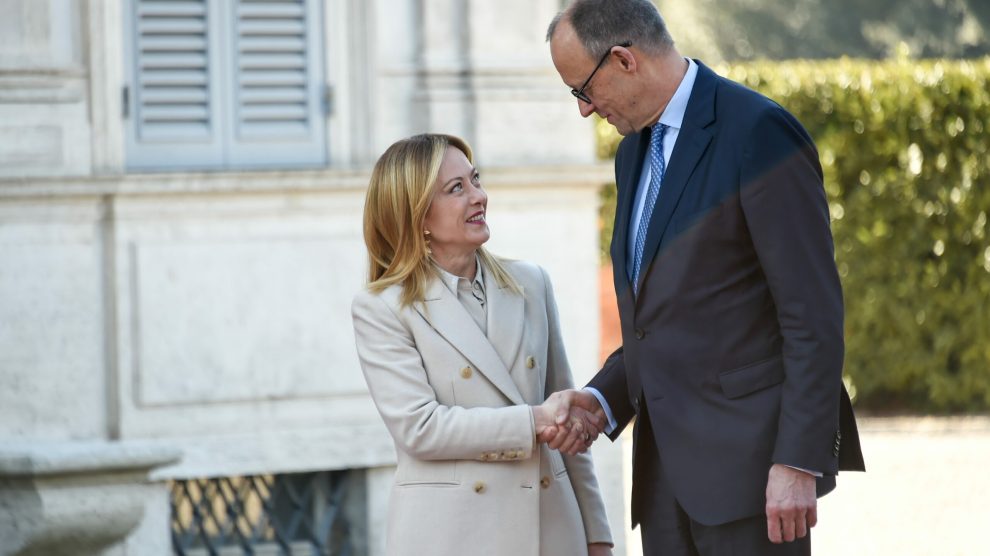
Setting the agenda: The February 12 meeting, convened by Italian Prime Minister Giorgia Meloni and German Chancellor Friedrich Merz, is not merely a preparatory appointment.
- It is a test of method and leadership: building a platform among “like-minded” countries to push the EU to act without waiting for unanimity.
- This approach explicitly echoes the call for pragmatism launched by Mario Draghi and seeks to translate into political action the recommendations — so far largely unimplemented — on Europe’s structural competitiveness challenges.
The context: The pre-summit comes ahead of the informal retreat of the Twenty-Seven at the castle of Alden Biesen, convened by European Council President António Costa, who has also invited Mario Draghi and Enrico Letta.
- In his invitation letter, Costa stressed the need to reduce national barriers, simplify the regulatory framework and encourage investment and growth, even floating the idea of a possible “28th regime” to help companies scale across the single market.
Who’s in (and who’s out). Around the table promoted by Rome and Berlin, more than a dozen leaders are expected, particularly from Northern Europe and the Baltic states, with the European Commission present in an institutional role.
- France was also invited, but no confirmation has come from Paris.
- An absence that reflects growing tensions between France and Germany over industrial policy, defence and responses to pressure from the United States, and that contributes to reshaping the EU’s traditional internal balances.
What’s on the table: At the core of the discussion are deregulation, the revival of the single market, industrial competitiveness and openness to global trade.
- Italy and Germany share the goal of strengthening Europe’s industrial base and creating an EU competitiveness fund, but they proceed cautiously on two red lines: systematic recourse to common debt and a strongly protectionist “Buy European” approach — instead favouring the notion of “Buy Transatlantic”.
- Their shared view is that excessive closure would reduce available capital, rigidify value chains, weaken Europe’s overall competitiveness and generate further friction with U.S. policies.
The geopolitical backdrop. The Meloni–Merz initiative unfolds against a more unstable transatlantic environment and a global order that, in Draghi’s words, no longer exists.
- The shared idea in Rome and Berlin is to strengthen Europe from within without breaking with Washington, avoiding ideological postures while focusing on greater industrial and regulatory autonomy.
- This line increasingly diverges from the more interventionist and protectionist approach promoted by French President Emmanuel Macron.
Defence and industry. Differences with Paris are also emerging on defence-industrial cooperation.
- Berlin is showing growing interest in the GCAP programme — led by Italy, the United Kingdom and Japan — while the Franco-German-Spanish FCAS project is cooling.
- A signal that further reinforces the Italo-German centre of gravity on highly sensitive strategic dossiers.
The Indo-Mediterranean projection. A further piece of the evolving Italo-German alignment has recently emerged from the remarks of German ambassador to Italy, Thomas Bagger.
- Speaking at John Cabot University in Rome during a lecture organised by the Guarini Institute for Public Affairs — an event for which our sister website Formiche was media partner — Bagger pointed to the India–Middle East–Europe Economic Corridor (IMEC) as one of the key areas of convergence between Rome and Berlin.
- For Germany, IMEC is not merely an infrastructure project, but a tool to reconnect Europe with India and the Middle East at a time of strained value chains and increasingly contested trade routes.
- Why Italy matters: According to Bagger, ports such as Trieste and Genoa represent natural hubs in a broader Indo-Mediterranean connectivity architecture, thanks to the deep integration between Northern Italy and Southern Germany.
- This north–south axis would offer Berlin a more direct and diversified access to Asia, while strengthening Europe’s strategic projection across the wider Mediterranean.
What we’re watching: After the pre-summit, Draghi and Letta are expected to bring the discussion back to the table of the Twenty-Seven, confronting leaders with a political choice: continue to delay or move forward with those who are ready.
- The real test for the Rome–Berlin axis will be how many countries are willing to follow this pragmatic approach and turn competitiveness rhetoric into operational decisions.
The bottom line: The competitiveness pre-summit marks a new step in the alignment between Italy and Germany.
- It is not yet a new European architecture, but it is a clear signal: Rome and Berlin intend to play an active role in redefining the EU’s priorities — from industry to geoeconomics, with an increasingly central Indo-Mediterranean projection.