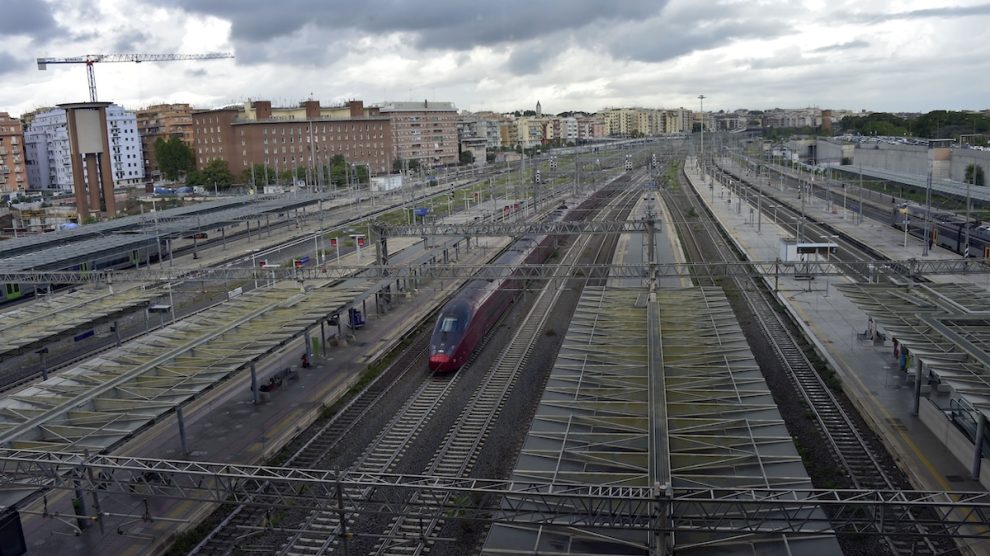
Sabotage runs along the tracks but travels, above all, through the cables. There is no need to hit a train: disabling the signaling is enough to halt traffic. It is a low-cost strategy with high media impact, seen before and back in the spotlight after recent damage to the rail network, to which the government has responded with several initiatives led by the Interior Ministry.
To understand the nature and prospects of the phenomenon seen in recent days—particularly affecting several high-speed lines—Formiche.net spoke with Professor Roberto Setola, director of the Master’s in Homeland Security at the University Campus Bio-Medico of Rome and an expert in critical infrastructure protection.
Q: Professor, are we facing an escalation or a reprise of known patterns?
A: The latter. The modus operandi is typically anarchist. It is not new: in 2019, for example, there was a sabotage attack at Florence Rovezzano station using similar methods. The perpetrators act on the manholes housing signaling cables, insert flammable material and start a fire. They do not touch the train’s power supply line, but the system that regulates traffic. Without signaling, trains cannot run for safety reasons.
Q: Does targeting signaling maximize impact with minimal risk?
A: Exactly. It is a relatively simple action that does not require sophisticated skills and achieves a significant impact on mobility, with inevitable media and political repercussions.
Q: The simultaneity of some incidents has stood out. Is that a change of pace?
A: This is the most interesting aspect. Anarchist cells are traditionally autonomous and loosely structured hierarchically. Seeing concurrent actions at multiple points on the network may indicate a higher level of coordination or, at least, an organized copycat effect. It is a pattern reminiscent of what happened in France during the Olympics, when several rail segments were hit almost simultaneously.
Q: Is there a European axis among anarchist groups?
A: Historically, yes. French, Italian and Greek anarchist circles have interacted and supported one another. Italy and France, for instance, share opposition to the Turin–Lyon line, which provides common ground for mobilization. These ties facilitate exchanges of narratives, experiences and sometimes operational practices.
Q: In Italy, however, the impact has been more limited than in the French case. Why?
A: Because in France the attacks occurred near a global event like the Olympics, with Paris at the center of worldwide attention. In Italy, the attacks affected strategic nodes—such as Bologna—but far from a stage of that magnitude. Moreover, over the years, the State Railways has built a solid security system, with significant investments in network protection and monitoring.
Q: How complex is it to protect railway infrastructure?
A: Very. We are talking about roughly 17,000 kilometers of track. It is clear that every meter cannot be guarded. The focus is on preventive intelligence, technological surveillance and rapid response. Italy has developed significant know-how in protecting critical infrastructure.
Q: Is the ideological profile of the groups involved also changing?
A: There is a thematic shift. Actions are intertwined with anti-militarist and environmental demands, onto which ideological readings related to the Middle East are grafted. There is a convergence between antagonistic fringes and anarchist milieus, with a radicalization of content to regain visibility. Some radical environmental groups in Europe have adopted more aggressive protest methods, moving closer to anarchist logic.
Q: Is this phenomenon likely to grow?
A: It will depend largely on prevention capabilities and on how public support around these groups is managed. When groups that have lost territorial roots seek visibility, they may resort to spectacular actions. But the state’s response, in investigative and security terms, is structured and consolidated.
The bottom line: “Intercepting weak signals: understanding when emulation turns into stable coordination. Protecting critical infrastructure is not only a technical issue, but also one of analyzing the social and political dynamics that can generate threats,” said Professor Setola.