Decoding the News: For Italy, what is happening around Iran is not a distant conflict but a direct strategic concern. Rome’s security, energy resilience, and economic stability are closely tied to Middle Eastern and Indo-Mediterranean connectivity corridors, maritime routes, and Gulf energy flows.
- Any escalation that threatens regional stability, disrupts supply chains or increases volatility in global energy markets immediately affects Italian national interests.
- The government’s rapid activation of inter-ministerial coordination and energy-sector consultations reflects an understanding that the crisis must be managed simultaneously as a diplomatic challenge, a security issue and a geoeconomic risk.
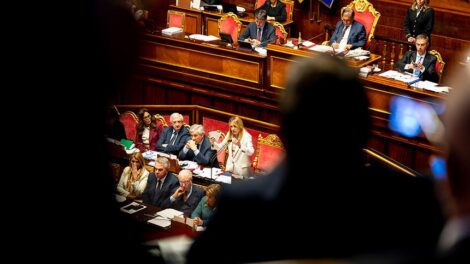
From Palazzo Chigi: Italy is moving on three fronts at once: citizen protection, energy security and high-level diplomacy. Prime Minister Giorgia Meloni is personally leading the response, signalling that Rome sees the crisis as both a security and economic risk.
What happened: PM Meloni chaired two government meetings focused on developments in the Middle East.
- The first brought together key ministers, including Foreign Minister Antonio Tajani and Defence Minister Guido Crosetto, as well as senior officials from the Prime Minister’s office.
- Focus:
- Monitoring the latest developments.
- Protecting Italian citizens in affected areas.
- Reinforcing the government’s maximum commitment to their safety.
- Focus:
- The second meeting expanded to include the CEOs of state-linked energy giants Eni and Snam.
- Focus:
- Assessing current and potential impacts of the hostilities on energy markets.
- Evaluating spillovers to the Italian economy.
- Identifying short- and medium-term mitigation measures.
- Focus:
The energy angle: Italy is closely monitoring volatility in global energy markets — particularly given its exposure to gas flows and Mediterranean routes.
- By bringing in the leadership of Eni and Snam, the government signalled that it is:
- Closely tracking supply risks.
- Stress-testing resilience mechanisms.
- Preparing contingency options if disruptions intensify.
- No specific measures were announced, but the meeting’s format suggests scenario planning is already underway.
The diplomatic push. Meloni maintained a dense schedule of calls with regional and European leaders.
- In these days, she spoke with:
- The King of Jordan.
- The Sultan of Oman.
- The King of Bahrain.
- The Emir of Kuwait.
- The President of the United Arab Emirates.
- The Emir of Qatar.
- The Crown Prince and Prime Minister of Saudi Arabia.
- She also coordinated with European leadership, including European Commission President Ursula von der Leyen and Cypriot President Nikos Christodoulides, whose country currently holds the EU’s rotating presidency.
- In previous contacts, Meloni also aligned with key European partners — including German Chancellor Friedrich Merz and UK Prime Minister Keir Starmer — to support a common response within both the G7 and the European Union framework.
- At the institutional level, Meloni briefed Italian President Sergio Mattarella on the evolving situation and diplomatic contacts.
Protecting Italians abroad. Parallel coordination continues with the Foreign Ministry.
- Rome renewed its call for maximum caution among Italian nationals residing in or transiting through the region and urged them to follow guidance from the Foreign Ministry’s crisis unit.
- The government has not announced evacuations, but the repeated emphasis on citizen security indicates close monitoring of conditions on the ground.
The big picture: Italy’s response combines:
- Security management (citizen protection).
- Economic containment (energy risk assessment).
- Regional diplomacy (direct outreach to Middle Eastern leaders).
- European alignment (coordination with Brussels and EU partners).
What we’re watching: The structure of the response — inter-ministerial meetings, engagement with energy CEOs, and sustained diplomatic calls — shows Rome preparing for both immediate shocks and longer-term instability.
- For now, the emphasis is on prevention and coordination rather than escalation.
- What comes next will depend on whether the crisis remains contained — or begins to disrupt energy flows, maritime corridors, and broader regional stability.