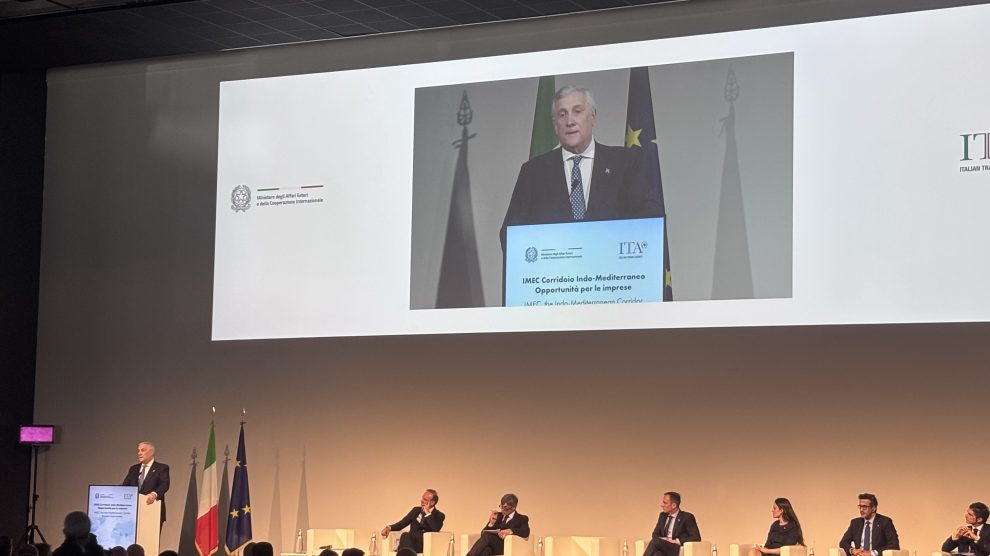
TRIESTE – The closure of the Strait of Hormuz — an Iranian response to the war unfolding on its territory involving Israel and the United States — has not only shaken global markets, starting with energy. According to Italy’s foreign minister, Antonio Tajani, speaking at the IMEC plenary session in Trieste, the crisis has also exposed the critical need to develop alternative routes to keep global geoeconomic supply chains moving.
A common view. That message resonated across the international audience gathered in the Adriatic port city to discuss the India‑Middle East‑Europe Economic Corridor. From Romania’s foreign minister, Oana Toiu, to the UAE minister of state, Saeed Alhajeri, and the European commissioner for the Mediterranean, Dubravka Suica — who joined via video message — participants converged around a shared assessment: economic stability increasingly depends on diversified routes and corridors.
- Local and economic actors echoed the same view. While Friuli‑Venezia Giulia governor Massimiliano Fedriga highlighted Trieste’s strategic role in the emerging connectivity landscape, representatives of the economic sector — including ICE president Matteo Zoppas, Confindustria logistics delegate Leopoldo Destro, SACE president Guglielmo Picchi and OECD deputy director Karim Dahou — emphasised that economic security is now inseparable from national security.
- In their view, the resilience of global trade increasingly depends on networks of corridors capable of maintaining flows of goods, commerce and economic activity even as geopolitical disruptions become more frequent.
The minister’s view: acceleration and realism. Against this backdrop, Tajani stressed that IMEC is gaining political traction precisely because of this strategic need.
- India — represented at the forum by Deputy National Security Adviser Pavan Kapoor — is “absolutely convinced” of the project, Tajani said. “The Gulf countries are convinced as well. So we must absolutely accelerate the timeline for its realisation.
- The minister also called on businesses to play a direct role in shaping the corridor’s development. “We must also listen to your ideas,” Tajani told the many logistics and infrastructure operators attending the forum.
- “The government will put its maximum effort into ensuring that the IMEC corridor can be completed as quickly as possible.”
- The strong presence of the private sector was one of the aspects most welcomed by international delegations — including the U.S. delegation, represented by IMEC envoy Dane Johnston.
- At the same time, Tajani acknowledged the scale and complexity of the infrastructure involved. “It will not be a matter of weeks, obviously, but it is a matter of moving fast,” he said.
- He added a note of caution linked to the region’s instability: “We hope the war does not cause us to lose opportunities,” he said, linking the development of the Indo‑Mediterranean corridor to the turbulent geopolitical environment currently unfolding in West Asia.
Yes but… A diplomatic source speaking privately on the sidelines of the forum suggested that the corridor could become even more relevant in the current context.
- “The minister’s assessment is logical,” the source said. “But pushing forward on IMEC in this please may be even more important now, because its geopolitical infrastructure could eventually become part of the broader geostrategic architecture that emerges after this complicated phase of regional conflict in West Asia.”
Italy’s strategy. The discussion in Trieste also revealed how IMEC fits into a wider Italian strategy centred on regional and continental connectivity. On the same day, Tajani also attended celebrations marking the 30th anniversary of the Executive Secretariat of the Central European Initiative (CEI), another regional cooperation forum.
- The goal is to create a “network,” as underlined by Ambassador Francesco Maria Talò, Italy’s Special Envoy to IMEC.
Go (not so far) East. In that context, the minister reiterated that integrating the Western Balkans into the European Union remains a strategic priority for Italy. Regional cooperation frameworks such as the CEI, he argued, remain essential tools for strengthening stability and economic development across Europe.
- According to Tajani, the initiative also offers a platform to advance regional connectivity and generate new economic opportunities for businesses and local territories.
- Within that broader framework, he announced that Italy intends to join “as a strategic partner” the Three Seas Initiative — a move that could further reinforce Trieste’s role as a bridge between the Adriatic, Black and Baltic Seas.
- Italian MP Paolo Formentini has suggested that linking this framework with IMEC could become a key element of Italy’s global connectivity strategy.
The bottom line: Taken together, the messages emerging from Trieste point to a broader strategic shift. Infrastructure corridors, logistics networks and trade routes are becoming central instruments of geopolitical competition.
- Italy is seeking to leverage its geographic position and port system to position itself within the emerging architecture of trade linking Europe, the Mediterranean, and Asia.
- Trieste — historically the maritime gateway of Central Europe — is once again positioning itself at the centre of a strategic contest: the race to shape the next generation of global trade routes and secure resilient supply chains.