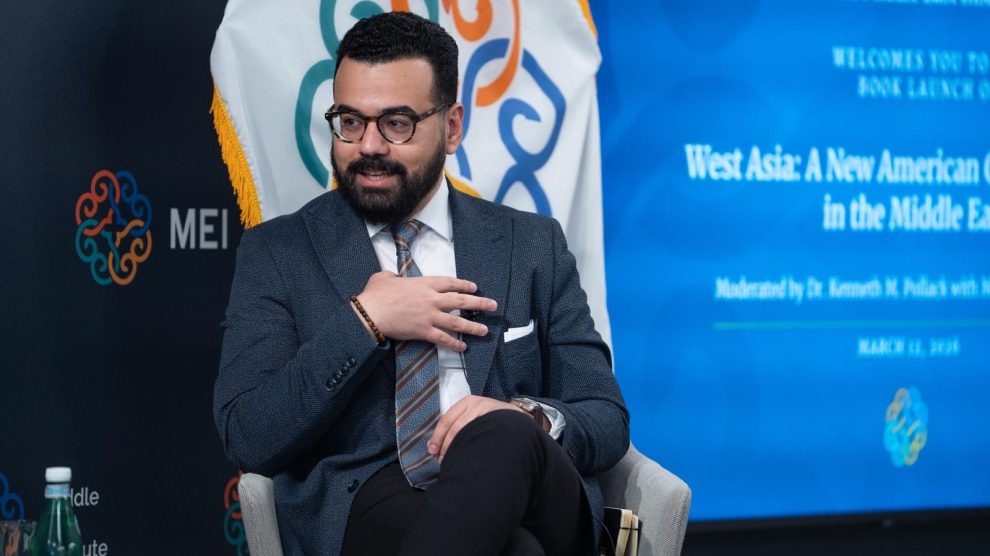
n Western strategic debates, few terms have remained as pervasive—and as insufficiently questioned—as “the Middle East.” A region restless, dynamic, and persistently unstable has once again returned to the center of global attention amid the ongoing conflict involving the United States, Israel, and Iran. To make sense of these evolving dynamics, Mohammed Soliman, in West Asia: A New American Grand Strategy in the Middle East (Polity, 2026), begins with a radical premise: the problem of American strategy in the region is not merely operational, but conceptual. Washington continues to think within a mental map inherited from the colonial era and shaped by the geopolitics of oil, even as the center of global power has shifted toward the Indo-Pacific and the networks of Eurasian connectivity.
Soliman’s proposal—to replace the concept of the “Middle East” with “West Asia”—is not a semantic adjustment but an attempt to redefine the strategic space between the Mediterranean and the Indian Ocean as a central hinge of the twenty-first century. Notably, “West Asia” is increasingly the term used by Indo-Pacific actors themselves to describe this region, particularly as countries in that space are now being called upon to help secure key maritime chokepoints such as the Strait of Hormuz, whose fragile balance has been upended by the war with Iran. For countries like Italy, which project their geopolitical and geoeconomic interests into the Indo-Mediterranean, this reframing is particularly relevant.
Mohammed Soliman is a senior fellow at the Middle East Institute, where he focuses on the intersection of technology, geopolitics, and emerging markets. A trained engineer, he is also a director at McLarty Associates and holds research affiliations with the Foreign Policy Research Institute and Third Way’s national security program. A frequent commentator on CNN, BBC, and other international outlets, his work has appeared in Financial Times, Foreign Affairs, Foreign Policy, and Project Syndicate.
The book arrives at a moment of transition for U.S. foreign policy. After two decades marked by costly military interventions with ambiguous results, Washington had begun to reduce its direct presence in the region, prioritizing competition with China—until the recent return to military action against Iran. Soliman argues that this retrenchment should not become disengagement, but rather recalibration. The United States, in his view, should act as an offshore balancer, supporting a regional system of partners capable of sharing burdens and responsibilities. In this framework, West Asia is no longer a standalone theater but the intermediate space linking the two decisive poles of U.S. strategy: Europe and the Indo-Pacific.
One of the book’s most original contributions lies in its analysis of the region’s internal transformation. According to Soliman, the post–Cold War Middle Eastern order collapsed with the 2003 invasion of Iraq and the Syrian civil war—events that enabled the rise of transregional powers such as Iran and Turkey while accelerating state fragmentation. In retrospect, the current war involving Iran may soon be added to this list of systemic shocks. At the same time, the Gulf monarchies have pursued economic diversification and technological projection strategies, transforming themselves into global financial, logistical, and digital hubs. The result is a region defined less by ideological identities and more by competition over infrastructure, connectivity, and capital. It is no coincidence that recent Iranian retaliatory strikes have targeted Dubai’s airport—symbol of this diversification—as well as data centers linked to global technology giants such as Amazon.
If the Gulf represents one of the engines of this transformation—assuming it remains so after the current conflict—it is also because emerging economies have invested heavily in it, often more decisively than traditional Western powers. While China’s presence is often more visible, India—now deploying naval assets to protect shipping through Hormuz—has emerged as one of the most dynamic actors in the region.
Expanding the analytical scope of West Asia, Soliman places India at the center of an Indo-Abrahamic system linking the subcontinent, the Gulf, and the Eastern Mediterranean. The growing cooperation among India, Israel, the United Arab Emirates, and Saudi Arabia is presented as the embryo of a new strategic bloc, potentially backed by the United States. In parallel, the author identifies an alternative axis led by Turkey, with connections to Pakistan and East Africa. The competition between these emerging systems is likely to shape the balance of power in West Asia in the decades ahead.
Another key element of the book is its focus on infrastructure as an instrument of power. Soliman reads geopolitics through ports, trade corridors, energy networks, and data centers. Initiatives such as the India–Middle East–Europe Economic Corridor (IMEC)—which will soon be discussed at an international event in Trieste organized by Italy’s foreign ministry—are framed as the material backbone of an alternative order to China’s Belt and Road Initiative. In this vision, the Suez Canal and Red Sea routes are not merely chokepoints, but nodes within an integrated economic system linking production, transport, and technology.
The book’s technological dimension is captured in the concept of “compute, not crude.” In the twenty-first century, power derives less from control of energy resources and more from the ability to generate and process data. The use of AI-enabled targeting systems such as Project Maven—reportedly allowing the Pentagon to strike more targets in the first 48 hours of the Iran conflict than in the first six months of operations against ISIS—offers a stark illustration of how rapidly technological change can reshape power balances. Partnerships between Western technology firms and Gulf actors, combined with investments in artificial intelligence and digital infrastructure, are presented as the new foundation of national and regional security. Yet, while persuasive, this thesis risks underestimating the enduring centrality of energy in global politics, as the disruption of Hormuz and the resulting volatility in energy markets clearly demonstrate.
Ultimately, the main constraints on Soliman’s vision stem less from the model itself than from the regional environment in which it would have to operate. The reconceptualization of the Middle East as West Asia must contend with a reality marked by active conflicts, systemic rivalries, and renewed instability. In such a volatile strategic environment, the formation of stable coalitions among actors with divergent interests—from India to Saudi Arabia, from Israel to Turkey—remains difficult. But these challenges reflect the region’s persistent fragmentation rather than flaws in the strategic framework itself.
From the standpoint of U.S. strategy, the value of the book lies precisely in its strategic proposition. Soliman urges Washington to abandon the logic of nation-building and large-scale military interventions in favor of constructing a regional order based on functional coalitions and deterrence. In an era of constrained resources and great-power competition, this approach reflects a pragmatic realism that is gaining bipartisan traction in the United States—even if the war with Iran has complicated its implementation in the short to medium term.
In the end, West Asia is less an operational manual than an exercise in strategic imagination. Its central contribution is to remind us that maps are not neutral: they shape priorities, alliances, and perceptions of threat. Reframing the Middle East as West Asia means shifting attention from local crises to global connections, from identity politics to the geopolitics of networks. Whether this vision translates into a new American grand strategy will depend on the ability of the United States and its partners to adapt to an increasingly multipolar world. Yet the unfolding military crisis itself seems to underscore the relevance of Soliman’s framework.
For European and Mediterranean observers, particularly those familiar with Rome’s decision-making corridors, the book offers an additional insight: if West Asia truly functions as the hinge between Europe and the Indo-Pacific, then the Mediterranean is no longer a periphery but a central strategic front.
Soliman is, at heart, a realpolitik thinker—unsentimental about power, clear-eyed about interests, and unencumbered by the ideological baggage that has distorted American strategic thinking for a generation. What distinguishes him is his Asianist perspective, a lens too rarely applied to a Mediterranean and Middle Eastern theater long dominated by liberalism-centric frameworks. He does not moralize; he maps. And in doing so, he brings the mainstream debate about sea power and regional order into productive tension with how Asia’s emerging strategists actually read the board.
Soliman belongs to an emerging school of strategists who view history not as a repository of warnings but as applied intelligence—a living archive from which to draw operational conclusions. Where a previous generation of American thinkers leaned on liberal institutionalism or neoconservative democratization theory, this cohort reads Bismarck alongside Brzezinski, Richelieu alongside Kissinger. They are shaped by long cycles of Eurasian power competition, fluent in the language of balance-of-power politics, and entirely unsentimental about the gap between declared values and real interests.
What further distinguishes them is a willingness to make difficult choices even on paper: to acknowledge declining hegemonies, to accept spheres of influence as realities rather than failures, and to advocate strategic retrenchment where necessary. Soliman’s forecasting methodology reflects this mindset: it does not rely solely on trend lines, but on structural pressures—reading the tectonic forces beneath the daily noise of regional politics and conflict.
In this sense, he and his peers represent something genuinely new in American strategic culture: a realism tempered by civilizational literacy and a forward-looking orientation grounded in the hard lessons of the past quarter century.
Soliman appears to be precisely the kind of thinker the United States needs in the aftermath of the Middle East wars—a moment that calls for neither triumphalism nor guilt, but for cold strategic recalibration. The postwar reckoning requires voices willing to shed the assumptions of the unipolar moment and engage the world as it is, not as Washington once imagined it.
In this sense, Soliman’s proposal concerns not only the future of American strategy, but the very redefinition of the balance between West and East in the twenty-first century.