“This is the moment to invest in Africa — through co-production, job creation and returns on investment.”
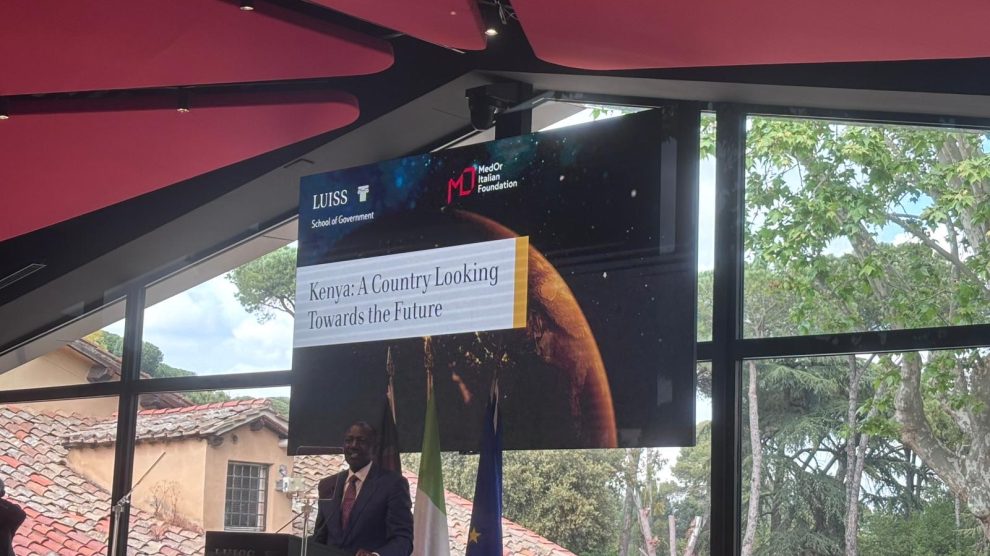
From Rome to Nairobi. Delivered in Rome during the event “Kenya: A country looking towards the future” at Luiss Guido Carli, these words by President William Samoei Ruto captured the political meaning of his visit.
- In office since 2022 and advancing a growth- and investment-oriented agenda, Ruto used his lecture at Luiss’ The Dome to frame Kenya’s regional and global role, while signalling a broader shift in Italy–Kenya relations.
- His intervention comes at a moment of intensifying bilateral ties, culminating in the intergovernmental meeting with Prime Minister Giorgia Meloni and the signing of the Italy–Kenya Action Plan 2026–2029.
From Strategy to Execution. More than a statement of intent, the Action Plan outlines an operational framework spanning political dialogue, economic cooperation, infrastructure, energy, security, education and technology. It reflects a multidimensional partnership designed to evolve over time and deliver tangible outcomes.
- On the political level, Rome and Nairobi aim to institutionalise their dialogue through regular consultations and enhanced coordination in multilateral fora.
- Economically, the focus is on promoting investment, engaging the private sector and developing industrial value chains—particularly in infrastructure, sustainable energy and agribusiness—within a model based on equal partnerships and shared value creation.
Technology, AI and Strategic Sectors. One of the most significant dimensions of the agreement lies in technology. Cooperation in artificial intelligence, scientific research and space is set to expand, building on joint initiatives and advanced training programmes.
- This includes the recent trilateral initiative between Italy, India and Kenya to develop AI infrastructure and applications across Africa—an effort that signals Rome’s ambition to position itself as a technological bridge between Europe, the Indo-Pacific and the African continent.
- Beyond AI, areas of cooperation increasingly extend to strategic sectors such as critical minerals value chains, cybersecurity and digital infrastructure—domains where economic development and national security are becoming increasingly intertwined.
- The Luigi Broglio Space Centre in Malindi remains a cornerstone of this cooperation, illustrating how a long-standing Italian presence is being adapted to new technological frontiers.
Building Presence on the Ground. This strategic framework is supported by a growing Italian operational footprint in Kenya.
- The recent visit by Minister of Universities and Research Anna Maria Bernini, together with the opening of the first overseas office of Med-Or Italian Foundation in Nairobi, marks a shift from declaratory policy to implementation.
- From its base in Kenya, Med-Or is implementing a range of strategic initiatives across the continent. Among these, the projects carried out in Kenya include: a training program on cybersecurity for government officials; a Blue Economy project aimed at enhancing the fisheries, shipbuilding, and maritime economy sectors in Kilifi County, led by the Autonomous Region of Friuli Venezia Giulia and implemented in partnership with the Office of the Special Envoy for Climate Change, the State Department for Mining and Blue Economy, and the County of Kilifi; a partnership on critical minerals involving the University of Nairobi and the Universities of Siena, Turin, and Milan, designed to strengthen scientific expertise and support mineral exploration in Kenya.
Kenya as a Regional Hub. Within this framework, Kenya emerges as a key node in Italy’s Africa strategy. Its position in East Africa, its role as a regional hub and its growing technological ecosystem—often described as Africa’s “Silicon Savannah”—make it a strategic partner.
- Located at the intersection of major geoeconomic routes linking Europe, Africa and Asia, Nairobi is evolving into both a diplomatic and operational platform for economic, scientific and industrial initiatives.
A Competitive International Environment. This deepening partnership unfolds within an increasingly competitive global context. Multiple international actors are active across Africa, investing in infrastructure and shaping economic ecosystems.
- European countries, including France, maintain a strong presence, contributing to an environment where continuity and execution are critical.
- At the same time, China’s long-term engagement—anchored in infrastructure, finance and market integration—has reshaped connectivity across the continent.
- Russia, by contrast, operates with a more flexible model, focusing on security cooperation and political relationships in specific contexts.
- Together, these dynamics reflect a broader convergence of economic, technological and security competition:
- “We do not look to the East or to the West; we, as Kenya, are looking forward,” Ruto said, responding to a question on U.S.–China great-power competition and his country’s position.
A European–African Trajectory. Against this backdrop, the strengthening of Italy–Kenya relations reflects a wider evolution in Europe–Africa ties, increasingly oriented towards investment, innovation and co-development.
- The Mattei Plan fits within this trajectory, proposing an approach that integrates economic, technological and institutional dimensions while aiming to translate political ambition into long-term presence.
From Trade to Co-Production. “For partners such as Italy and the European Union, this represents a strategic opportunity. The EU is already Africa’s largest trading partner, yet much of this trade remains concentrated in raw materials — an imbalance we must urgently address together.”
- Ruto’s words bring the discussion back to its central point: the need to move beyond extractive models towards partnerships based on production, industrialisation and shared value. In this context, Kenya stands out as one of the main platforms through which Italy seeks to turn its African strategy into a concrete and durable presence.