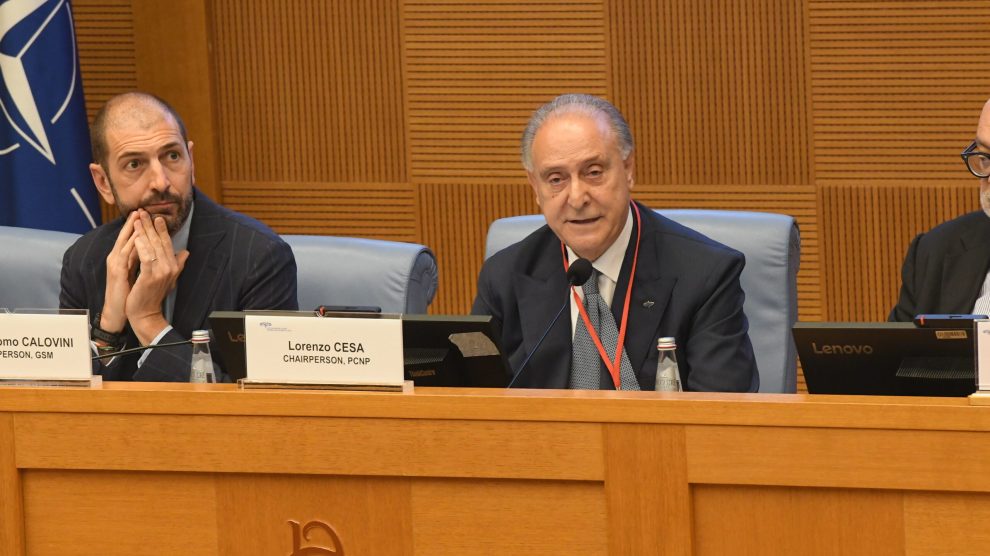
Marking its 30th anniversary, the Italian Delegation to the NATO Parliamentary Assembly — chaired by Lorenzo Cesa — is hosting the Seminar of the Mediterranean and Middle East Special Group (GSM), bringing together parliamentarians from NATO member states and partner countries. Delegations from Algeria, Austria, Bosnia and Herzegovina, Egypt, Israel, Morocco, Qatar, Serbia, Switzerland, and Ukraine are among those participating.
As Italian Prime Minister Giorgia Meloni recently argued, the debate represents both a strategic opportunity and a long-term geopolitical priority.
Who was there. The seminar, which opened on Monday and is chaired by Giangiacomo Calovini, features interventions from prominent political and institutional figures, including Speaker of the Italian Chamber of Deputies Lorenzo Fontana, NATO Parliamentary Assembly President Marcos Perestrello, and Italian Defence Minister Guido Crosetto.
- Among the keynote speakers are Marco Minniti, president of the Med-Or Italian Foundation and former Interior Minister; Luigi Di Maio, the European Union’s Special Representative for the Gulf Region and former Italian Foreign Minister; Javier Colomina, NATO Secretary General’s Special Representative for the Southern Neighbourhood.
The Strategic Weight of Cooperative Security. The southern flank, cooperative security, and structural uncertainty emerged as the three central themes highlighted by Meloni in her message marking the GSM’s 30th anniversary.
- “Uncertainty is no longer an exception — it is becoming the new normal,” she said, stressing the need for a comprehensive approach capable of understanding interconnected threats and anticipating them. According to the Italian prime minister, this is the framework Italy has chosen for its role within the Atlantic Alliance.
- Italy, she noted, has consistently supported the strategic relevance of NATO’s southern flank not because of geography, but because of long-term strategic conviction. Until now, cooperative security and partnerships have often played a secondary role compared to NATO’s traditional core tasks, functioning primarily as channels for political dialogue, capacity-building tools, and instruments for stability beyond the Alliance’s borders.
- That contribution remains valuable, Meloni argued, but it was designed for a different geopolitical environment.
From Preventive Diplomacy to Collective Defence. “The current context requires us to go further,” Meloni stated. In a strategic environment where external instability and direct threats to Allied security are increasingly interconnected, investing in partnerships with the southern neighbourhood is no longer merely preventive diplomacy — it is an essential component of collective defence.
- For this reason, she argued, cooperative security should finally receive the strategic relevance it deserves within NATO’s agenda.
- Meloni also stressed that the Italian government is closely monitoring developments across the region while supporting initiatives aimed at restoring stability through an integrated political and security approach. Energy security and the resilience of critical infrastructure remain among Rome’s top priorities.
- The prime minister recalled her diplomatic missions to North Africa, the Gulf, and Central Asia, aimed at strengthening strategic partnerships, diversifying energy supplies, and reinforcing supply chain resilience.
- Ultimately, the southern flank is increasingly seen by Italy as a platform for building pragmatic architectures of cooperation based on converging interests: regional security, energy transition, and shared resilience.
- According to Meloni, forums such as the GSM are not merely consultative platforms, but spaces where the strategic culture necessary for collective action is shaped.
From the Mediterranean to the Indo-Pacific. Lorenzo Cesa, president of the Italian delegation to the NATO Parliamentary Assembly, outlined what he described as NATO’s evolving geopolitical trajectory — one stretching from the Mediterranean to the Indo-Pacific.
- In his view, NATO can no longer be understood simply as a defensive structure protecting one part of the world against an opposing bloc. Instead, the Alliance must increasingly embrace a genuinely global logic that also includes the Indo-Pacific dimension and deeper engagement with partners.
- At the same time, NATO should act as a “security bulwark for the wider Mediterranean,” reflecting the reality that in today’s interconnected world, the stability and security of neighbouring regions directly affect the Euro-Atlantic community itself.
- “The Euro-Atlantic community is going through a critical phase,” Cesa warned, arguing that the regionalisation of conflicts risks undermining Allied cohesion. Reacting against fragmentation, therefore, becomes a strategic necessity for the Alliance as a whole.
- In this perspective, the challenges facing the Mediterranean are no longer exclusively Mediterranean issues — they concern the entire Atlantic community.
NATO’s Next Challenges. Beyond Iran, relations with Washington, and energy security, another recurring theme during the seminar has been European deterrence and its dependence on NATO.
- Defence Minister Guido Crosetto addressed the issue directly, arguing that only one country in the world — the United States — could theoretically survive outside the NATO framework. “None of our nations could survive if we withdrew from the Alliance,” he said, stressing that Europeans now understand that every member must contribute and assume responsibility.
- Crosetto acknowledged that increasing defence and security spending may not be politically popular, but recent crises have demonstrated that peace remains the precondition for hospitals, schools, and welfare systems.
The Modern warfare, he argued, differs radically from the conflicts of the past. Today, war reaches citizens directly through inflation, energy shocks, and economic disruption. This is precisely why NATO remains indispensable — and why anticipation and strategic preparedness are becoming central pillars of Allied security.
- These issues are expected to dominate discussions at the upcoming NATO summit in Ankara. According to Javier Colomina, three priorities will remain at the core of the debate: the 5% spending target, support for Ukraine, and strengthening the defence industrial base.
- “We are living through a particularly difficult moment for multilateralism,” Colomina observed, while also stressing the importance of continuing to invest in multilateral platforms alongside bilateral initiatives, which remain equally essential for NATO and its partners.