
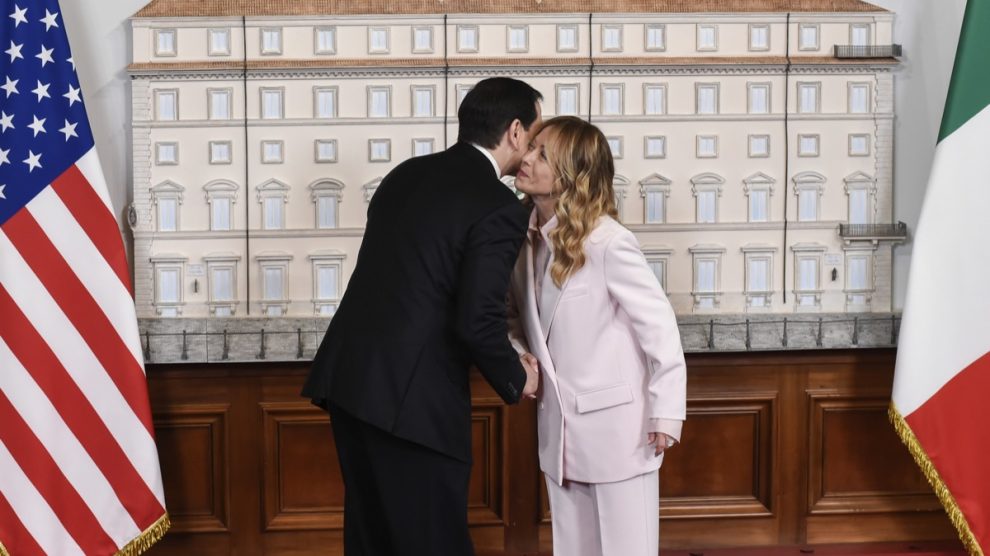
There is hardly an article about U.S. Secretary of State Marco Rubio’s visit to Italy that does not begin with the same factual premise: Rubio arrived in Rome on Thursday at a particularly delicate moment for transatlantic relations. Indeed, his meeting with Prime Minister Giorgia Meloni came after weeks of tensions involving the Trump administration, several European governments — including Italy — and the Vatican, against the backdrop of discussions over security, the American military presence, strategic technologies, and the management of crises ranging from Ukraine to Iran.
Speaking with Decode39, Jörn Fleck, senior director of the Europe Center at the Atlantic Council and an expert on transatlantic relations and European politics, described the visit as an attempt at reconciliation. According to the American think tanker, Washington cannot afford to lose Italy’s support, given Rome’s strategic importance both for U.S. power projection in the Mediterranean and for broader geopolitical balances, particularly in light of the confrontation with China and the upcoming meeting between Donald Trump and Xi Jinping.
Q: Rubio’s visit to Rome came, as mentioned, after weeks of tensions involving both Giorgia Meloni and the Vatican, but also amid sensitive discussions over security cooperation, the American military presence, strategic technologies, and Italy’s broader role in the Mediterranean. Is Washington now trying to recalibrate its relationship with Rome after these recent frictions? And how important is Italy today for the broader geopolitical strategy of the Trump administration?
A: It seems to me that both Marco Rubio and Giorgia Meloni are trying to recalibrate the U.S.-Italy relationship. For this administration, Italy has been one of its strongest European supporters. Losing Rome’s backing would represent an image problem for an administration that has sought to align itself with ideologically like-minded European governments — and Meloni’s Italy was seen as one of them — in an effort to counter what they describe as Europe’s civilizational decline. However, it remains unclear how effective this strategy can ultimately be, especially given Donald Trump’s recent threats to withdraw American troops from Italy.
- Beyond the rhetoric of the culture wars, Italy remains important to America’s geopolitical strategy. As the operation in Iran demonstrated, the United States needs its European allies — including Italy — in order to project power abroad. The fact that Rome and other partners pushed back against some of these efforts helps explain why Donald Trump reacted so negatively toward Italy. In an effort to mend the relationship, Foreign Minister Antonio Tajani confirmed after his bilateral meeting with Rubio that Italy is prepared to deploy naval assets and mine-clearing capabilities to help reopen the Strait once a ceasefire is reached, while also reaffirming Rome’s commitment to the peacekeeping mission in Lebanon.
Q: In Europe, Rubio is often perceived as a more traditional and diplomatic Republican voice compared to Donald Trump and other figures within the administration. After the recent tensions not only with Italy and the Vatican, but also with Germany and Chancellor Friedrich Merz, can the State Department serve as a tool to reassure European allies and contain the political damage caused by the White House’s rhetoric?
A: Yes, Marco Rubio represents the administration’s “good cop” compared to the “bad cop” embodied by Donald Trump and, to some extent, JD Vance. Rubio’s trip to Rome will likely mirror what we saw at the Munich Security Conference, where he adopted a much softer tone while still not fundamentally distancing himself from the speech JD Vance delivered there a year earlier.
- On the Italian side, the message conveyed by Foreign Minister Tajani was clear: “Europe needs the United States, but it is equally true that the United States needs Europe.” At the same time, however, it remains evident that decision-making power is concentrated entirely in Donald Trump’s hands. I therefore expect European capitals to be reassured by Rubio’s tone, while continuing to look toward Washington to understand what the White House itself will ultimately announce — for example on troop deployments.
Q: Rubio’s visit to Rome also comes just days before the highly anticipated May 14–15 meeting between Donald Trump and Xi Jinping, at a time when Washington’s strategic attention remains heavily focused on China, even as the management of the Iranian crisis continues to prove difficult. Is there a risk that transatlantic frictions could weaken Western cohesion precisely as the United States seeks to consolidate its position vis-à-vis Beijing? And what role can Europe play in this context?
A: These concerns should certainly exist, but I do not see a particular emphasis on Western cohesion when it comes to China. The administration is working in a limited way on some dossiers, such as cooperation on critical raw materials, but these remain relatively narrow initiatives.
- Europe will not play a central role in the discussions between Trump and Xi. In the absence of a clear China strategy from Donald Trump, and with the administration’s tariff leverage weakened by recent court rulings, Europe will likely continue to maintain at least a partially cautious and balanced approach toward Beijing.