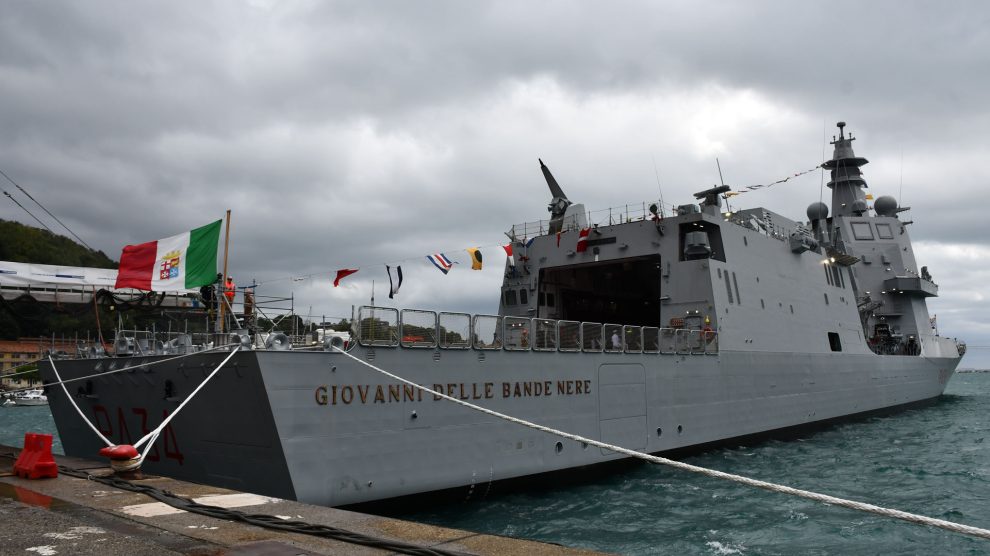
The mission will take the ship across roughly a dozen ports in about ten countries before joining two major multinational exercises this summer — RIMPAC and Pacific Dragon — around Hawaii.
The deployment reflects a broader Italian effort to strengthen operational ties with allies and partners in the Indo-Pacific while expanding the Navy’s ability to operate far beyond the Mediterranean.
Why it matters:
- Italy is steadily increasing its naval presence in the Indo-Pacific amid rising geopolitical competition and maritime security concerns.
- The deployment strengthens interoperability with the U.S. and allied navies in high-end multi-domain operations.
- The mission showcases the Italian Navy’s new Full Combat MPCS configuration, including ballistic missile defense-related capabilities.
- Previous Indo-Pacific deployments have also generated diplomatic and industrial returns for Italian defense firms.
The big picture: Italian naval missions to the Indo-Pacific have become increasingly frequent in recent years as Rome places greater emphasis on protecting maritime trade routes and building ties with “like-minded” regional partners.
- Italian officials have framed these deployments as part of a broader effort to ensure secure sea lines of communication in a region considered crucial for global trade and supply chains.
- According to information released in recent days, the campaign aims to strengthen operational capabilities, deepen cooperation with partner navies and maintain a qualified Italian maritime presence in an area Rome increasingly considers strategically relevant.
Zoom in: The deployment. The Bande Nere will conduct courtesy visits in Egypt and Sri Lanka before heading toward Guam, home to a key U.S. naval and air base in the Western Pacific, and then Hawaii.
There, the ship will participate in:
- RIMPAC 2026, the world’s largest biennial naval exercise;
- Pacific Dragon, a multinational ballistic missile defense-focused exercise typically held after RIMPAC.
RIMPAC 2024 involved personnel from 29 countries and marked the first-ever participation of an Italian Navy MPCS with the deployment of the Raimondo Montecuccoli.
The exercise simulates multi-domain conflict scenarios including:
- anti-submarine warfare;
- surface warfare;
- amphibious operations;
- carrier strike group defense.
After the Hawaii phase, the Bande Nere is expected to continue toward:
- Japan, including Yokosuka, headquarters of the U.S. Seventh Fleet;
- Vietnam;
- Thailand;
- Indonesia;
- Malaysia.
The ship will later return via Sri Lanka, Aqaba in Jordan and the Suez Canal before re-entering the Mediterranean around November.
Defense and tech. The deployment also highlights the Italian Navy’s ongoing transition toward higher-end combat capabilities.
- Unlike the Montecuccoli, which operates in the “Light Plus” configuration, the Bande Nere is equipped in the more advanced Full Combat configuration.
Key systems include:
- Leonardo’s dual-band radar with eight fixed AESA arrays;
- MBDA Italia’s SAAM ESD air-defense system;
- vertical launch systems for Aster missiles;
- future integration of the Aster 30 Block 1NT missile with ballistic missile defense capabilities;
- advanced electronic warfare systems;
- anti-submarine warfare systems;
- the SADOC 4 combat management system.
The participation in Pacific Dragon is particularly notable given the exercise’s focus on ballistic missile defense interoperability.
Fleet modernization. Italy has ordered seven MPCS vessels. Four have already been delivered, while the first three ships — Thaon di Revel, Francesco Morosini and Raimondo Montecuccoli — are expected to be upgraded to the Full Combat standard.
- Three additional MPCS vessels are still pending delivery, including the Domenico Millelire, expected this year.
The upgrades also include unspecified cyber-defense capabilities as well as remotely operated vehicles (ROV) and unmanned underwater vehicles (UUV), reflecting the Navy’s broader focus on multi-domain operations.
Beyond military operation. Rome’s Indo-Pacific naval deployments are also producing industrial and diplomatic effects.
- Following the Montecuccoli’s 2024 mission, Indonesia purchased two MPCS vessels built by Fincantieri and ordered Leonardo’s M-346 advanced trainer aircraft.
- Jakarta is also expected to receive the former aircraft carrier Garibaldi, which is being phased out by the Italian Navy.
- The missions therefore serve not only operational and diplomatic purposes but also support Italy’s defense-industrial outreach across Asia.
Between the lines: The growing tempo of Italian naval deployments suggests Rome increasingly sees the Indo-Pacific as directly linked to European and Italian economic security.
- The missions also signal Italy’s ambition to position itself as a credible maritime security actor capable of operating alongside allies well beyond its traditional Mediterranean theater.
The bottom line: The Giovanni dalle Bande Nere deployment marks another step in Italy’s effort to turn Indo-Pacific naval missions into a combined tool of military interoperability, strategic presence and defense diplomacy.