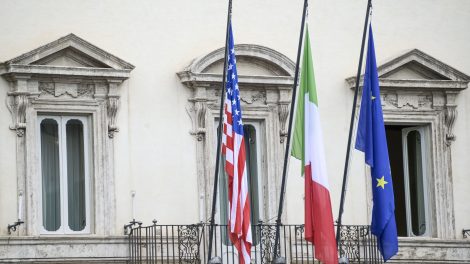
Rome increasingly sees trade, infrastructure and regional economic integration as geopolitical tools tied to stability, resilience and Europe’s long-term competitiveness.
Why it matters: The presence of Indian External Affairs Minister Subrahmanyam Jaishankar and Saudi Foreign Minister Prince Faisal bin Farhan at the informal EU ministerial highlighted how increasingly interconnected Europe, the Gulf and the Indo-Pacific have become across energy, shipping and security dynamics.
- Italy is pushing a stronger EU internal market — including energy and capital markets — as part of its competitiveness agenda.
- European officials are showing growing concern over the spillover effects of instability stretching from Gaza to the Strait of Hormuz, particularly on shipping routes, energy flows and broader economic security.
- Rome is increasingly presenting economic cooperation in the Mediterranean as a geopolitical tool tied to security and stability.
- The participation of India and Saudi Arabia reflected a broader European effort to engage regional powers more directly on Middle East diplomacy, maritime security and strategic connectivity.
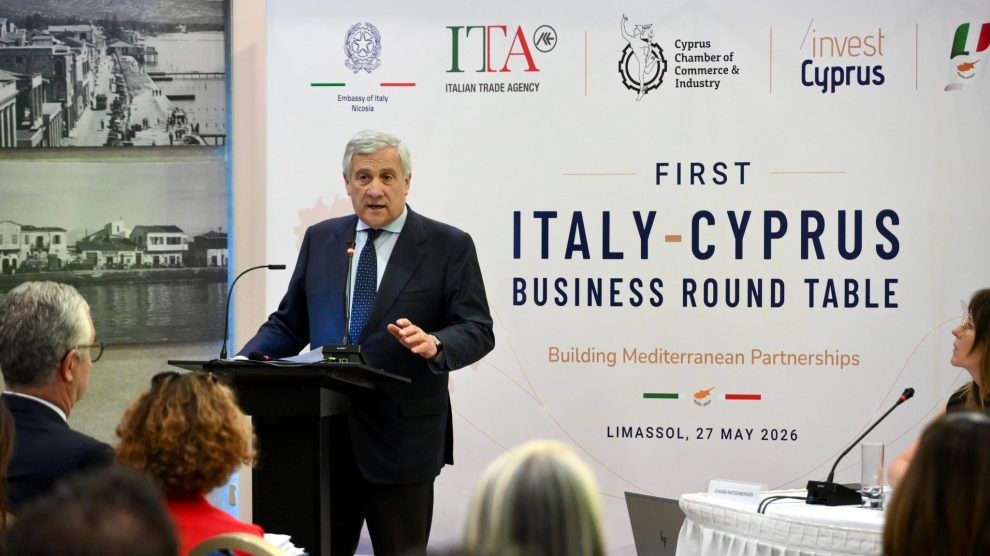
Zoom in: Italy-Cyprus ties. Speaking at the Italy-Cyprus Business Forum in Limassol, Tajani framed cooperation between the two countries as part of a broader European economic and connectivity strategy.
- “Italy and Cyprus can do extraordinary joint work,” Tajani said, pointing to innovation, research and training as key priorities.
- Trade between the two countries exceeded €1.2 billion in 2025, according to Italian officials, while Italian exports to Cyprus rose by nearly 30% over the past year.
- Defense and energy cooperation also emerged as possible areas for closer collaboration.
Energy first. Tajani repeatedly linked economic integration to Europe’s strategic resilience.
- “The Mediterranean must become a sea of peace and growth,” he said, arguing that business forums help strengthen ties between companies with government backing.
- The Italian foreign minister also called for deeper European integration through a single energy market, banking union and stronger capital markets.
- The message mirrored broader European concerns over economic security, supply-chain resilience and freedom of navigation through strategic maritime chokepoints such as the Strait of Hormuz.
The big picture: The Cyprus meetings offered a snapshot of how European foreign policy priorities are evolving beyond the continent’s traditional geographic perimeter.
- The presence of Indian External Affairs Minister Subrahmanyam Jaishankar and Saudi Foreign Minister Prince Faisal bin Farhan underscored the growing overlap between European, Gulf and Indo-Pacific strategic dynamics.
- Speaking after the discussions, EU High Representative and Vice-President Kaja Kallas said: “We discussed the situation in the Middle East, together with the Saudi Foreign Minister Prince Faisal and India’s Minister of External Affairs Jaishankar. Both countries play an important role through their extensive diplomatic engagement across the region, and it was good to hear their views. It was very eye-opening also for us and to see what more we can do together.”
The Indo-Mediterranean angle. The remarks reflected growing recognition inside Europe that regional crises, maritime security and economic connectivity increasingly require coordination with partners such as India and Saudi Arabia.
- The discussions unfolded against the backdrop of the India-Middle East-Europe Economic Corridor (IMEC), the connectivity initiative backed by India, the EU and Saudi Arabia linking Asia to Europe through the Gulf and the Eastern Mediterranean.
- For Italy and other southern European countries, IMEC reinforces the strategic relevance of Mediterranean ports, energy corridors and maritime routes connecting the Gulf to Europe.
European security. Ministers focused on the Middle East crisis, including its military and economic implications, the situation in Lebanon and the Palestinian territories, and efforts to safeguard maritime routes in the Gulf.
- EU officials also exchanged views on Russia’s war against Ukraine, sanctions pressure on Moscow and the future European Security Strategy currently being shaped following earlier proposals by the European Commission.
Between the lines: Italy is increasingly framing economic diplomacy as part of a wider geopolitical strategy. Rome sees stronger trade ties, industrial cooperation and infrastructure integration across the Mediterranean as tools not only for growth but also for political stabilization.
- That approach also shapes Italy’s position on EU enlargement. Tajani reiterated support for Ukraine’s path toward EU membership, while stressing that the Western Balkans remain a priority for Rome. He said both Ukraine and Moldova must continue reforms on corruption and rule-of-law standards.
On Gaza and Israel. Tajani also signaled support for tougher EU action against Israeli National Security Minister Itamar Ben-Gvir.
- Italy is pushing for targeted European sanctions against Ben-Gvir “for very specific facts,” Tajani said, adding that Rome is working to build broader EU backing for the measure.
The bottom line: The Cyprus meetings reflected a broader shift underway in European strategic thinking: the growing fusion of economic security, maritime connectivity and geopolitical competition across the Mediterranean and beyond.
- For Italy, that increasingly means positioning the Mediterranean not as Europe’s southern flank, but as an IndoMed central node linking Europe, the Gulf and the Indo-Pacific through trade, energy and security.
(Photo: X, @Antonio_Tajani)