
As NATO debates higher spending commitments, Prime Minister Giorgia Meloni is trying to frame Italy’s approach around a broader concept of security that combines military investment, industrial policy and strategic partnerships.
Why it matters:
- NATO allies are under growing pressure to increase defense spending.
- Meloni is signaling that Italy is prepared to assume greater security responsibilities.
- Rome is increasingly linking defense spending to industrial competitiveness and technological adaptation.
- The Italian government wants a broader discussion on security that goes beyond military budgets alone.
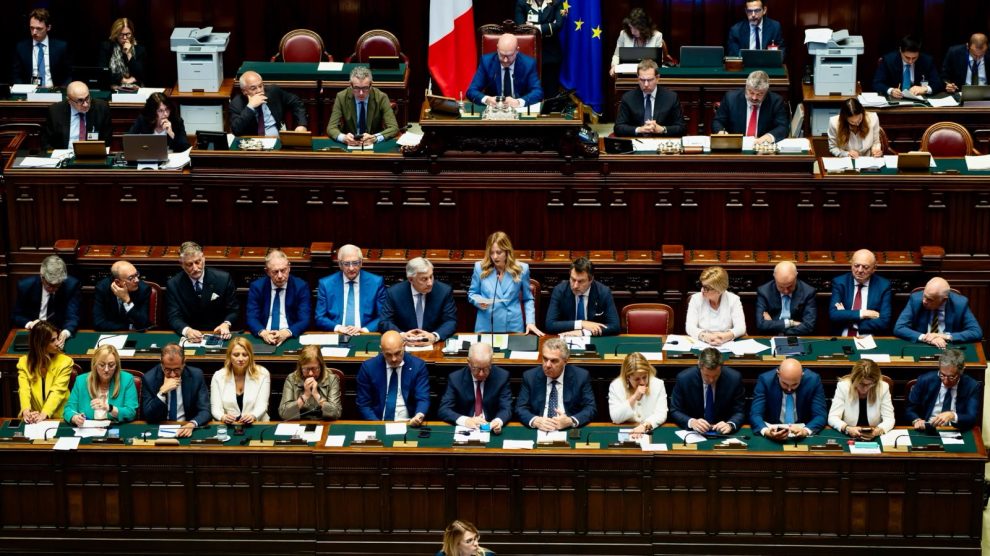
The big picture: Addressing parliament ahead of the European Council (next week, June 18-19), Meloni argued that treating defense and security as secondary issues would be “short-sighted” in an increasingly unpredictable international environment.
- The government, she said, has chosen to explain to citizens why higher investment is necessary to preserve strategic autonomy and protect national interests.
- That approach combines stronger military capabilities with efforts to reinforce Italy’s defense industrial base and expand cooperation with strategic partners.
Zoom in: Beyond the percentages. Italian Prime Minister repeatedly challenged what she described as an overly narrow debate focused on the share of GDP devoted to defense.
- “We continue to talk about how much is spent as a percentage,” she said, arguing that there is not enough discussion about how those resources are used. “The issue of security is not only defense, it is not only weapons.”
- She also pointed to lessons from the war in Ukraine, where technological change is reshaping the battlefield. According to Meloni, military planners must reckon with the fact that “a tank that costs millions of euros can be destroyed by a drone that costs €20,000.”
- She suggested that this debate should take place not only at the national level but also within NATO, where many defense decisions are coordinated.
Follow the money. Meloni said Italy will present itself at the July’s NATO summit with spending equivalent to 2.8% of GDP in defense and security.
- She said the figure reflects an increase of 0.71 percentage points, driven largely by expenditures related to domestic security.
- The remarks come as allies continue discussing future spending benchmarks and the balance between traditional military capabilities and broader security requirements.
Defense and industry. Italy’s PM linked defense spending directly to industrial policy, arguing that Europe and its allies must invest more, strengthen their industrial capabilities and support what she called an “open strategic autonomy.”
- That means, in the government’s view, both developing domestic capabilities and building industrial partnerships with key international partners.
Between the lines: Italian officials have continued to stress support for Ukraine, but reports in the Italian press suggest Rome is unlikely to join the Priority Ukraine Requirements List (PURL), the NATO-backed mechanism through which participating countries purchase U.S.-made weapons for delivery to Kyiv.
- According to Il Messaggero, the Italian government does not plan to take part in the initiative, despite maintaining military and political support for Ukraine. The newspaper also reports that Italy’s position has been clear to Washington for months.
- If confirmed, the decision would align with a broader pattern in which Rome has continued backing Kyiv while showing little appetite for joining a procurement scheme centered on purchases from U.S. defense manufacturers. In that sense, the reports confirm that Italian participation in the PURL mechanism was never considered a realistic option.
What we’re watching:
- The European Council’s discussion on defense and security.
- The NATO summit and potential new spending commitments.
- Debate within the alliance over emerging technologies and battlefield adaptation.
- Efforts by Italy to expand defense-industrial partnerships beyond the Euro-Atlantic area.
The Indo-Pacific angle. Meloni highlighted growing cooperation with partners in the Indo-Pacific and the Gulf.
- During the address at Chamber of Deputies, she cited South Korea, Japan, India and Gulf countries as examples of strategic partners with whom Italy is expanding cooperation.
- The prime minister announced that South Korean President Lee Jae-myung would begin a state visit to Italy on Wednesday evening. She also noted upcoming contacts with Japanese leaders and recalled Indian Prime Minister Narendra Modi’s recent visit to Italy.
- According to Meloni, these exchanges reflect a growing willingness among Indo-Pacific countries to deepen cooperation with Europe.
The domestic debate. Meloni also pushed back against opposition criticism, particularly from the Five Star Movement, which has accused the government of prioritizing military spending over public services.
- The prime minister argued that higher security spending does not come at the expense of healthcare, education or social services, saying the resources are being used to protect critical infrastructure, energy supplies, citizens’ data and national borders.
- Responding to opposition attacks in parliament, Meloni said the government was investing in security rather than diverting resources away from essential services.
The bottom line: Meloni’s message ahead of the European Council and NATO summit is that defense spending remains necessary, but that the real challenge for allies is adapting their security strategies, industrial capabilities and military planning to a rapidly changing strategic environment.