
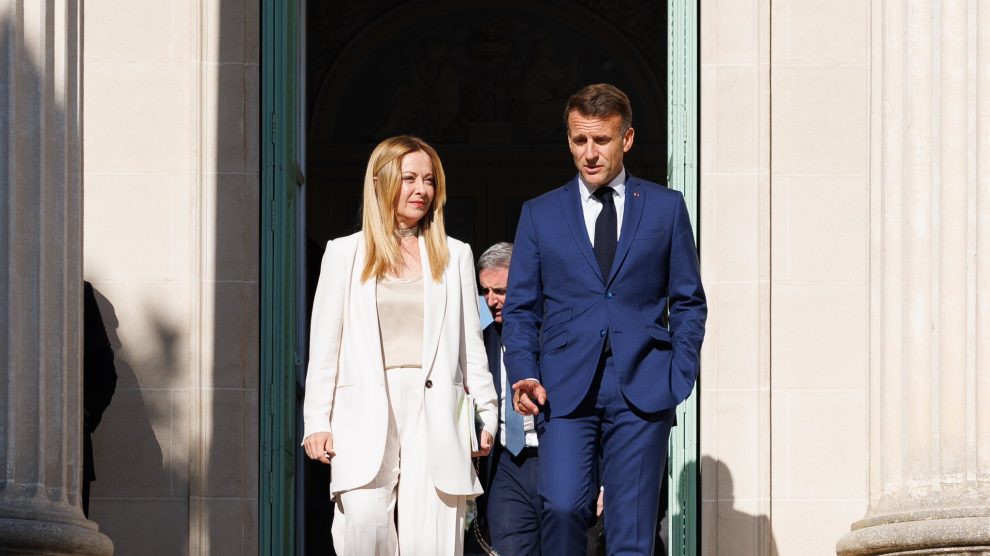
French President Emmanuel Macron and Italian Prime Minister Giorgia Meloni met on the French Riviera for the 36th Franco-Italian Summit, the highest-level bilateral meeting between the two leaders since Meloni took office in 2022. Held against the backdrop of a rapidly evolving international environment, the summit provided an opportunity for Paris and Rome to review their strategic partnership and advance cooperation across a broad range of political, economic and security issues.
Political context. The meeting came only days after Meloni’s public disagreement with U.S. President Donald Trump following the G7, adding further political significance to the summit. Against this backdrop, Macron and Meloni reaffirmed the importance of Franco-Italian cooperation across a broad strategic agenda, particularly in defence, industrial policy and European competitiveness.
Defence and strategic technologies. The defence ministers of both countries signed the Defence Roadmap for 2026–2031. The agreement, which forms part of the wider European Defence Industry Programme (EDIP), focuses on joint capability development in space, maritime security, integrated air and missile defence, and robotic combat systems for land operations.
- A bilateral industrial strategic committee will also be established, while both governments reaffirmed their commitment to further developing the SAMP/T NG air defence system and expressed their intention to explore a future interceptor capable of addressing hypersonic threats. Macron and Meloni also reiterated their support for IRIS², the EU’s planned sovereign satellite constellation, alongside continued cooperation on civil nuclear energy through the Edison–EDF–Nuward agreement, with the aim of strengthening Europe’s industrial capabilities in the sector.
- Together, these initiatives point to a broader effort by Paris and Rome to deepen cooperation in areas increasingly viewed as central to Europe’s long-term security, technological resilience and industrial competitiveness.
Lebanon and regional security. The two leaders also coordinated their positions on Lebanon, a longstanding area of interest for both countries. They reaffirmed their support for UNIFIL and welcomed preparations for the European Union’s Common Security and Defence Policy (CSDP) mission expected to launch later this year, as part of a broader European engagement alongside the Military Technical Committee for Lebanon (MTC4L).
- The two governments also discussed possible future security arrangements following any eventual winding down of UNIFIL, reflecting their shared interest in maintaining a leading European role in Lebanon.
Economic and industrial cooperation. The summit also carried significant economic implications. Macron and Meloni reaffirmed their commitment to expanding cooperation in strategic sectors including automotive manufacturing, critical raw materials, semiconductors, fashion and luxury industries. Among the initiatives announced was the strengthening of cooperation between the two countries’ fashion federations.
- The Le Cannet Business Forum, held alongside the summit, brought together more than 300 companies from both countries, underlining the growing role of the private sector in the bilateral relationship. Bilateral trade has also continued to expand, with trade volumes increasing by 6.1% and Italy recording a €17.6 billion trade surplus with France.
- The economic dimension of the summit highlighted the depth of the Franco-Italian partnership, which increasingly extends beyond political dialogue into long-term industrial and technological cooperation.
Mediterranean connectivity. Foreign ministers Antonio Tajani and Jean-Noël Barrot also met to reaffirm their commitment to closer diplomatic coordination and enhanced cooperation across the Mediterranean, building on the framework established by the 2021 Quirinale Treaty.
- Their discussions covered projects ranging from the India-Middle East-Europe Economic Corridor (IMEC) to the Einstein Telescope research infrastructure. Together, these initiatives reflect the growing interest of both countries in strengthening Mediterranean connectivity and supporting alternative trade and infrastructure networks linking Europe with the Indo-Pacific.
A partnership with enduring differences. Despite the progress achieved at the summit, important differences remain between Paris and Rome. While both governments broadly support strengthening Europe’s defence capabilities and industrial base, they continue to hold different positions on issues including migration policy, third-country processing centres and the possible deployment of European forces in Ukraine following a future peace agreement.
The bottom line: Even so, the Riviera summit suggests that the Quirinale Treaty is gradually evolving beyond a framework for bilateral reconciliation into a platform for broader strategic coordination.
- Whether this momentum will translate into lasting policy convergence remains to be seen, but the agreements reached this week point to a relationship that is becoming increasingly consequential for both countries and for the wider European agenda.
(Photo: X, @EmmanuelMacron)