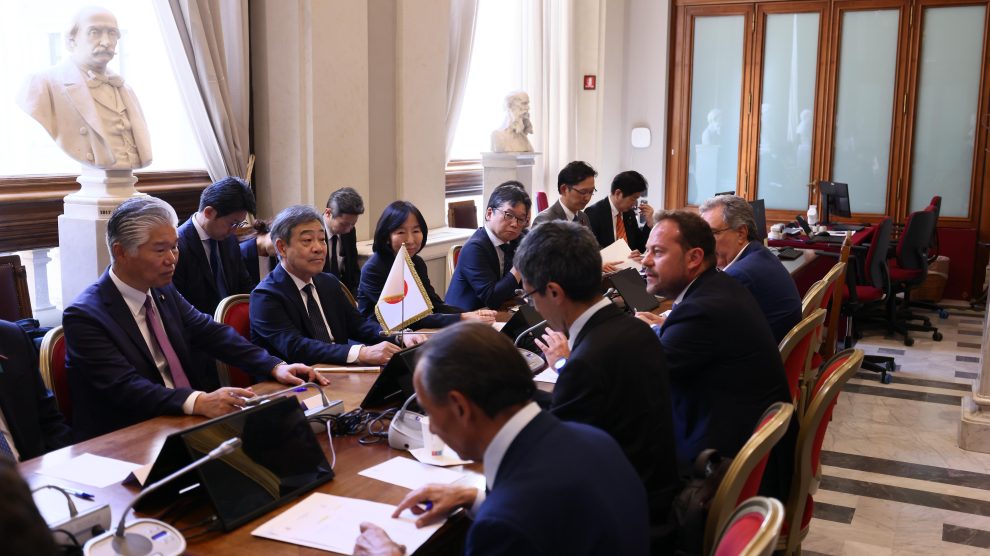
“The Indo-Pacific is a strategic region for international peace and security.” Eugenio Zoffili, a League MP in Italy’s Chamber of Deputies, president of the Italy-Japan bilateral friendship section of the Inter-Parliamentary Union and vice-president of the OSCE Parliamentary Assembly, starts from this point when describing to Decode39 a meeting held in recent days at Montecitorio with a delegation of ten members of Japan’s House of Councillors.
Parliamentary ties. The meeting, also attended by MP Graziano Pizzimenti and Japan’s Ambassador to Italy Hikariko Ono, covered security and migration, tourism promotion, natural-disaster preparedness, political participation and the fight against drug trafficking. It was a practical agenda within a relationship whose strategic scope is steadily expanding.
- “I believe in the value of parliamentary diplomacy and in personal ties and friendship,” Zoffili said. “By combining the efforts of parliaments, governments and diplomatic missions, we can address global challenges together at a time that requires us to remain united in the face of common threats.” The meeting, he added, also provided an opportunity to discuss recent agreements on culture, defense and mobility for young people and workers, as well as cooperation to protect Japanese workers in Italy.
160 years. The visit comes as the two countries celebrate 160 years of diplomatic relations. On August 25, 1866, aboard the Italian frigate Magenta, Italy and Japan signed their Treaty of Friendship and Commerce. The image has an intriguing contemporary resonance: a relationship born aboard a ship is once again finding one of its most important strategic dimensions at sea.
Maritime continuum. Rome and Tokyo sit at opposite ends of a network of connections stretching from the Mediterranean through Suez, the Red Sea and the Gulf region, before opening onto the Indian Ocean and ultimately the Pacific. This is the Indo-Mediterranean continuum: not a single geopolitical theater, but a space in which the security of distinct regions increasingly depends on the stability of the routes connecting them.
- Crises from Bab el-Mandeb to the Strait of Hormuz have demonstrated how quickly regional tensions can ripple through trade, energy flows and industrial supply chains. For Italy and Japan, two manufacturing economies heavily dependent on international connectivity, freedom of navigation and maritime security therefore carry both economic and strategic significance.
The growing ties between their navies are part of the same picture. The recent visit to Japan by Italian Navy Chief of Staff Admiral Giuseppe Berutti Bergotto focused on technological cooperation, interoperability and opportunities for the defense industry.
- Italy’s presence in the Indo-Pacific should be understood in this context: not as an alternative to the Mediterranean’s centrality in Italian strategy, but as an extension of the security of the connections on which the Mediterranean itself depends.
Strategic technology. The political step-change came in January, when the two prime ministers, Giorgia Meloni and Sanae Takaichi, elevated bilateral ties to a Special Strategic Partnership. Defense, economic security and technology are now part of the same agenda.
- The Global Combat Air Programme with the United Kingdom is its most advanced example: the future combat air system brings together software, sensors, artificial intelligence, industrial capabilities and intellectual property. At stake, ultimately, is control over the technological stack required to preserve autonomy in strategic sectors.
- This makes Italy-Japan cooperation part of a broader shift in which industrial policy and national security are becoming increasingly difficult to separate. Resilient supply chains, critical technologies and defense capabilities are no longer parallel policy areas, but increasingly interconnected elements of strategic autonomy.
Takaichi’s Japan. But the relationship with Tokyo is becoming more important also because of what is happening inside Japan. Takaichi is attempting to reshape a model long constrained by weak growth, demographic ageing and risk aversion through industrial policy, investment and a greater commitment to defense.
- Her project envisages roughly €2.2 trillion in public and private investment across 17 sectors, even as Japan confronts high public debt, rising interest rates and an increasingly difficult relationship with China.
- It is an ambitious and risky transformation, compounded by the need to keep the alliance with Washington strong at a time of greater uncertainty in US foreign policy. Yet this is precisely why Japan matters more than ever to Italy.
The reverse is also true. Takaichi chose Rome, ahead of the G7 summit in France, to launch in Europe an updated version of Japan’s Free and Open Indo-Pacific doctrine, or FOIP, which Tokyo increasingly presents as an international strategic framework.
The bottom line: Rome is therefore deepening its relationship with Tokyo as Japan seeks to redefine the nexus between industry, technology, growth, security and global standing.
- Being present at this stage means gaining a place within the industrial and strategic networks that will shape the next phase of Japan’s development.
- One hundred and sixty years after the Magenta, the friendship remains. The stakes have become considerably higher.