
With everything in place for the White House summit between Donald Trump and Xi Jinping, the United States and China are seeking to establish a channel of communication on artificial intelligence just as AI is becoming one of the most sensitive arenas of their strategic competition.
During talks in New York, US Treasury Secretary Scott Bessent and Chinese Vice Premier He Lifeng discussed the possibility of creating a notification mechanism through which Washington and Beijing could alert each other when an AI-related incident crosses a threshold involving national security.
Why it matters: This would not amount to a truce in the technological race, nor to a compromise over US export controls. Rather, it could provide a mechanism to prevent an accident, autonomous system behavior or the actions of a third party from being interpreted as a hostile act and triggering a crisis between the two powers.
- What, realistically, can be expected from such a dialogue? Where is there genuine scope for cooperation, and where are the interests of Washington and Beijing likely to remain irreconcilable? “I think the first thing is not to confuse dialogue with convergence.”
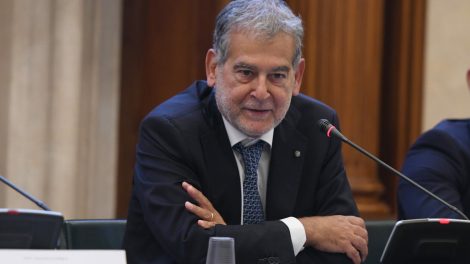
Why she matters: Speaking to Decode39 about how much room actually exists for this kind of cooperation — and what it could mean for the global governance of artificial intelligence — is Maria Adele Carrai, Associate Professor at the Department of Politics and International Relations and the Oxford School of Global and Area Studies (OSGA) at the University of Oxford, and a Fellow of St Cross College.
- Carrai has long studied the relationship between China’s rise and the transformation of international norms and institutions. She is the author of China’s Normative Power in Cyberspace: The Contested Making of Global Digital Governance, forthcoming with Routledge, which examines how Beijing seeks to shape global digital standards and governance, and how those norms are in turn negotiated, adapted and contested by other countries.
Dialogue is not convergence. “The United States and China will continue to view artificial intelligence as a strategic technology,” Carrai explains, “closely linked to national security, economic competitiveness and, increasingly, the ability to exercise international power.
- Precisely for this reason, however, they also share an interest in preventing competition from producing incidents or escalation dynamics that neither side can control.”
- It is from this perspective, she argues, that the proposed dialogue mechanism becomes particularly interesting.
A Cold War logic for the AI age. “The idea of creating a notification system for AI-related incidents that reach a national-security threshold recalls, in some respects, the logic of the risk-management mechanisms developed during the Cold War, where the objective was not to eliminate competition but to make it more predictable and avoid catastrophes.”
- What, then, is the most realistic outcome? “At least initially, it is not a grand agreement on the governance of artificial intelligence, but the construction of minimal procedures for communication and transparency.”
- The Oxford scholar notes that there are nevertheless several areas where US and Chinese interests could genuinely overlap: incidents involving advanced systems, loss of control over particularly powerful models, the use of AI by non-state actors, cyberattacks, biological risks and potential consequences for critical infrastructure. These are areas in which vulnerability is, at least to some extent, mutual.
- “In these sectors, a form of competitive cooperation could emerge, where Washington and Beijing do not need to share the same political vision of AI to recognize that there are certain risks that both have an interest in containing.”
From risk management to power competition. Under Carrai’s perspective, however, “finding common ground will become much more difficult when we move from risk management to the distribution of power.”
- Why? “Advanced semiconductors, computing capacity, export controls, access to models, technological standards, intellectual property and military applications of AI are directly linked to strategic competition. Here we are not simply talking about two different regulatory models, but about a competition to determine who will control decisive technological capabilities and infrastructure.”
- “For this reason, I would see the dialogue not as the beginning of shared AI governance, but as an attempt to build guardrails within a competition that is bound to continue. And even that, if it worked, would be an important outcome.”
What happens if the dialogue lasts? If this dialogue were to become a stable channel rather than merely a symbolic confidence-building measure, what could the consequences be for global AI governance? Could the United States and China eventually reach some shared understandings — for example on AI safety, military applications or possible red lines — that could then influence the rules of the game for everyone else? And in such a scenario, what room would remain for Europe and other actors seeking to contribute to the definition of global standards?
- “A stable dialogue between the United States and China,” Carrai replies, “would have consequences extending far beyond the bilateral relationship, because both are seeking not only to develop the most advanced technologies, but also to influence the norms, standards and institutions through which artificial intelligence will be governed globally.”
Not simply two AI blocs. The risk is the emergence of an increasingly fragmented AI governance landscape, organized around competing technological and regulatory ecosystems.
- “But I do not think we should simply imagine two closed blocs, one American and one Chinese. As I have tried to show in my work on China’s normative power in cyberspace, norms are not simply exported by a great power and passively adopted elsewhere. They are negotiated, adapted, contested and transformed by the countries that receive them.”
This dynamic is likely to become even more apparent in AI. Europe, countries across the Global South and middle powers are not merely spectators of Sino-American competition.
- “They will have their own preferences regarding data sovereignty, access to technology, open source, security and the relationship between innovation and regulation. The global governance that emerges will therefore probably be far more plural and negotiated than a simple Washington-Beijing confrontation would suggest.”
The space for Europe and middle powers. At the same time, Carrai explains, a stable dialogue between the world’s two leading AI powers could produce a minimal core of shared principles concerning extreme risks, incidents and crisis communication.
- “Historically, international regimes can emerge even among powers that remain deeply antagonistic when both recognize that a complete absence of rules carries excessive costs and risks.”
- The broader question, then, is whether the two powers can turn a potentially destabilizing competition into one that is at least partially governed.
The bottom line: Governing competition, not ending it. “From this perspective, the value of the new dialogue may lie less in immediate agreements than in the creation of a common language, procedures and, over time, perhaps minimal shared norms for managing a technology that no state will be able to govern on its own,” says Carrai.