

TOKYO — The hybrid pressure sweeping across Europe has its counterpart in the Indo-Pacific. Strategic priorities differ only to a degree, political sensitivities vary, and many of the actors involved are the same.
Cyber operations and information manipulation are increasingly targeting democratic societies that share a heavy dependence on digital infrastructure and political systems built around the free formation of public consent. In other words, the so-called like-minded democracies.
This convergence becomes particularly apparent when comparing developments in Europe over recent years — which have moved into the mainstream political debate in recent weeks — with what Japan is experiencing, where influence activities linked to Russia and China have become as much a national security concern as they are in the Euro-Mediterranean region.
Jun Osawa, Senior Fellow at the Nakasone Peace Institute (NPI) and a specialist in national security and cyberspace, discusses with Decode39 a security landscape strikingly similar to the one unfolding in Rome.
Why he matters: Drawing on extensive experience within Japanese institutions, including the National Security Secretariat, Osawa’s research into Foreign Information Manipulation and Interference (FIMI) provides insight into how geopolitical competition is penetrating the information environment of advanced democracies, often through dynamics that are difficult to distinguish from ordinary political and social controversies.
The context: The conversation comes as Italy faces a new wave of hybrid pressure, involving incidents which, according to authorities’ assessments and claims of responsibility, reflect a broader security challenge shared by other European countries.
- Cyberattacks against refrigeration systems used by major retailers, threats affecting air traffic, and the online exposure of personal information belonging to Foreign Minister Antonio Tajani have brought renewed attention to a security dimension that Defence Minister Guido Crosetto now considers structural.
- The concern has been reflected in Italy’s highest-level institutional assessments, while a recent European study on hybrid warfare has highlighted the cumulative effects of sustained pressure across multiple domains.
- Italy’s debate over the need to strengthen its response capabilities therefore finds an important point of contact with Japan’s experience, despite the differences between individual operations.
How AI broke Japan’s linguistic barrier. For Osawa, the most significant change concerns how quickly Japan has lost a form of protection that, until just a few years ago, appeared relatively robust: its language. The complexity of Japanese had long presented an obstacle for foreign operators seeking to infiltrate domestic online conversations.
- But now, “artificial intelligence has progressively eliminated this advantage,” making it possible to produce linguistically credible messages, construct artificial identities, and sustain networks of accounts at relatively modest cost. In the researcher’s assessment, the result is growing exposure to the same manipulation techniques already experienced in Europe.
- Russia provides one example of this evolution. Osawa points to activities observed during Japan’s July 2025 Upper House elections, when networks of automated accounts believed to be pro-Russian reportedly helped amplify messages critical of the government and content favorable to certain political parties. His findings complement research by the Atlantic Council’s Digital Forensic Research Lab, which had previously identified Japanese online communities involved in circulating narratives aligned with Moscow’s positions.
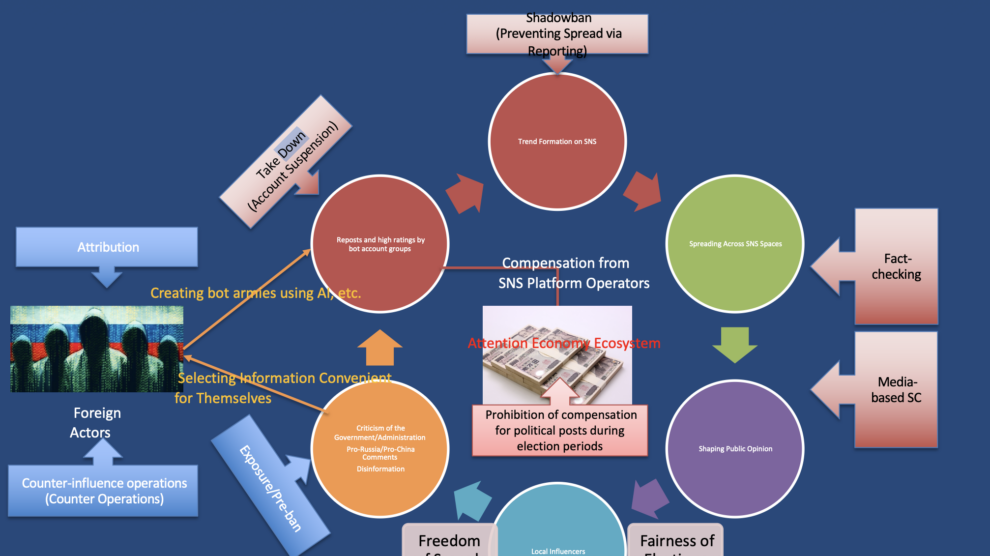
Osawa’s references to Russian campaigns observed in Romania and Germany are particularly useful for understanding the methods involved. These operations exploit issues that already resonate with public opinion, encouraging their circulation through coordinated networks and automated accounts.
- External interference, he explains, can thus become embedded in an authentically domestic debate, making it harder to determine where “spontaneous participation ends and organised manipulation begins.” The question of effectiveness remains separate: the presence of suspicious networks and the increased visibility of certain content do not, in themselves, demonstrate a shift in voters’ preferences.
China’s expanding influence operations. Chinese activities, however, occupy a particularly prominent place in the conversation. Osawa describes operations combining fabricated information environments, automated accounts, and narratives tailored to Japan’s political and social divisions.
- Operation PAPERWALL, documented by the University of Toronto’s Citizen Lab, revealed how Chinese companies had created websites impersonating local news outlets in several countries, including Japan, to distribute content favourable to Beijing.
- Developments since the beginning of 2026 point to a further evolution. According to Osawa’s findings, networks of accounts linked to China circulated images and messages portraying Prime Minister Sanae Takaichi as the embodiment of a new Japanese militarism. O
- ther campaigns sought to enter debates over social issues, the presence of American military bases in Okinawa, and Japan’s potential involvement in a crisis in the Taiwan Strait. In the latter case, the narrative emphasised China’s military superiority, echoing arguments already circulating within Taiwan’s information environment.
The case: One of the most interesting developments involves content that, at least initially, bears little resemblance to traditional political propaganda. Osawa cites a series of satirical music videos created using artificial intelligence and published on the Chinese platform Bilibili.
- The animations, accompanied by Japanese-language lyrics, address issues familiar to Japanese audiences: the cost of living, the weak yen, demographic decline, and shortcomings in the management of certain emergencies. Through circulation by local Japanese influencers, one video reached more than 12 million views. Some of the content was subsequently amplified by Chinese state media.
The role of local intermediaries is crucial to understanding how these campaigns work. A message can reach a much wider audience when it is picked up by figures who already command attention and credibility within a national community.
- Those contributing to its circulation do not necessarily need to be aware of the content’s origins or share its political objectives. The disruptive effect comes from the subsequent amplification.
Cognitive warfare and the challenge for democracies. In Osawa’s assessment, the most sophisticated influence operations seek precisely to exploit “existing tensions between social groups, steering conversations and amplifying conflicts: the ability to identify divisive issues and insert them into the circuits of digital attention is becoming an increasingly important component of cognitive warfare.”
- Artificial intelligence makes this process faster, cheaper, and more adaptable to different national contexts.
- Hence the need, emphasised by the Nakasone Peace Institute scholar, to “intervene across the entire chain of influence operations, from the creation of artificial networks to the dissemination and amplification of content.”
- Monitoring, attribution, platform transparency, fact-checking, and strategic communication are ”complementary tools, whose implementation must nevertheless be balanced against the protection of freedom of expression and the integrity of electoral processes.” These are complex considerations that further complicate the task facing democracies.
The bottom line: It is in this context that Japan’s experience becomes directly relevant to Italy and the European Union. “Cooperation between European and Indo-Pacific democracies can also develop through the exchange of information on the techniques employed by hostile actors, methods for identifying coordinated campaigns, and the most effective institutional responses.”
- Osawa’s work illustrates how the security of the information environment is increasingly tied to the ability to detect operations unfolding within the ordinary dynamics of digital communication. It is a challenge that Tokyo and European capitals have growing reasons to address together.