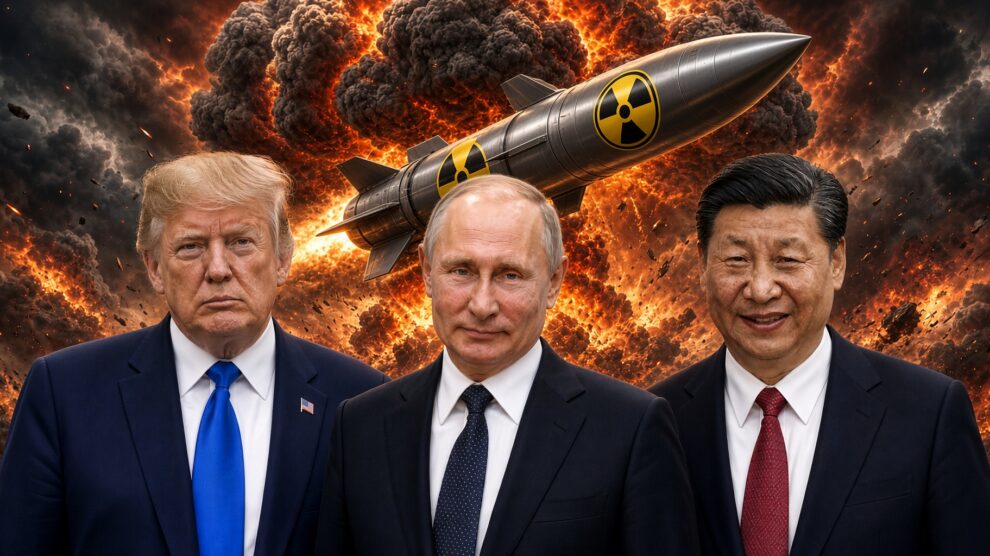
Donald Trump, Vladimir Putin and Xi Jinping agreed at their trilateral summit in Shenzhen on November 19 to open a dialogue on reducing nuclear risks and preventing proliferation. Their joint declaration, however, contains no commitments to reducing arsenals, introducing new limits or establishing a negotiating timetable.
Why it matters: The summit comes nine months after the expiration of New START, the last nuclear arms control treaty between the United States and Russia.
- “New START is the elephant in the room,” Ludovica Castelli, a research fellow at the Institute of International Affairs (IAI) and project manager of the EU Non-Proliferation and Disarmament Consortium, told Decode39.
- Washington has sought to involve Beijing in a new arms control framework. China has resisted, citing the considerable disparity between its nuclear arsenal and those of the US and Russia.
The big picture. Washington and Beijing attach different meanings to nuclear negotiations. “Arms control does not eliminate deterrence. It builds on the concept of deterrence and legitimises it. What it seeks to do is make it more manageable and controllable,” Castelli explains.
- Disarmament, by contrast, envisages the progressive reduction and eventual elimination of nuclear arsenals.
- “Washington is asking for arms control, while Beijing frames these proposals as disarmament negotiations, allowing it to argue that the first step should be taken by those with the largest arsenals.”
- Xi’s call for a world without nuclear weapons reflects this distinction: a long-term aspiration that imposes no immediate constraints on Beijing.
From two to three. The US and Russia still account for approximately 90% of the world’s nuclear warheads, while China’s considerably smaller arsenal is expanding rapidly. “Cold War arms control relied on parity between two powers,” Castelli notes.
- “An equal ceiling for everyone legitimises Chinese growth, while a lower ceiling for China asks it to accept permanent inferiority.” A numerical formula acceptable to all three countries remains elusive.
Between the lines. The notion of strategic stability itself is contested. Moscow and Beijing oppose Washington’s Golden Dome missile defence project, while China’s understanding of strategic stability extends to broader political interests, particularly Taiwan.
- Transparency is another sticking point. “Without transparency, there is no verification, and without verification, there is no arms control. We must remember that arms control exists precisely because of a lack of trust,” Castelli says.
The Italian angle. For Italy and its European partners, the emergence of a tripolar nuclear order raises questions that extend well beyond relations between Washington, Moscow and Beijing.
- Europe’s security remains closely tied to American extended deterrence, while the erosion of arms control mechanisms adds urgency to the debate over its own strategic responsibilities.
- Writing in Formiche, Paolo Alli, secretary-general of the De Gasperi Foundation and former president of the NATO Parliamentary Assembly, argues that Europe was the implicit target of the Shenzhen summit.
- Rome has a particular interest in ensuring that renewed dialogue among the major nuclear powers reinforces the multilateral non-proliferation architecture.
- The challenge for European diplomacy is to help shape an emerging strategic order whose consequences Europe will have to manage, even if its principal negotiations take place elsewhere.
What to watch. Xi proposed regular high-level exchanges among the three powers and a crisis communication mechanism. Whether these initiatives will translate into a dedicated nuclear dialogue remains unclear.
- “Xi’s remarks about red lines show that Beijing links stability among major powers to its own political interests, rather than exclusively to nuclear issues,” Castelli observes.
The bottom line. Shenzhen has opened a diplomatic channel without rebuilding the architecture of arms control. Its significance will depend on whether the three powers can translate their political commitments into concrete, verifiable measures and insulate nuclear dialogue from their wider geopolitical disputes.