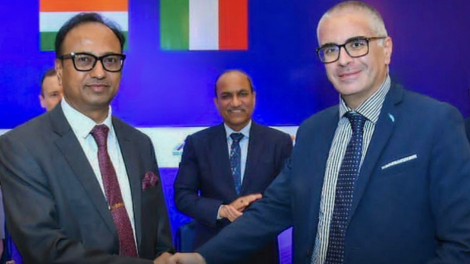

The move: MBDA Deutschland and German startup Atmos Space Cargo have signed a cooperation agreement to develop a new military capability known as Precision Orbital Deep Strike (PODS). The initiative aims to combine the European missile group’s expertise with that of the German company, which specialises in orbital transportation and atmospheric re-entry technologies.
- The stated objective is to develop a demonstrator capable of integrating military payloads into space transportation systems and subsequently bringing them back through the atmosphere.
- In announcing the partnership, the two companies explicitly framed the initiative as a contribution to strengthening European conventional deterrence. But the implications could be considerably broader.
Deep strike refers to the ability to hit targets deep inside enemy territory. When that capability is delivered from orbit, however, it generally implies the use of ballistic systems, potentially with intercontinental reach.
Complementary capabilities: Understanding the significance of the agreement requires looking at the two companies involved.
- MBDA is one of Europe’s leading missile and weapons systems manufacturers. Its portfolio covers land, naval and air-based capabilities, ranging from air and missile defence to long-range strike systems.
- Owned by Airbus, BAE Systems and Leonardo, the group represents one of the most important industrial assets in European defence.
- Atmos Space Cargo, meanwhile, is a German company with operations in France and Poland, specialising in reusable orbital transportation and atmospheric re-entry systems. Its main civilian technology programme is Phoenix, an orbital vehicle designed to transport payloads into space and return them to Earth through a controlled re-entry procedure.
What they’re saying::
- Atmos CEO Sebastian Klaus presented the agreement as a step towards establishing a new European strategic infrastructure: “Orbital transportation and re-entry constitute a new level of strategic infrastructure, and infrastructure determines what Europe can achieve on its own terms” .
- MBDA Deutschland CEO Thomas Gottschild expressed a similar vision. The objective, he explained, is to provide European armed forces with a sovereign technological capability, as part of the group’s broader space strategy, covering both “space for defence” and “defence of space”.
(Very) Deep strike. MBDA already has an extensive portfolio of long-range strike systems. These include Storm Shadow, an air-launched cruise missile with an estimated range of between 250 and 600 kilometres, and the Naval Cruise Missile (NCM), with a range exceeding 1,000 kilometres.
- The portfolio also includes the Deep Precision Strike (DPS) programme, developed for the British and German governments, among others. It involves an advanced cruise missile and a hypersonic glide vehicle (HGV), both designed to achieve ranges exceeding 2,000 kilometres.
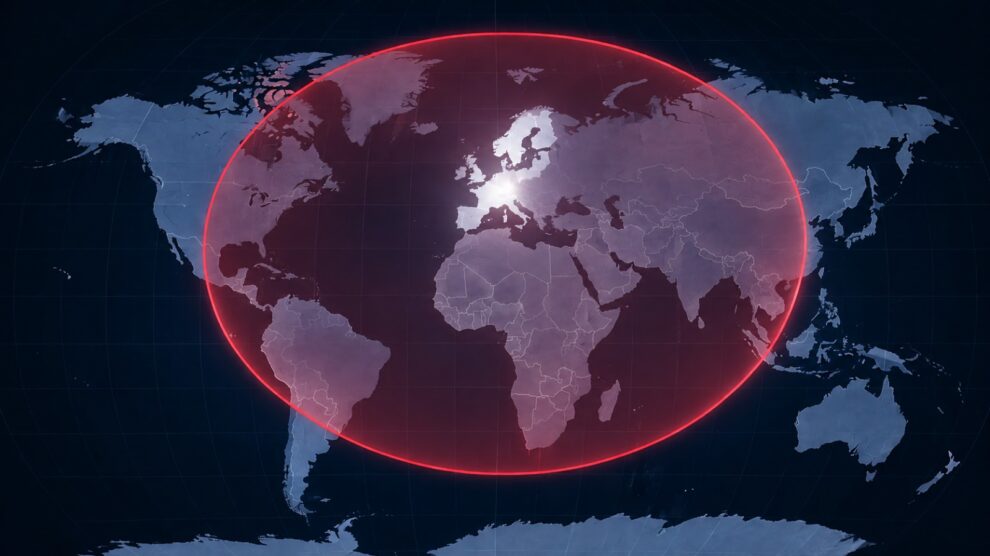
- An orbital component would nevertheless represent a significant leap in scale. A system based on a vehicle capable of placing a payload into orbit and subsequently directing it towards Earth could cover several thousand kilometres, potentially reaching intercontinental or even global dimensions.
To put this into perspective, some studies of suborbital ballistic architectures have examined trajectories of approximately 6,700 kilometres, while a fully orbital architecture could offer an even greater range.
- In any case, this would amount to a conventional deterrence capability currently unprecedented in Europe.
Strategic implications. Although MBDA is a European consortium and official statements refer to European armed forces and European capabilities, the German footprint behind the agreement is unmistakable, as demonstrated by the nationality of the two companies involved.
- Considered separately, the expertise of MBDA and Atmos belongs to different industrial sectors. Combined, however, their capabilities represent two crucial components of the technological architecture required for the re-entry phase of an intercontinental ballistic system.
One element is still missing: a launch vehicle capable of carrying these systems into orbit. This brings into focus companies such as Italy’s Avio, which specialises in space launchers and has recently attracted the attention of Finland’s ICEYE, which has submitted a €2 billion takeover proposal for the Italian company.
- ICEYE itself is becoming increasingly important to Germany’s industrial strategy, particularly through its joint venture with Rheinmetall, established in 2025 and 60% owned by the German defence group.
- With direct or indirect access to all these capabilities, the prospect of an intercontinental ballistic system – currently a capability exclusive to France within the EU – is not so far-fetched.
- Even the programme’s name, Orbital Deep Strike, leaves little room for interpretation.
The European dimension. While the MBDA-Atmos initiative clearly has a German industrial footprint, its stated ambition is part of a broader European effort to strengthen space and missile capabilities.
- Other initiatives are moving in the same direction. These include Bromo, the proposed satellite industrial alliance bringing together Leonardo, Airbus and Thales, which aims to combine the established capabilities of companies in countries such as France and Italy with Germany’s financial resources and growing strategic ambitions.
Why it matters for Italy: Within this broader effort to consolidate European space capabilities, Italy also has a role to play, as demonstrated by the growing interest in Avio.
- Beyond its Vega launchers, Italy possesses highly innovative capabilities across the main segments of the space industry, from serial satellite manufacturing to in-orbit servicing.
- A stronger Italian presence in European industrial consortia – potentially following the model established by MBDA – would therefore have a strong strategic rationale.
- The alternative would be for individual European countries to compete alone against major space powers such as the United States, China and India.