

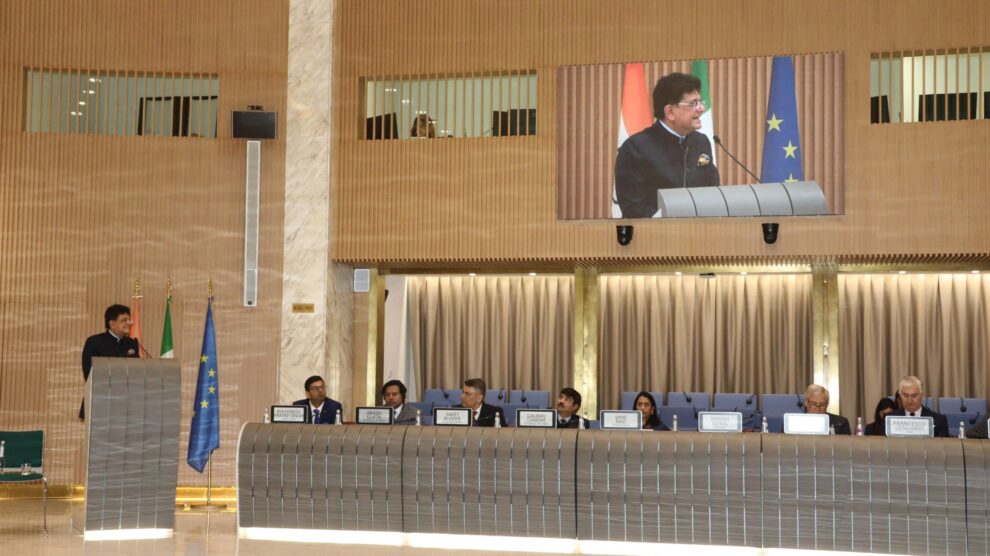
ROME — Italy and India will establish two task forces within their respective foreign ministries to streamline bureaucratic procedures and facilitate business operations, Foreign Minister Antonio Tajani announced after meeting Indian Commerce and Industry Minister Piyush Goyal at the Farnesina.
The announcement came during the 23rd session of the bilateral Joint Commission for Economic Cooperation, alongside a renewed push to translate political alignment into industrial and strategic cooperation.
Why it matters: The initiative reflects a broader effort by Rome and New Delhi to move beyond expanding bilateral trade toward building reciprocal economic security, based on more resilient supply chains, diversified partnerships and greater industrial integration.
- Reducing friction: The task forces are intended to accelerate administrative procedures and make cross-border business operations easier.
- Securing strategic sectors: Cooperation on critical raw materials, defense, space and advanced technologies could help both countries reduce industrial vulnerabilities.
- Strengthening connectivity: The India-Middle East-Europe Economic Corridor (IMEC) offers a framework for diversifying trade routes and connecting industrial ecosystems.
The big picture: From strategic alignment to economic resilience. Italy and India are seeking to give greater operational substance to their special strategic partnership. The relationship already encompasses defense, energy, counterterrorism, space and scientific research. Economic security provides a connecting theme across several of these areas.
- Rome’s perspective: India represents a major market for Italian companies and a partner in diversifying strategic supply chains.
- New Delhi’s perspective: Italy offers manufacturing expertise, industrial capabilities and potential partnerships in advanced technologies.
- Diversification is a central element of Italy’s approach to India.
Follow the money: Trade, investment and industrial partnerships. The economic foundations of the relationship are expanding.
- €20 billion: The bilateral trade target set by the two governments for 2029, following a doubling of trade over the past decade.
- 1,000 companies: Approximately the number of Italian businesses already operating in India.
- €500 million: A financing facility prepared by Italy’s Foreign Ministry to support market access and joint ventures.
- Nearly 100 delegates: The Indian business delegation accompanying Goyal, representing 30 traditional and emerging sectors.
- Tajani expressed hope that the EU-India Free Trade Agreement would be signed by the end of the year, describing its potential as transformative for bilateral business opportunities. The agreement’s strategic implications, beyond tariff reductions, have also been examined in a Decode39’s interview with Italian Ambassador Antonio Bartoli.
Zoom in: Critical minerals and technology. Economic security is particularly relevant to the industrial sectors identified by both ministers. Tajani emphasized the need to avoid markets dominated by a single country capable of determining prices, pointing to joint ventures in raw materials as a possible response.
- Goyal highlighted India’s technological talent, data-center potential and opportunities in artificial intelligence, space and scientific cooperation.
- Italy also plans to establish an innovation center in India to connect companies, universities, research institutions and start-ups.
- The technological agenda complements the two countries’ existing defense-industrial cooperation, where supply-chain resilience and critical infrastructure protection are already prominent concerns.
Zoom out: IMEC and strategic connectivity. The India-Middle East-Europe Economic Corridor adds a geopolitical dimension to the bilateral economic-security agenda.
- Tajani described IMEC as fundamental to cooperation between Rome and New Delhi, linking it to freedom of navigation and diversified trade routes.
- The initiative seeks to strengthen commercial, infrastructure and digital connections between India, the Middle East and Europe.
- As Decode39 previously examined, the Italian debate increasingly concerns translating IMEC’s diplomatic ambitions into operational infrastructure and logistics.
Culture as another channel. The two countries will also celebrate 2027 as the Year of Culture and Tourism, with exhibitions, performances and initiatives spanning design, fashion, cinema and scientific research.
- A dedicated business forum for cultural and creative industries will seek to connect institutions and private operators, adding another channel for bilateral engagement.
The bottom line: Italy and India are increasingly treating economic security as a shared strategic interest. The new task forces offer a practical mechanism for reducing business barriers, while cooperation on critical materials, technology and connectivity provides the broader framework. The challenge is turning this convergence into concrete industrial partnerships and more resilient economic ties.
(Photo: X, @PiyushGoyal)