

Italy’s decision to leave China’s Belt and Road Initiative in December 2023 did not amount to a diplomatic disengagement from Beijing. The recent visit of Chinese Defence Minister Dong Jun to Rome and Brindisi illustrates the continuing importance of bilateral dialogue, according to Alessandro Politi, director of the NATO Defense College Foundation and geopolitics lecturer.
Speaking to Francesco De Palo in an interview with Formiche, Politi argues that Italy’s approach reflects an effort to reconcile its Atlantic orientation with the practical requirements of maintaining relations with China.
Why it matters. Rome’s withdrawal from the Belt and Road memorandum was largely driven by considerations related to its Atlantic positioning, Politi explains. However, the agreement was a memorandum rather than a binding treaty, leaving considerable room for continued engagement.
- “We withdrew from the Belt and Road memorandum for reasons related to our Atlantic positioning, but in reality a memorandum is a memorandum, not a treaty,” Politi said.
- Italy subsequently made clear that it intended to maintain international relations with China without necessarily formalising them through similar political frameworks.
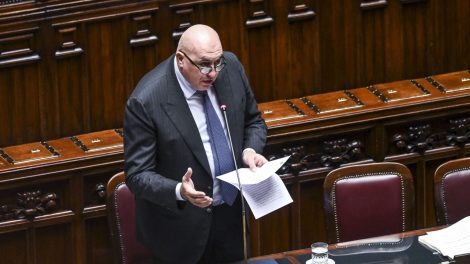
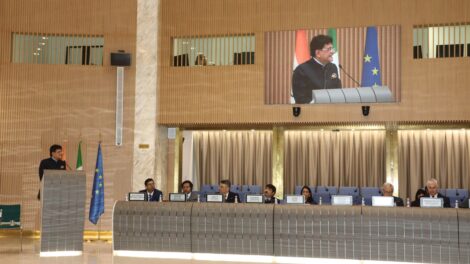
The military dimension. Dong Jun’s visit provides a concrete illustration of this approach. The Chinese defence minister met his Italian counterpart Guido Crosetto before travelling to Brindisi, where he boarded an Italian Navy vessel.
- The visit, the first by a Chinese defence minister to Italy since 2008, marked a significant moment in bilateral military diplomacy.
- “The fact that the Chinese defence minister boarded one of our ships is clearly not a coincidence,” Politi observed.
- However, he rejects interpretations suggesting that the visit was part of a regional political initiative intended to create difficulties for Prime Minister Giorgia Meloni’s government.
Following the Apulia connection. The Chinese minister’s stop in Brindisi coincided with an institutional and commercial mission to China by Apulia Governor Antonio Decaro.
- Politi places the regional dimension within Italy’s broader economic relationship with Beijing, noting that Apulia belongs to the unified Special Economic Zone for Southern Italy, an important framework for commercial engagement.
- The region’s strategic position along the Adriatic corridor has also raised questions about Chinese involvement in sensitive industrial sectors and infrastructure.
- Politi suggests that such relationships should be assessed according to their specific strategic significance, rather than treating all forms of Chinese industrial involvement as equivalent security concerns.
- He distinguishes, for instance, between carbon-fibre applications in civilian shipbuilding and those involving advanced military aircraft such as the F-35.
The big picture: Politi connects Italy’s diplomatic engagement with developments in US-China relations, particularly the dialogue between Donald Trump and Xi Jinping.
- In his interpretation, Beijing has signalled an interest in peaceful coexistence based on cooperation and the management of competition, while maintaining Taiwan as a non-negotiable issue.
- He argues that Washington has not explicitly rejected this framework, creating diplomatic space for other countries to pursue dialogue with China.
- Against this background, Politi believes the Meloni government remains attentive to opportunities for negotiation with Beijing, including what he describes as work towards a strategic agreement.
Brussels under scrutiny. Politi reserves his strongest criticism for the European Union’s approach to China. “The problem remains Brussels, which has not identified a precise strategy on China since 2023,” he argues.
- His assessment also extends to European positions on the war in Ukraine, where he questions the sustainability of continuing the conflict without a clearer diplomatic perspective.
- These arguments reflect Politi’s broader concern that European governments need to develop more coherent strategies for dealing with major powers amid an increasingly fluid international environment.
China’s strategic limits. Politi also cautions against assuming that Beijing is already prepared to replace Washington as the dominant global power.
- He describes China’s naval ambitions primarily in terms of establishing a capacity to share strategic influence in the Pacific, while noting that Chinese leaders remain conscious of the considerable costs associated with global military primacy.
The bottom line. Politi’s analysis portrays Italy’s China policy as an attempt to preserve diplomatic flexibility within its established Atlantic framework. The end of the Belt and Road memorandum did not eliminate bilateral interests or the need for dialogue.
- For Rome, the challenge is to maintain that engagement while managing strategic dependencies, protecting sensitive national interests and navigating an international environment in which Washington, Beijing and Brussels are reassessing their respective positions.