
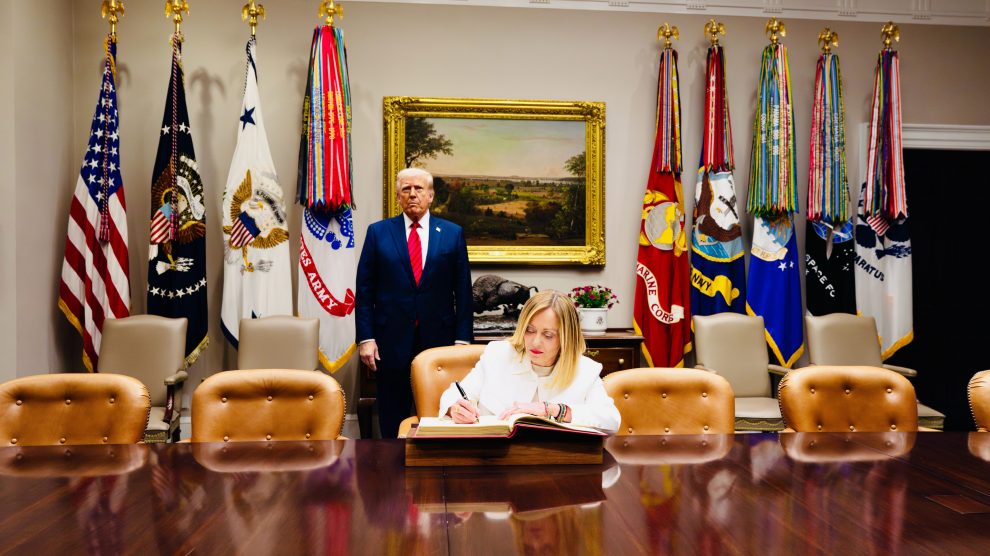
The tensions between Donald Trump and Giorgia Meloni are part of a larger context involving internal political pressures, public perceptions, and geopolitical crises. According to James Carafano, the war with Iran, rather than weakening the trans-Atlantic bond, underscores its resilience and strategic importance.
Why he matters: James Jay Carafano is the director of the Douglas and Sarah Allison Center for Foreign Policy Studies and vice president of the Kathryn and Shelby Cullom Davis Institute for International Studies at The Heritage Foundation. He is also an adjunct professor at the Institute of World Politics.
Q: How would you frame the recent tensions between Donald Trump and Giorgia Meloni? Is it an isolated episode or it should be placed within a broader context?
A: To be expected. European leaders, even those that recognize the importance and value of the American partnership, must deal with the incessant negative coverage and partisan criticisms that pervade in Europe, influence public opinion and impact domestic politics.
- No leader, I think, recognizes that and tries to balance those political realities better than Italian Prime Minister Meloni.
- Both President Trump and the Prime Minister believe in the importance of the bilateral alliance and they are not going let politics or on-going geopolitical challenges undermine their personal bonds or bilateral cooperation.
Q: The above-mentioned tensions have been (in)directly caused by the war with Iran. Do you think that it is hampering the transatlantic relations as a whole, and not just the US-Italy one?
A: No. War always brings uncertainty and that troubles people. But the reality is regardless of how events unfold from here Trump has eliminated Iran as a threat to regional stability or to the vital interests of Europe or the U.S. Europe is going to better off for this. Also, hopefully Europe will learn two important lessons.
- One is that Europe needs abundant, reliable, and affordable energy–the foundation of that is conventional fuels and will likely always will be.
- Supply disruptions have shown how fragile Europe’s energy situation is because of wrongheaded decisions driven by unrealistic objectives to transition to green energies.
- The second lesson is the need for alternative, redundant and resilient supply chains. It is ridiculous that Europe is so dependent just on transit of oil through the Strait of Hormuz.
Q: What could be a right compromise between Washington and Teheran to quickly reach an agreement and put an end to the conflict?
A: Not really concerned what the settlement looks like, because most of the strategic threat has been neutralized. Conflict persists just because of the regime in Iran.
- All the regime cares is that it survives in charge. But to survive it wants to continue to look as tough, uncompromising and threatening as possible.
- The longer they refuse deal the weaker and more vulnerable they are likely to become. Their intransigence is the biggest threat to their future.
Q: To what extent is the Iran war accelerating European strategic autonomy? And could a more self-reliant Europe ultimately prove to be a more effective partner for Washington?
A: An honest assessment is that the war reminds what a hopeless pipe dream European strategic autonomy is as a suitable and feasible policy objective.
- Also it is not acceptable to many Europeans – they don’t want to rely just on Brussels for their future security, prosperity and freedom.
- They see the partnership with the U.S. as non-negotiable. Breaking with the U.S. just means more vulnerability to Russia and China not strategic independence