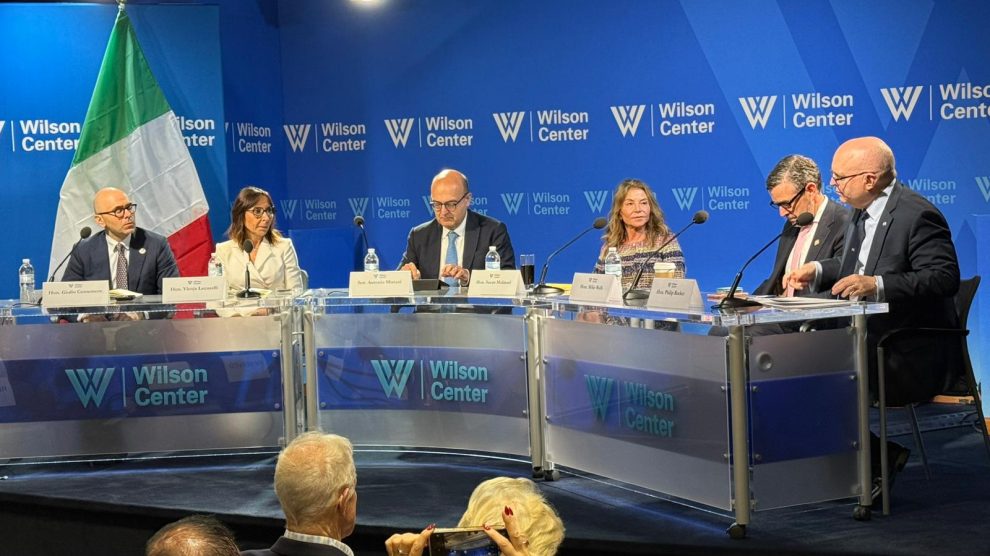
WASHINGTON – Among policymakers taking part in the event co-organized by Decode39 at the Wilson Center, complementary readings of the transatlantic relationship emerge.
A Transatlantic Dialogue at a Turning Point. The meeting comes during the visit to Washington of Italy’s Minister of Economy and Finance, Giancarlo Giorgetti, offering an opportunity for a day of reflection dedicated to the 165th anniversary of diplomatic relations between the United States and Italy, within the broader framework of the 250th anniversary of the United States.
Economic Security as a Shared Priority. “Geopolitical tensions, technological competition, and disruptions to global trade have highlighted the need for more secure, diversified, and reliable supply networks,” Giorgetti said, framing economic security as a shared priority among like-minded partners.
- The minister emphasized how Italy and the United States share the objective of reducing critical dependencies and strengthening reliable value chains in strategic sectors, underscoring the need for greater transatlantic coordination to reconcile resilience, openness, and efficiency.
- A relationship that, Giorgetti noted, has been strengthened precisely through its ability to manage moments of divergence: “It is precisely our ability to manage these moments that has strengthened our partnership over time.”
A Deep-Rooted Strategic Relationship. In a conversation with Decode39 on the sidelines of the Washington event, League MP Giulio Centemero highlighted the historical and strategic depth of the relationship:
- “The bond between Italy and the United States of America has deep, centuries-old roots, dating back to the year of its discovery in 1492 thanks to an Italian, Christopher Columbus. It is a history of relations in which our countries have shared fundamental values, also thanks to the large Italian emigration that made a significant cultural and social contribution to the growth of this democracy.”
- For the Italian politician, transatlantic relations between Italy and the US today represent one of the fundamental pillars of contemporary geopolitics, embedded in a global context that is crucial in shaping the rules of the international system.
- “Italy, being strategically positioned at the center of the Mediterranean—where the cradles of civilization were born—has always had a natural vocation for mediation and dialogue,” recalled Centemero, who also serves as President of the Parliamentary Assembly of the Mediterranean.
Managing Divergence Without Breaking Ties. “Our foreign policy,” Centemero continued, “aims never to break ties but rather to always find opportunities for cooperation rather than confrontation. The special relationship that has developed between Italy and the United States over the years has always been based on mutual respect, even when there have been moments of disagreement on specific issues.”
- This reference inevitably points to recent developments, including an interview with Donald Trump published in Corriere della Sera, in which the US president criticized Prime Minister Giorgia Meloni.
- “Criticism from an ally should not be seen as an act of betrayal, but as a reflection that can help improve a situation,” Centemero stressed. He added: “The transatlantic relationship needs committed supporters on both sides of the ocean, even on issues that are not necessarily popular. Italy, in the international arena, is not a subordinate partner but an equal player, even in the presence of differing views.”
Calls for Rebalancing the Transatlantic Relationship. A line that insists on continuity and the value of cooperation even amid divergence. More explicit, however, was Democratic Party senator Antonio Misiani: “The transatlantic relationship remains essential, but it must be rebalanced on the basis of equal dignity and mutual interest.”
- Faced with what he described as the “aggressive policies of the Trump administration,” Misiani stressed the need to respond “with firmness, not complacency.” Defending European interests, he argued, “requires credibility, unity, and the ability to combine diplomacy with clear red lines grounded in international law. Europe must not be a passive recipient of Washington’s choices on Ukraine, Iran, or trade.”
Strategic Autonomy and Economic Priorities. This position reflects a broader European debate on the need for greater strategic autonomy. Member of Parliament Ylenja Lucaselli, from Fratelli d’Italia, linked the issue to economic and security priorities:
- “If we want more defense, more energy security, and more growth, we cannot treat every euro invested as just another expense: European rules must be made consistent with the West’s strategic priorities, and on this front the Rome–Washington axis can make the difference.”
Beyond Celebration: A Relationship to Be Rebuilt. Beyond its celebratory dimension, the initiative co-organized by Decode39 and hosted at the Wilson Center comes at a moment of redefinition in transatlantic relations.
- Amid technological competition, political tensions, and new industrial priorities, the bond between Italy and the United States remains solid but increasingly less automatic.
- More than a given relationship, it appears as a balance to be constantly rebuilt—between economic cooperation, European autonomy, and Western cohesion.