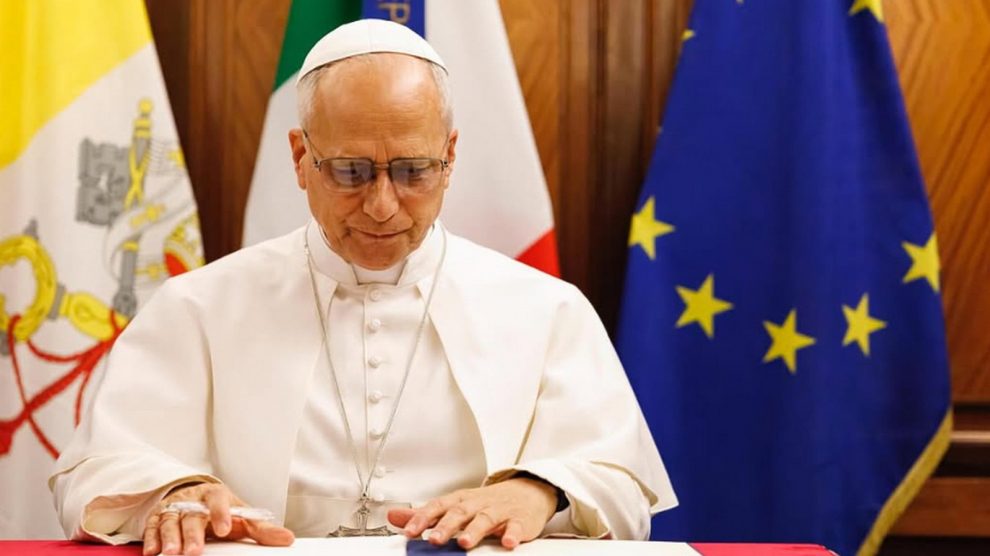
VATICAN CITY — In Magnifica Humanitas, the pope links AI-powered weapons, autonomous systems and military robotics, the erosion of multilateralism and the concentration of technological power in private hands into a single moral and geopolitical challenge for the digital age — a message that lands as the Trump administration pushes for faster AI and defense innovation amid intensifying global competition with China.
Why it matters: The Vatican is positioning AI not only as an ethical issue, but as a global security and governance problem.
- Leo XIV explicitly connects AI to the “normalization of war” and to the weakening of international institutions.
- The encyclical suggests Vatican wants tighter political and legal oversight over emerging military technologies.
- The document places human responsibility — not technological capability — at the center of decision-making.
The big picture: The encyclical frames artificial intelligence as the defining “res novae” of the current era, comparable in scale to the industrial transformations that shaped modern Catholic social doctrine.
- But unlike earlier technological revolutions, Leo XIV argues that today’s AI systems are emerging in a context where power is increasingly concentrated in private and transnational actors rather than states.
- That shift, according to the pope, makes technological power “more difficult to discern, govern and orient toward the common good.”
- The warning becomes sharper in the sections devoted to war, security and global order.
Zoom in: AI and weapons. Paragraphs 188-193 focus on what the pope describes as the growing risk that technological systems reshape the logic of conflict itself.
- Leo XIV argues that AI risks making war appear more “efficient,” more distant and politically easier to sustain, especially when responsibility becomes fragmented between algorithms, operators, governments and private contractors.
- The text warns against reducing human beings to “targets,” “data” or variables inside automated systems of calculation.
- The pope also raises concerns about the delegation of lethal decisions to machines, insisting that moral responsibility can never be transferred to an algorithm.
- The argument closely aligns the Vatican with ongoing international debates over autonomous weapons systems and human control over military AI.
Between the lines: The encyclical goes beyond a generic ethical appeal. Leo XIV effectively links three trends:
-
- technological acceleration,
- the privatization of strategic power,
- and the weakening of multilateral governance.
- The implication is that AI could deepen geopolitical instability if states and corporations develop military systems faster than international norms and institutions can regulate them.
- The pope repeatedly returns to the idea that technological progress without political and moral limits produces a new “Babele” — a system driven by domination, efficiency and control rather than solidarity and human dignity.
The Vatican’s AI doctrine. The document does not reject technology itself. Instead, Leo XIV frames AI as inherently political and non-neutral because it reflects the interests of those who design, finance and control it.
- That marks an important continuity with Pope Francis’ warnings about the “technocratic paradigm,” but the new encyclical pushes further into questions of defense, governance and international order.
- The pope argues that regulation alone is insufficient without a broader cultural and political “discernimento” about the direction of technological development.
What we’re watching: The Vatican is likely to increase its diplomatic engagement on:
-
- international AI governance,
- autonomous weapons regulation,
- digital human rights,
- and the role of Big Tech in global decision-making.
- The encyclical also gives Catholic institutions, universities and diplomats a clearer doctrinal framework for engaging with AI policy debates now unfolding at the UN, the EU and G7 level.
The bottom line: Leo XIV’s message is that the core risk of AI is not simply technological malfunction.
- It is the possibility that political systems normalize a model of power where efficiency overrides responsibility, war becomes more automated and human dignity becomes secondary to calculation.