
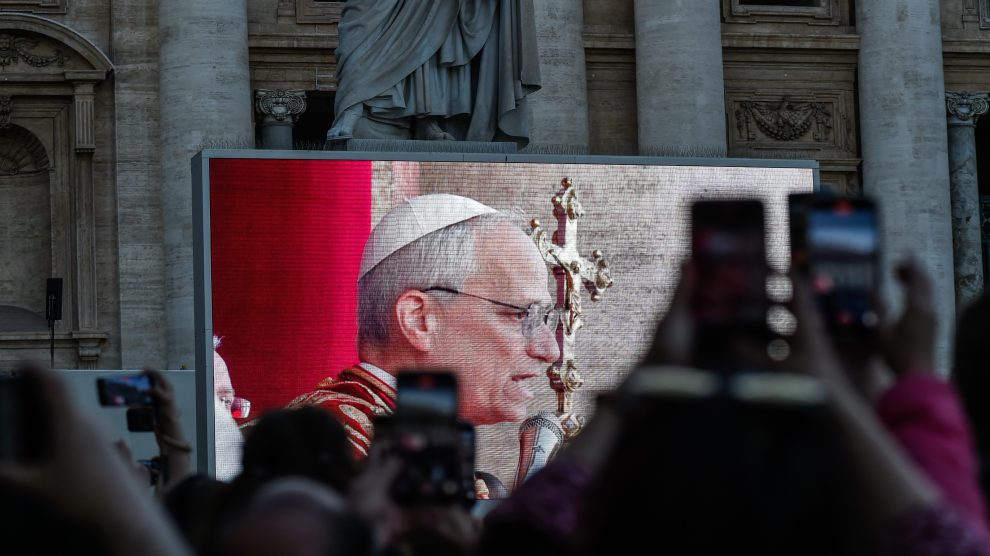
VATICAN CIY – “Magnifica Humanitas,” the first encyclical of the American-born pope Robert Francis Prevost, argues that the real danger of AI is not only technological disruption but the emergence of a global culture increasingly shaped by permanent conflict, strategic rivalry and automated decision-making.
The text repeatedly criticizes what Leo calls a contemporary “culture of power,” in which governments and private actors pursue technological supremacy while political systems struggle to preserve accountability, restraint and the common good.
The document also lands at a delicate moment for Vatican-U.S. equation, with tensions growing between the Holy See and the Trump administration over war, migration and the moral language surrounding the use of force.
Why it matters: Leo XIV frames AI as part of a broader crisis of peace and international cooperation, not simply a technological disruption.
- The pope argues that military AI risks normalizing a permanent state of conflict by lowering political and moral barriers to violence.
- The encyclical doubles as a defense of multilateralism and humanitarian law at a moment of global fragmentation.
- Leo also targets the concentration of technological and data power in the hands of a small number of private actors.
- The document reinforces the Vatican’s attempt to position itself as a moral counterweight to increasingly transactional great-power politics.
The big picture: The central argument of the encyclical is that AI emerges inside a geopolitical environment where peace itself has been downgraded.
- Leo XIV argues that development cooperation, disarmament and conflict prevention are increasingly treated as secondary priorities compared to power competition and strategic deterrence. Humanitarian protections once considered foundational — proportionality, civilian protection and access to essential goods — are described as being pushed aside by the logic of force.
- The pope presents this as part of a broader crisis of multilateralism.“Peacebuilding, development cooperation, disarmament, conflict prevention and the construction of mutual trust are set aside in the name of power politics,” the encyclical states.
- According to the encyclical, the post-Cold War order failed to generate a stable political architecture for peace, producing instead a fragmented system marked by nationalism, distrust and rival blocs.
- The result, in the Vatican’s view, is a world where war increasingly appears permanent and diplomacy increasingly appears weak.
Zoom in: Peace replaced by management of conflict. One of the most original aspects of the encyclical is that Leo XIV does not describe AI primarily as a future threat. He describes it as a tool arriving in a world that has already started adapting itself to conflict, and AI could be a force capable of amplifying existing political disorders rather than solving them.
- The text repeatedly suggests that governments are moving from the idea of preventing war to the idea of managing war more efficiently. That concern becomes explicit in the sections on autonomous weapons.
- The pope warns that AI systems can make violence faster, more distant and politically easier to sustain because they compress the time for moral judgment and fragment responsibility across operators, programmers and institutions.
- The deeper concern is cultural and political.: Leo XIV argues that once conflict becomes technologically optimized, societies risk accepting violence as inevitable rather than something to be politically prevented.
- “A more moral AI is not enough if that morality is determined by a few,” the encyclical states.
Between the lines: The text can also be read as a defense of moral authority against purely strategic and transactional reasoning. That matters in the current context of Vatican-U.S. tensions.
- Secretary of State Marco Rubio was this month in Rome after weeks of friction between the Trump administration and the Holy See over Iran, Lebanon and migration.
- While the encyclical never mentions Washington directly, several passages mirror themes that Pope Leo has recently emphasized publicly: skepticism toward escalation, concern over civilian casualties and criticism of political narratives built around enemies and permanent confrontation.
- The pope also warns against simplified “us versus them” logics that reduce international politics to rival camps and weaken trust between nations. That language indirectly intersects with broader Vatican concerns about the increasingly confrontational tone of global politics — including inside the United States.
The Vatican’s deeper message. The encyclical ultimately presents AI as a stress test for the international system itself. The Vatican’s concern is not only that machines could become more autonomous.
- Leo repeatedly argues that political systems risk surrendering too much authority both to algorithms and to private technological actors operating beyond meaningful public oversight.
- It is that political leaders could become more comfortable with a world governed by deterrence, automation and permanent emergency.
- That explains why the document repeatedly links technological systems to diplomacy, international law and civilian protection rather than discussing AI in narrowly technical terms.
- The pope’s argument is that peace requires political restraint, human accountability and institutions capable of slowing down decisions — precisely the opposite of the speed, efficiency and predictive logic driving many AI systems.
- The encyclical also insists that ethical language alone is insufficient without enforceable political and legal structures capable of regulating the technology.
Th bottom line. Leo XIV’s encyclical is less a warning about machines than about the political culture surrounding them.
- The pope argues that AI risks reinforcing a world where conflicts are managed instead of prevented, humanitarian norms are weakened and moral responsibility becomes diluted inside technological systems.
- That message also helps explain the Vatican’s growing friction with the Trump administration. For the Holy See, the real danger is not only autonomous weapons themselves, but a broader international order increasingly tempted to treat peace as secondary to power.