

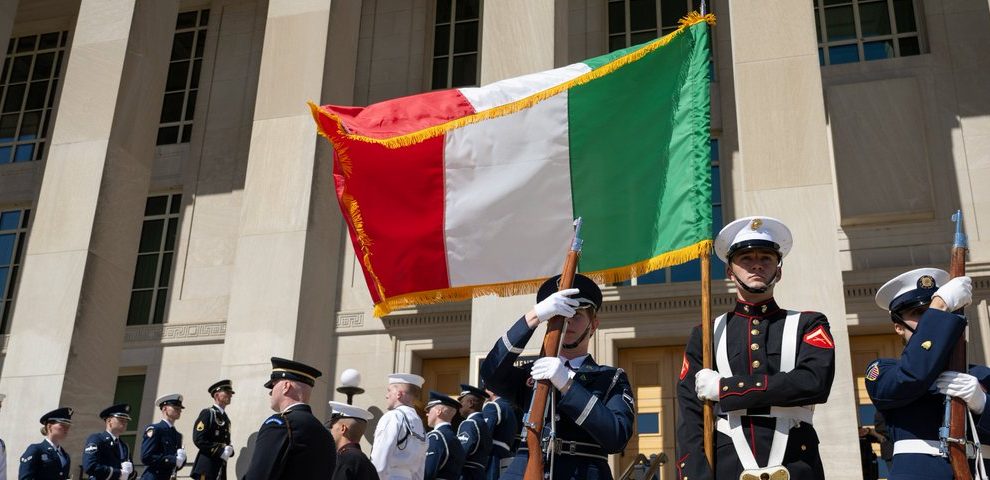
Italian Defense Minister Guido Crosetto met US Defense Secretary Pete Hegseth in Washington at a time when defense spending and burden-sharing remain central topics across NATO. The meeting reaffirmed the commitment of both countries to closer cooperation within an Alliance that both governments view as a cornerstone of transatlantic security.
The visit also included discussions with US Navy Secretary Hung Cao, with a particular focus on naval shipbuilding and defense-industrial collaboration.
Why it matters:
- The visit highlighted the continuity and depth of the strategic relationship between Rome and Washington, while underscoring the growing importance of defense-industrial cooperation within the broader transatlantic partnership.
- Symbolism mattered as much as substance. Rather than limiting itself to a routine readout, the Pentagon dedicated a full article to the meeting and promoted it through official channels, underscoring the importance Washington continues to attach to its defense relationship with Italy.
- For Rome, maintaining strong defense ties with the United States remains essential not only for security cooperation but also for access to some of the world’s largest and most technologically advanced defense programs.
Industrial opportunities: Naval shipbuilding emerged as one of the most significant themes of the visit. Through its American subsidiary, Fincantieri Marine Group, Fincantieri already occupies a unique position within the US defense industrial base. As the US Navy seeks to expand and modernize its fleet while addressing long-standing challenges related to costs, timelines, and production capacity, rebuilding American shipbuilding capabilities has become an increasingly important strategic priority.
- Against this backdrop, Fincantieri’s US presence has gained additional relevance. The company recently secured preliminary work on the Landing Ship Medium program, reinforcing its role in future naval projects. Discussions between Crosetto and Cao therefore highlighted the potential for further industrial cooperation in a sector that is becoming increasingly important to US strategic planning.
Strategic convergence. The naval dimension aligns with broader priorities shared by both governments. The Trump administration has placed industrial resilience and maritime power among the key pillars of its defense agenda, while Italy has consistently promoted defense-industrial cooperation as an essential component of the transatlantic relationship.
- Both governments have also emphasized the importance of strengthening NATO capabilities and expanding cooperation among trusted allies. This creates additional opportunities for Italian firms to contribute to American strategic objectives while further deepening bilateral industrial ties.
Leonardo’s opening. Another potential beneficiary is Leonardo, whose M-346 training aircraft remains in contention for the US Navy’s Undergraduate Jet Training System program. The competition has narrowed considerably after Boeing and Lockheed Martin withdrew their respective bids. The remaining contenders are Textron Aviation Defense, partnered with Leonardo on the M-346N, and a rival consortium led by SNC, Northrop Grumman, and General Atomics.
- The Italian-designed aircraft already serves as an advanced trainer in multiple countries and is tailored for pilots transitioning to fourth- and fifth-generation fighters. Under the partnership arrangement, Leonardo provides the platform while assembly would take place in the United States, supporting domestic production requirements and strengthening the program’s industrial footprint in America.
The bigger picture: The discussions reflect a broader trend in transatlantic defense relations: industrial cooperation is becoming increasingly intertwined with strategic competition. As Washington seeks to strengthen its defense manufacturing base and reduce vulnerabilities in key sectors, trusted allies with established industrial capabilities are likely to play an increasingly important role.
- Italy’s defense industry is among the few European players already embedded in critical segments of the US market, particularly in naval construction and military aviation.
What it signals: Crosetto’s visit highlighted the depth of the US-Italy defense relationship and the growing role of industrial cooperation within the broader transatlantic partnership.
- Whether through shipbuilding contracts for Fincantieri or training aircraft opportunities for Leonardo, Italian companies appear well positioned to expand their contribution to America’s evolving defense ecosystem.
- The discussions in Washington suggest that industrial cooperation will remain an increasingly important pillar of the alliance, creating opportunities that extend well beyond traditional diplomatic engagement.
(Photo: Department of War)