The United States is extending its technology diplomacy beyond chips, critical minerals, and artificial intelligence. Its next frontier is science itself – and Italy is in the process.
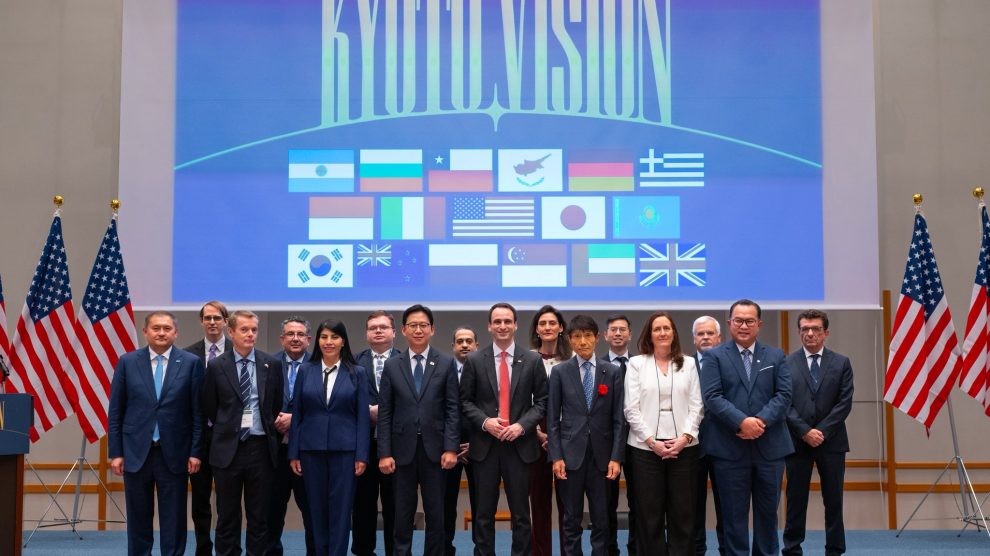
On October 4, Washington and 16 other governments, including Italy, endorsed the Kyoto Vision for a Golden Age of Science, a U.S.-led declaration aimed at reshaping how scientific research is organized, funded and ultimately conducted in an age of increasingly capable artificial intelligence.
What happened: Presented at the Science and Technology in Society Forum in Kyoto by White House Office of Science and Technology Policy Director Michael Kratsios, the initiative rests on three broad ambitions: reforming the institutions and funding mechanisms behind scientific discovery; integrating “Super Intelligence” into research; and expanding the pool of scientific and technical talent.
The most consequential element: The signatories want researchers to gain greater access not only to advanced AI tools, but also to scientific data, computing infrastructure and experimental facilities. The goal is to move toward research environments in which AI can reason across enormous bodies of knowledge, model physical and biological systems and eventually support autonomous, closed-loop experimentation.
- Kyoto, in other words, is not another declaration about governing artificial intelligence. It is about using AI to change the production of knowledge.
Washington’s science strategy goes international: The initiative also needs to be read in the context of a broader shift in U.S. policy.
- In July, Kratsios delivered to President Donald Trump Science: A New Golden Age, which the White House describes as the most comprehensive rethink of the American scientific enterprise since Vannevar Bush’s Science: The Endless Frontier eight decades ago.
AI is changing the economics and organization of scientific research itself. Frontier science is becoming more capital intensive; computing power, large datasets and sophisticated experimental facilities increasingly matter alongside individual scientific talent; and the boundary between public research and private technological capabilities is becoming harder to draw.
- The U.S. response is therefore not simply to spend more on research. Washington wants to experiment with new funding mechanisms, AI-enabled laboratories, scientific foundation models, public-private partnerships and new institutions designed specifically around machine-augmented research.
Kyoto takes that domestic agenda abroad. That international dimension matters because many of the inputs required for AI-driven science cannot easily be reproduced within national borders.
- Compute, data, laboratories, capital, specialist personnel and industrial capabilities are unevenly distributed.
- Cooperation among trusted partners can therefore become part of the infrastructure of scientific competition itself.
- And this is where Italy becomes an interesting case study.
An Italian connection already taking shape. Rome’s endorsement of the Kyoto Vision does not start a new scientific relationship with Washington. It lands in the middle of a bilateral relationship that has accelerated considerably during 2026 — often outside the political spotlight.
- On April 1 and 2, the two countries held the 15th U.S.-Italy Joint Commission Meeting on Science and Technology Cooperation in Washington. The meeting produced an unusually forward-looking set of priorities: quantum sciences; high-performance computing and artificial intelligence; fission and fusion energy; biotechnology; and advanced materials.
- More importantly, the two governments agreed on mechanisms to pursue them, including joint research, researcher exchanges, shared scientific infrastructure and public-private partnerships. Research security in critical technologies was also explicitly included in the discussion.
Only a few months later, Rome began putting additional resources behind those commitments.
- In June, Italy launched the call for the 2027-2028 Italy-U.S. scientific and technological cooperation programme. For the first time, resources from the Foreign Ministry, the Ministry of Universities and Research and the Ministry of Health were pooled into the same framework.
- The result is approximately €1.8 million per year for two years — roughly twice the funding of the previous edition— for bilateral projects in precisely the sectors identified in Washington: HPC, AI and quantum technologies, biotechnology for health, advanced and sustainable nuclear technologies and innovative materials.
There is also a human infrastructure behind the institutional one. According to the Italian Foreign Ministry, more than 15,000 Italian researchers are currently working in the United States, while Rome maintains seven scientific attachés across the country as well as the INNOVIT technology and innovation hub in San Francisco.
Other bilateral mechanisms are already operating below this overarching political framework. The U.S. National Science Foundation and Italy’s Ministry of Universities and Research have established a specific Lead Agency mechanism for joint AI research under which American and Italian teams can submit a single collaborative proposal, evaluated through a single NSF-led review process. Eligible projects can receive up to $600,000 on the U.S. side and €500,000 on the Italian side over as many as three years.
On September 2 and 3 — barely a month before the Kyoto declaration — representatives of Italy’s National Institute for Nuclear Physics met in Washington with the U.S. Department of Energy and National Science Foundation. Discussions ranged from particle accelerators and the Electron-Ion Collider at Brookhaven to CERN’s possible Future Circular Collider and emerging technologies.
- Even space is increasingly part of the same picture. In March, Italy and NASA signed a Statement of Intent covering Italian contributions to lunar surface infrastructure under Artemis, including habitation modules, communications and scientific activities as the United States works toward a sustainable lunar presence.
Why the dynamic matters: Taken separately, these are specialist agreements and meetings. Taken together, they reveal something more substantial: Italy and the United States were already building many of the channels through which the principles announced in Kyoto could eventually operate.
From minerals to knowledge. There is an even broader pattern. Italy’s science cooperation with Washington is developing alongside its integration into a wider U.S.-led technology architecture.
- On July 31, Italy formally joined Pax Silica, the American initiative connecting trusted partners across the value chain underpinning artificial intelligence — from critical minerals and semiconductors to advanced manufacturing and digital infrastructure.
- As Decode39 reported ahead of the signing, the significance of Rome’s decision reflects a particular conception of technological sovereignty: countries do not need to reproduce the entire AI stack domestically, but can contribute complementary capabilities to an ecosystem of trusted partners.
- Foreign Minister Antonio Tajani and Secretary of State Marco Rubio signed a bilateral memorandum on critical minerals, establishing a technical working group and opening cooperation to information and expertise sharing as well as public and private investment in extraction, processing and recycling. As Decode39 explained, the agreement effectively moves the bilateral relationship from critical-minerals diplomacy toward industrial policy.
The sequence is revealing. Critical-minerals cooperation addresses the physical inputs. Pax Silica connects those inputs to semiconductors, computing infrastructure and the AI value chain. Kyoto moves one level further, toward the production of knowledge itself.
- These remain formally separate initiatives, and Kyoto is a non-binding vision rather than a common research programme with its own budget. But they increasingly share a strategic logic.
- The infrastructure of technological power now stretches from raw materials to energy, advanced manufacturing, chips and computing capacity, and from there into the models, laboratories, researchers and institutions capable of turning those resources into scientific discovery.
- Washington appears increasingly interested in organizing trusted international networks across that entire chain.
For Italy, the question is therefore becoming less whether to participate than where it can position itself inside that architecture.
- Rome already brings capabilities in advanced manufacturing, semiconductor technologies, nuclear and particle physics, aerospace and scientific research. Its growing network of bilateral agreements with Washington gives it channels through which those capabilities can be connected to American capital, infrastructure and research institutions.
Kyoto potentially adds another dimension: access. If its principles eventually translate into mechanisms for sharing computing capacity, scientific datasets, advanced experimental facilities, AI-for-science tools and talent, membership could become materially more important than the diplomatic declaration itself.
That will also be the test of the initiative. The Kyoto Vision contains no common budget, binding commitments or detailed implementation timetable. Its significance will depend on whether governments turn political alignment into actual research infrastructure and opportunities for scientists.
The bottom line: Italy’s experience offers an early indication of what that implementation could look like. The bilateral machinery is already being assembled: the April Joint Commission, the new 2027-2028 funding programme, NSF-MUR cooperation on AI, the September INFN-DOE-NSF talks, and the expanding space partnership.
- Kyoto can now connect those individual pieces to something larger.
- From minerals to silicon, from silicon to compute, and from compute to scientific discovery, a new architecture of technological cooperation is taking shape. Italy is increasingly positioning itself across the entire chain.
(Photo: X, @WHOSTP47)