The October 7, 2023 Hamas attack did more than trigger the war in Gaza. It set in motion a chain of escalation that moved from terrorism to regional confrontation — and eventually reached some of the arteries connecting Europe and Asia.
What began as a security shock inside Israel expanded through Gaza and Lebanon, the Red Sea and Iran. Three years later, its wider legacy is increasingly geoeconomic: Suez, Bab el-Mandeb and Hormuz have all come under pressure at different stages of the crisis.
The result is a destabilized Indo-Mediterranean — the strategic space connecting the Mediterranean to the Indian Ocean and, through it, Europe to the Indo-Pacific.
How we got here: Hamas’ attack, which killed about 1,200 people and saw 251 taken hostage, prompted Israel’s military campaign in Gaza.
- The scale of the Israeli response contributed to a widening conflict: Iran-backed groups mobilized across the region, the Houthis opened a front in the Red Sea, confrontation between Israel and Iran became direct, and the escalation eventually drew the United States into war with Tehran.
- None of those steps was inevitable. But together they transformed a geographically concentrated terrorist attack into a regional security crisis with global economic consequences.
Follow the chokepoints: Hormuz is where the security and geoeconomic dimensions now intersect most visibly.
- Oil flows through the Strait recovered to around 16.5 million barrels a day in September, approaching pre-war levels. But the apparent normalization masks a deeper adjustment. Refined-product traffic remains depressed, while Gulf producers have expanded their use of pipelines, ship-to-ship transfers and alternative export routes.
- The share of regional crude bypassing Hormuz has risen to roughly 40%, from 17% before the conflict. The message is significant: energy producers are not waiting for geopolitics to become predictable. They are adapting their infrastructure to instability.
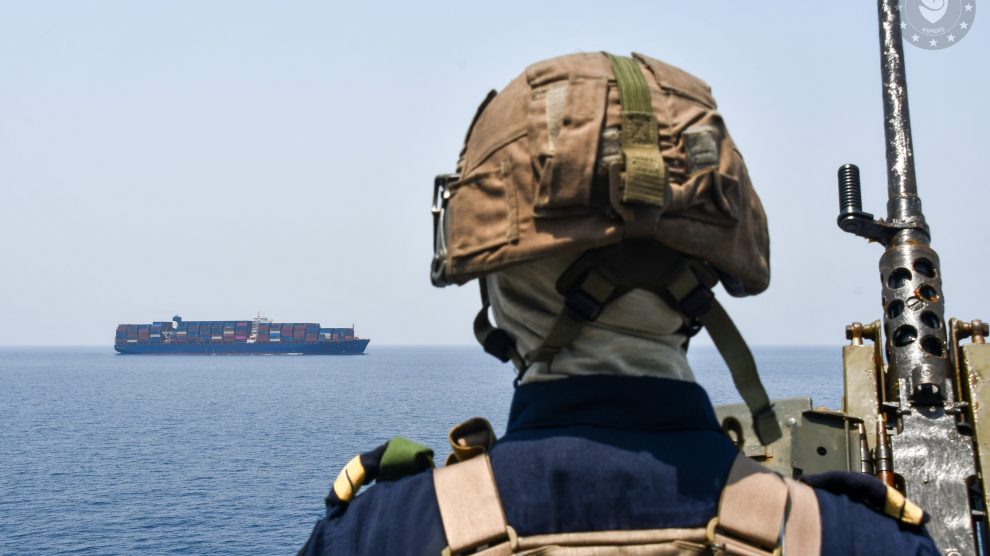
The Red Sea was the warning. The Houthis presented their intervention as support for Hamas and the Palestinians in Gaza. Their attacks turned Bab el-Mandeb into another front of the conflict, forcing shipping companies to reconsider one of the main arteries between Asian manufacturing centres and European markets.
- This created a strategic chain running from Hormuz through Bab el-Mandeb to Suez. Disruption at any point can reverberate thousands of kilometres away.
The Italian view: For Rome, this geography matters more than the distance from the battlefield might suggest.
- Italy is a manufacturing and trading economy that imports energy and raw materials while exporting high-value goods. Its economic security therefore depends heavily on open maritime routes between Asia, the Gulf and the Mediterranean.
- The Italian Maritime Economy 2026 report by SRM identifies the crises around Hormuz, the Red Sea and Suez among the forces reshaping international trade, while giving ports, logistics and alternative corridors growing importance for Italy’s competitiveness and supply security.
But there is a broader strategic implication. From an Italian perspective, the Mediterranean can no longer be treated as a self-contained geopolitical space. What happens in the Gulf or the Indian Ocean can affect Italian ports, industrial supply chains and energy prices.
- The Indo-Mediterranean is therefore more than a geopolitical label: it describes the geography through which Italian economic interests connect to Asia.
- That also helps explain Rome’s growing attention to India, the Gulf and connectivity projects such as Imec. The objective is not to replace maritime trade, but to make the networks supporting it more resilient.
Zoom out — China: Beijing has confronted a different version of the same vulnerability.
- China has built enormous commercial influence across the Middle East without acquiring comparable control over the security environment supporting those relationships. As the world’s largest crude importer, with roughly half of its oil imports coming from the Middle East, its energy security remains heavily exposed to Hormuz.
- The crisis has therefore highlighted a structural gap in China’s global position: economic reach does not automatically translate into an ability to stabilize the spaces through which that economic power operates. Beijing can manage the consequences, diversify suppliers and exercise diplomatic influence. It cannot easily insulate itself from a security crisis stretching across the Indo-Mediterranean.
Zoom out — America: Washington faces almost the inverse problem.
- Years of debate over the pivot to Asia focused on freeing diplomatic and military resources for the Indo-Pacific and competition with China. Yet the United States has again found itself militarily absorbed by the Middle East.
- This does not make the Indo-Pacific less important. It demonstrates how difficult it has become to separate the two theatres. Gulf security affects Asian energy supplies. Red Sea security affects Asian-European commerce. And instability across the Indo-Mediterranean inevitably feeds into the strategic competition farther east.
The distinction between the Middle East and Indo-Pacific, useful on an organizational chart, is becoming less convincing on a map of global flows.
What to watch: The response emerging from the crisis is not simply more military security. It is redundancy.
- Saudi Arabia’s East-West Pipeline to Yanbu, the UAE’s access to Fujairah, Omani ports and prospective land connections towards the Mediterranean all reflect the same calculation: if chokepoints cannot be made permanently secure, economies need credible ways to bypass them.
- This is also where Imec acquires strategic relevance. The India-Middle East-Europe Economic Corridor should not be seen as a replacement for Suez, much less as a solution to Middle Eastern instability. Its value lies in adding another layer to a denser network of ports, railways, pipelines, digital cables and logistics infrastructure linking Europe and Asia.
- For Italy, sitting at the European end of this space, redundancy is increasingly part of economic security.
The bottom line: October 7 exposed how closely the Mediterranean, the Gulf and the Indo-Pacific are connected.
- For Italy, a trading and manufacturing economy at the European end of this system, keeping the Indo-Mediterranean open — and building redundancy when its chokepoints fail — is increasingly a matter of national economic interest.
(Photo: X, @EUNAVFORASPIDES)