
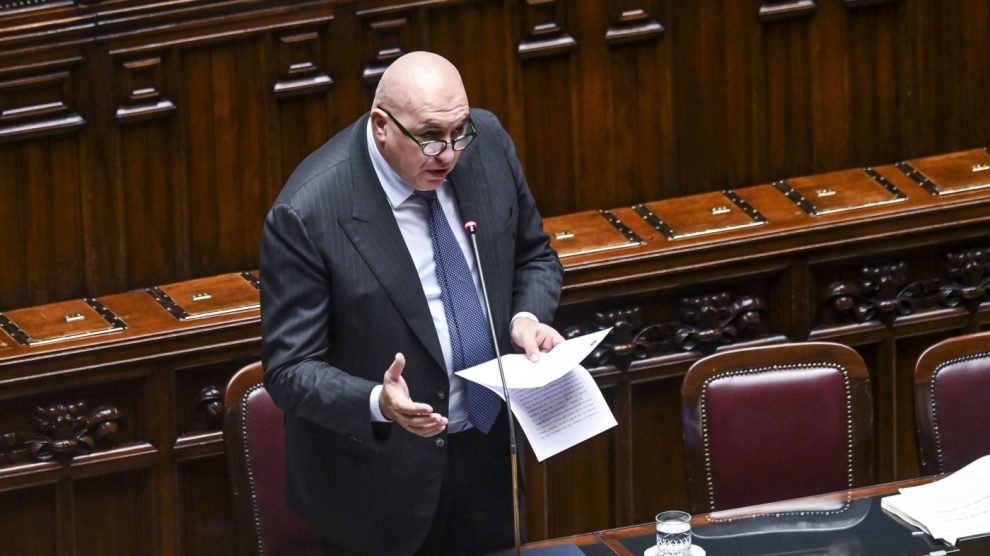
Italian Defence Minister Guido Crosetto has called for a significant strengthening of Italy’s cyber capabilities, identifying the need for approximately 5,000 specialists and €6 billion in resources.
Speaking during parliamentary discussions on defence requirements, Crosetto highlighted the growing importance of cybersecurity in an increasingly complex security environment and while Italy is under a continuous hybrid pressure.
-
“Disrupting Hybrid Coercion. From Reactive Defence to Strategic Initiative”: go deeper, read the special report by Jacopo Marzano.
Crosetto’s remarks come alongside a warning to the Italian banking sector about the need to reinforce its protection against cyberattacks, bringing the relationship between national defence and financial security into sharper focus.
Why it matters. Italy’s cybersecurity requirements increasingly extend beyond the traditional boundaries of military defence. Financial institutions, digital infrastructure and essential services represent potential targets whose disruption could have consequences for national security and economic stability.
- Crosetto’s intervention highlights the scale of the investment and expertise required to address these vulnerabilities. The challenge involves strengthening operational capabilities while ensuring that public institutions and private companies can respond effectively to an evolving threat environment.
Zoom in: The banking sector enters the security equation. The Defence Minister has specifically urged Italian banks to strengthen their cybersecurity preparedness, warning about the potential consequences of increasingly sophisticated attacks.
- The financial sector occupies a particularly sensitive position within the national security architecture. Its dependence on digital infrastructure, interconnected networks and continuous information flows makes operational resilience essential to the functioning of the broader economy.
- Crosetto’s appeal places particular emphasis on the need for financial institutions to invest in technological protection and specialised personnel.
- The discussion also reflects the growing importance of cooperation between government institutions and private operators. Although banks maintain their own security systems and regulatory obligations, the increasingly interconnected nature of cyber threats creates opportunities for closer coordination with national security authorities.
Zoom out: The investment challenge. The figures presented by Crosetto illustrate the financial and organisational dimensions of Italy’s cybersecurity ambitions.
- Developing advanced capabilities requires sustained investment in technology, infrastructure and training. Recruiting thousands of specialists also presents a challenge in a labour market where cybersecurity expertise is increasingly sought after by governments and private companies.
- The availability of funding remains a central issue. Italy must reconcile growing security requirements with competing public spending priorities, while ensuring that resources translate into operational capabilities.
The big picture. Cybersecurity has become a central component of European and transatlantic security discussions, reflecting the growing dependence of modern economies and defence systems on digital technologies.
- Within NATO, cyberspace is recognised as an operational domain, while the European Union has progressively strengthened its cybersecurity and critical infrastructure resilience frameworks.
- For Italy, these developments reinforce the importance of integrating national capabilities into broader European and allied security arrangements.
- The growing involvement of private companies also highlights the relationship between technological competitiveness and national resilience. Protecting strategic sectors increasingly depends on the availability of advanced technologies, specialised expertise and effective institutional coordination.
Mal comune: A significant cyberattack struck the European Commission, potentially compromising vast amounts of personal data. This incident has left staff unable to input salary and leave information, prompting the most senior officials to convene an emergency meeting yesterday to address the crisis, as reported by Politico.
The bottom line. Crosetto’s assessment provides a measure of the resources Italy considers necessary to strengthen its cyber defences. His warning to the banking sector also illustrates how cybersecurity is becoming a shared responsibility across the national security ecosystem.
- The decisive question will be whether Italy can translate these requirements into sustained investment, qualified personnel and stronger operational coordination between public institutions and strategic industries.