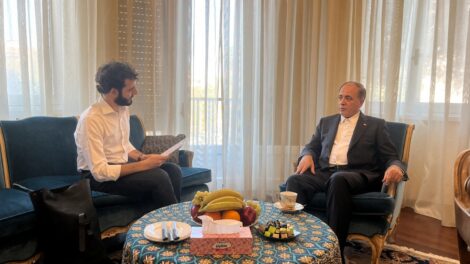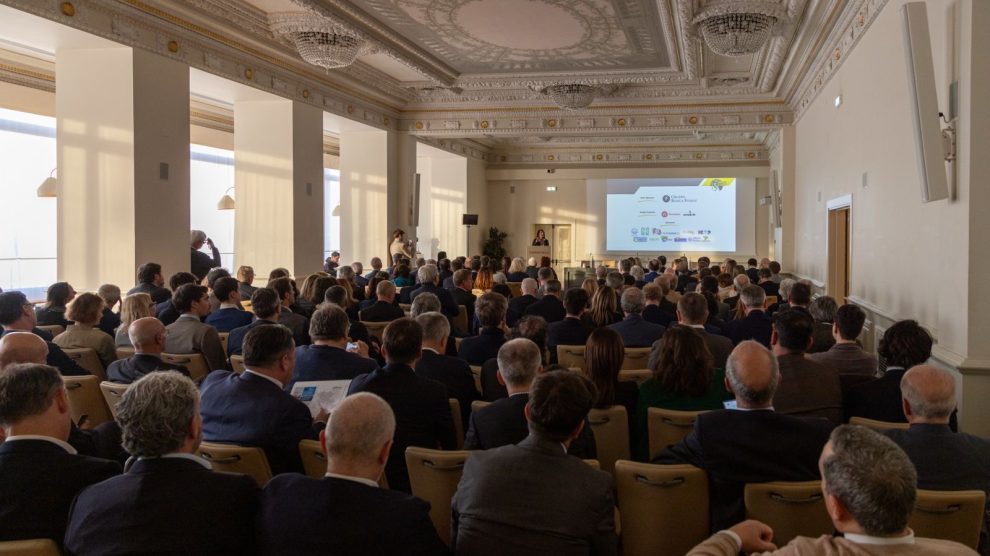
One of the key moments of these two days of events in Trieste was “Priority Actions: Upper Adriatic Interoperability & Balkan Connectivity,” a conference organized by the Trieste Summit Association, which focused on the infrastructure priorities needed to strengthen links between the ports of the Upper Adriatic and Central and Eastern Europe. Decode39 was media partner of the event
Why it matters: The ports of the Upper Adriatic connect a vast economic hinterland.
- Together they serve a territory of more than 100 million EU citizens across 11 member states, including five landlocked countries.
- This makes the region one of Europe’s most strategic maritime gateways for trade flows moving toward Central Europe and the Western Balkans.
- The goal of the Trieste Summit event was clear: identify the priority actions needed to unlock the full logistical potential of Trieste and the wider Upper Adriatic port system in the context of emerging Eurasian trade corridors.
The message from industry: rail first .Across panels and discussions, one message was repeated by logistics leaders from Italy, Slovenia and Croatia.
- Rail connectivity is the top priority.
- Executives and operators summarized the challenge with a simple formula: “trains, trains, trains.”
- Without modern and efficient rail links connecting the ports of Trieste-Monfalcone, Koper and Rijeka to Central and Eastern European markets, the region’s ports risk operating far below their potential.
- The main bottlenecks identified by industry actors include freight rail corridors along three critical routes:
- Trieste–Monfalcone toward Central Europe
- Koper–Ljubljana
- Rijeka–Zagreb
- Upgrading these connections and improving rail interoperability is no longer seen as a national priority for individual ports but as a strategic necessity for the entire Upper Adriatic port system.
Connecting regional ports to global corridors. The discussion also highlighted how the Upper Adriatic fits into broader global connectivity projects.
- Participants repeatedly referred to major Eurasian trade routes, including the Middle Corridorand the India–Middle East–Europe Economic Corridor (IMEC), which aims to link India, the Gulf and Europe through integrated transport, energy and digital infrastructure.
- According to projections discussed during the event, trade flows along IMEC could potentially exceed the combined projections of China’s Belt and Road Initiative and the Middle Corridor.
- For Europe, this could translate into greater economic resilience and stronger strategic autonomy.
- But capturing these flows will depend on one crucial factor: efficient port-to-rail connectivity from the Upper Adriatic to Central and Eastern Europe.
A gathering of logistics and infrastructure leaders. The Trieste Summit event brought together a wide range of logistics and transport actors.
- Among the rail and logistics operators participating in the discussions were METRANS, Adria Kombi, Alpe Adria, Serbia Railways JSC and Grampet Rail, alongside representatives from the ports of Trieste, Koper and Rijeka and locomotive manufacturer Škoda.
- Their discussions focused on practical steps to increase freight capacity, improve rail interoperability and coordinate investment strategies across borders.
Political support for the Adriatic gateway. The event also drew strong political backing from national and international policymakers.
- Speakers included Italian parliamentarians Tatjana Rojc, Marco Dreosto and Paolo Formentini, European Parliament member Anna Maria Cisint, and Italy’s special envoy for IMEC, Ambassador Francesco Maria Talò.
- International participation included Serbian State Secretary Nevena Jovanović and U.S. State Department officials Dane Johnston and Hugo Yon.
- Local institutions were represented by Trieste Mayor Roberto Dipiazza and Cristina Amirante, regional minister for infrastructure and territory of Friuli-Venezia Giulia.
Italy pushing IMEC forward. Rome has moved faster than other signatory countries both politically and economically — from the creation of a parliamentary IMEC intergroup to the launch of the Indo-Mediterranean Business Forum.
- Meanwhile, Trieste Summit leaders Francesco S. Parisi and Stefano Visintin emphasized the association’s mission: ensuring that the geopolitical vision of IMEC is balanced with the local economic priorities of Trieste, the Friuli-Venezia Giulia region and the Upper Adriatic port system.
What’s next: The association is currently working with the US-India Strategic Partnership Forum to launch IMEC NetWork, a business-focused digital platform expected to go live in mid-April.
- Looking ahead, Trieste will host the Indo-Mediterranean Business Forum in December 2026, aimed at bringing together companies, policymakers and logistics operators involved in developing the corridor.
The bottom line: Taken together, the events held in Trieste outline a clear geopolitical map.
- The city is emerging as a meeting point for three layers of cooperation:
- Central and Eastern European integration
- Adriatic and Balkan regional connectivity
- Global trade routes linking the Mediterranean to the Indo-Pacific through IMEC
- In an era where geopolitical competition increasingly revolves around infrastructure and supply chains, Trieste is seeking to reclaim a role that echoes its historical past.
- Once the maritime gateway of Central Europe during the Habsburg era, the Adriatic city is now positioning itself as a node in a new network stretching from the Mediterranean to Asia.