WASHINGTON – While the political dimension remains central, it is the business community that offers the clearest indication of where the transatlantic partnership is actually heading. Supply chains, digital infrastructure, defence, and technological innovation are increasingly driving relations between Italy and the United States in this complex phase of international affairs.
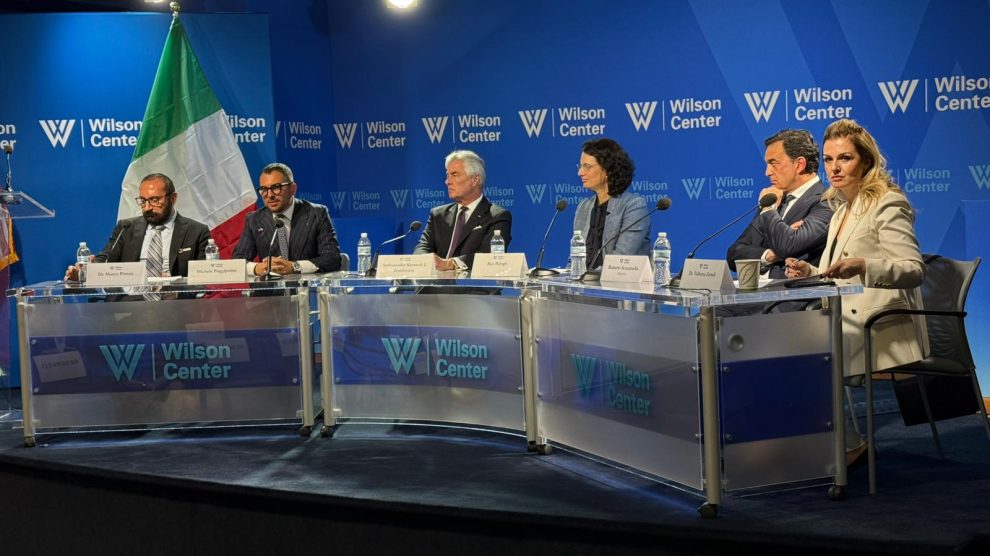
In Washington, the event co-organised by Decode39 at the Wilson Center, held during the visit of Italy’s Minister of Economy Giancarlo Giorgetti, provides a privileged vantage point to observe how the Italy–US relationship is evolving at the industrial level.
Industry and technology at the core A central focus of the discussion is the future of economic and technological cooperation. The panel on “Innovation, Investment, and Industry” brings together key actors in the transatlantic industrial relationship, including:
- Ambassador Kenneth J. Braithwaite, chairman of Fincantieri Marinette Marine,
- Michele Poggipolini, CEO of Poggipolini Group,
- Roberto Scaramella, general manager Transportation and International at Almaviva,
- Rita Balogh, Europe & Canada Lead for International Government Affairs at Google,
- Marco Pistoia, CEO of IonQ Italy.
- The panel is moderated by Valbona Zeneli, senior advisor at Decode39.
What emerges is a relationship gradually shifting toward value chains, innovation, and technological security, against the backdrop of intensifying great-power competition.
- Within this context, Pistoia highlights the strategic risks associated with falling behind in quantum technologies. “Lagging in quantum computing,” he notes, “would mean exposing oneself to the risk of developing and using algorithms that will soon become obsolete and uncompetitive compared to those of actors who seize this transformation early.”
- Even more critical, he adds, is quantum security: “Falling behind would mean facing an even greater danger — that sensitive corporate, industrial, and government data could, over time, be exposed to adversaries with superior technological capabilities.”
The voice of industry. The overarching message is one of ongoing transformation — one that requires scale, integration, and speed.
- Michele Poggipolini captures this trajectory succinctly: “Poggipolini is transforming a major industrial challenge into a global, innovative platform focused on modernising the current supply chain of critical fasteners to better support both the present and the future of aerospace and defence.”
- In the case of Almaviva, the perspective broadens to the functioning of the transatlantic partnership as a whole. Roberto Scaramella stresses that while Italy and the United States share trust and an industrial base, they do not yet share the speed required to compete globally.
- He identifies three main directions: co-investment in critical technologies — from semiconductors to artificial intelligence and secure communications — to strengthen and make supply chains more resilient; the creation of genuine transatlantic industrial corridors capable of combining Italian design with American scale to define global standards; and the transition from traditional client–supplier relationships to partnerships based on equity participation and shared research and development.
- This approach has already been tested by Almaviva, notably through the acquisition of Iteris in North America, which has significantly reduced product development cycles and enabled deeper integration of expertise across both sides of the Atlantic.
Infrastructure, defence, and the AI transition. Digital infrastructure emerges as a key enabling factor. Traffic management systems, integrated data, and intelligent platforms are already improving the efficiency of ports, road networks, and rail systems. In practice, technologies developed in the United States are being scaled in Italy, while Italian AI solutions are finding applications in American cities.
- Particular attention is also given to public–private partnerships, especially in the railway sector, where the combination of public vision and private execution can transform networks into fully-fledged digital platforms, enhancing the competitiveness of the entire transatlantic supply chain.
- Fincantieri represents this dynamic in a paradigmatic way. Through its US subsidiary, it has secured an initial contract from the US Navy for the Landing Ship Medium programme, marking a key phase between design and procurement.
- These vessels reflect the evolution of US strategy toward more distributed operational models, with a growing focus on the Indo-Pacific. For the Italian group, this represents a significant step in a highly competitive and politically sensitive market.
- Artificial intelligence, meanwhile, is identified as a decisive factor in the shift from reactive to predictive systems — from real-time optimisation of logistics flows to emissions reduction and the rapid simulation and management of disruptions.
- “AI represents a transformative opportunity to boost productivity, advance healthcare, and build resilient communities,” Balogh notes, “but capturing this €150–170 billion economic potential requires urgent and collective attention to widespread adoption.” She adds that, as Google marks its 25th anniversary in Italy, the company remains committed to strengthening the country’s digital future through critical infrastructure such as cloud regions and subsea cables, while also promoting cultural heritage via Google Arts & Culture.
- Through targeted skills initiatives like Italia in Digitale and AI for Made in Italy, the goal is to ensure that individuals and businesses alike are equipped to embrace these technologies and thrive.
From politics to industrial alignment. Taken together, these signals point to a transatlantic relationship increasingly anchored in industrial alignment rather than political rhetoric alone. In a global environment defined by technological competition and strategic fragmentation, the Italy–US partnership appears to be consolidating where it matters most: along the fault lines of innovation, infrastructure, and security.