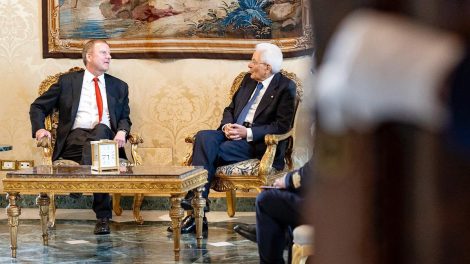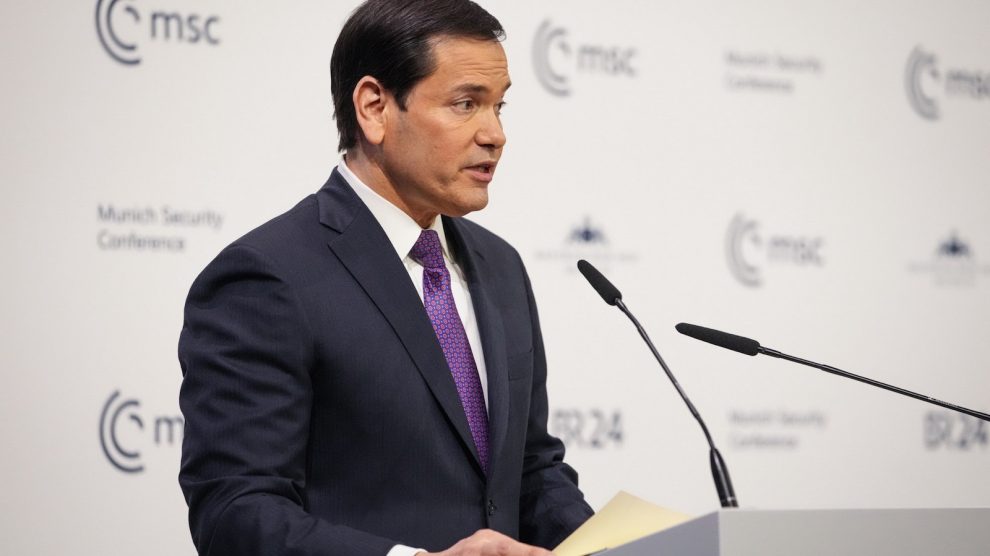
The visit of U.S. Secretary of State Marco Rubio to Rome comes at a moment of cooling relations between the United States, the Vatican, and Italy, following Donald Trump’s attacks on the Pope and growing tensions across several international dossiers.
According Prof. Giovagnoli, it represents an attempt at mending ties that highlights both American difficulties and, at the same time, the strengthening of the Holy See’s position and that of Pope Pope Leo XIV. In the background lie the unease of American Catholicism, the Meloni government’s more European-oriented repositioning, and unresolved issues ranging from tariffs to Cuba.
Keyword: repair. Rubio’s mission to Rome comes at a delicate juncture, amid diplomatic tensions and political fractures that have widened in recent weeks. In the background are Trump’s attacks on the Pope—reiterated even in recent hours over Iran—the discomfort within American Catholicism, and a relationship with Italy that appears less straightforward than in the early months of the new administration.
Q: What significance do you attach to Rubio’s visit to Rome?
A: It most likely represents an attempt to repair recent rifts, both with the Vatican and with the Italian government. It is a mission born out of difficulty: Trump’s attacks on the Pope have been unprecedented and have triggered a united response from the Catholic Church, including the American episcopate. In this sense, the visit appears as a form of damage control by the United States.
Q: Can this be seen as a victory for the Pope?
A: In a sense, yes. The very fact that Washington feels the need to send an envoy to restore relations suggests that the Holy See’s position has been strengthened.
- The Pope’s figure, by its very nature, tends to absorb attacks and emerge reinforced. Moreover, the measured way in which Leo responded to Trump has contributed to enhancing his authority.
Q: How significant are the internal tensions within American Catholicism?
A: They are very significant. There has been clear discomfort among Catholics who had voted for Trump. At the same time, there is now a strong sense of pride in having an American Pope: support for Leo is extremely high.
- In his first year of pontificate, he has been very careful to foster unity within the U.S. Church, mending divisions that had emerged during the papacy of Pope Francis.
- This has also strengthened him in the eyes of more conservative elements of the episcopate, which in fact have shared criticisms of Trump’s migration policies.
- All of this ultimately weakens the president.
Q: Are there precedents for similar tensions between the United States and the Holy See?
A: The closest precedent dates back to the final phase of Trump’s first presidency, during the visit of Mike Pompeo. At that time, there was a very aggressive stance toward the Holy See, particularly regarding China.
- It was an approach that damaged U.S. policy, because the Church tends to rally around the Pope when he is attacked. This dynamic now appears to be repeating itself.
Q: What about relations with Italy?
A: Here too, the situation is not straightforward. The initial enthusiasm of Italy’s center-right toward Trump has faded. Giorgia Meloni herself has gradually repositioned her line, distancing herself on several dossiers, from Greenland to Iran. This is a choice driven by national interests and a more European-oriented posture.
- Sec. Rubio therefore arrives with the aim of avoiding further rifts, but it remains to be seen how strong the American willingness to mend ties truly is. The issue of tariffs, for example, is a concrete source of tension.
Q: Which dossiers will be central in talks with the Vatican?
A: Many. But Cuba is certainly one of them. The ties between the Holy See and Havana are historically well established, and Pope Francis had worked extensively toward a rapprochement between Havana and Washington.
- Today, the situation is complicated: the embargo has worsened conditions on the island, and Trump’s threats make the picture even more critical.
- Leo, also because of his sensitivity toward the entire American continent, is watching this dossier very closely. It is likely to be central in the talks, including those with Cardinal Pietro Parolin.
Q: Ultimately, can Rubio’s mission really repair relations?
A: It is certainly an attempt. But its effectiveness will depend on the consistency of the American line. If attacks and tensions continue, it will be difficult to restore a stable relationship.
- The visit, however, signals that there is awareness of the problem in the United States. And that, at least, is a first step.