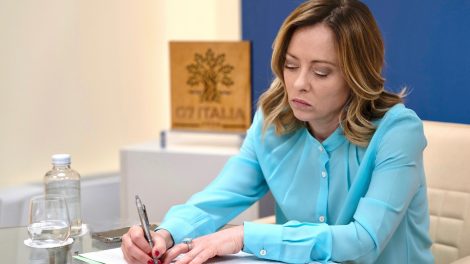

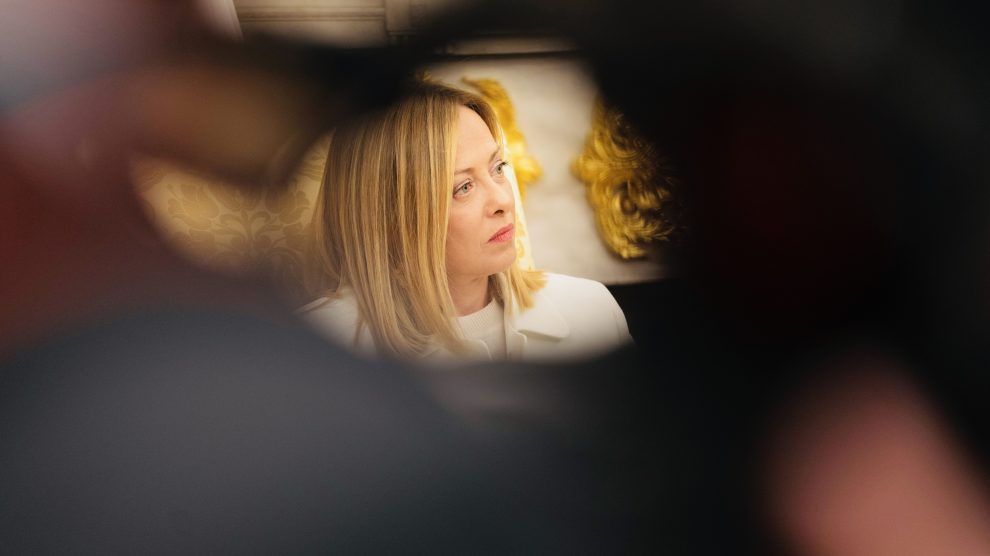
The back-to-back meetings — with Libyan Prime Minister Abdul Hamid Dabaiba, Hungarian Prime Minister Péter Magyar, Polish Prime Minister Donald Tusk and finally U.S. Secretary of State Marco Rubio — offered a snapshot of how Rome is trying to position itself amid mounting instability around the Middle East, Ukraine, global energy markets and Euro-Atlantic relations.
Why it matters: Italy is increasingly framing the Mediterranean as a strategic pillar of European security and energy policy. Rome is trying to strengthen its role as a bridge between Washington, North Africa and the EU.
- The sequence of meetings highlighted an Italian approach built around pragmatism, energy security and diplomatic flexibility.
- The talks came as tensions linked to Iran and the Strait of Hormuz reshaped Western security calculations.
The big picture:The density of Meloni’s diplomatic agenda reflected the growing overlap between energy, migration, defense and transatlantic coordination.
- Rather than focusing on a single crisis, the Italian government used the meetings to reinforce a broader geopolitical narrative: Italy sees its geographic position in the Mediterranean as a strategic asset for both Europe and the United States. That message emerged across all four meetings.
Indo-Mediterranean strategy. The diplomatic sequence had already started on Wednesday with a phone call between Meloni and Kuwait’s Emir Sheikh Mishal Al-Ahmad Al-Sabah, focused on regional security, freedom of navigation in the Strait of Hormuz and bilateral economic cooperation.
- According to the Italian government, Meloni reiterated Italy’s solidarity following recent Iranian attacks, while the Kuwaiti side expressed appreciation for Italian defense systems supplied to the Gulf country.
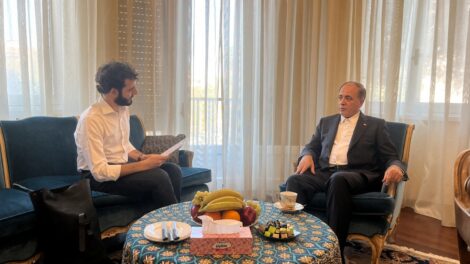
- Energy dominated Meloni’s talks with Libyan Prime Minister Abdul Hamid Dabaiba.
- Gas, oil and electricity remain the core pillars of cooperation between Rome and Tripoli, with discussions centered on energy security and diversification at a time of heightened uncertainty tied to Hormuz and regional instability.
- Italian officials increasingly present the Mediterranean as central to Europe’s long-term energy strategy.
- Go deeper with our coverage after and before the meeting.
Europe and the EU dimension. Meloni’s meetings with Hungary’s Péter Magyar and Poland’s Donald Tusk highlighted another dimension of Italy’s diplomatic positioning: maintaining political channels across different camps inside the EU.
- Talks with Magyar focused on Iran, migration, defense cooperation and the EU agenda. The meeting also served as a first exchange with Hungary’s new leadership.
- With Tusk, the emphasis shifted toward economic cooperation and political convergence. Trade between Italy and Poland reached a record €36 billion in 2025, according to the Italian government.
- “The deep bond between Italy and Poland is also reflected in our very intense economic relations,” Meloni said.
- Tusk described Italy and Poland as “friends who understand each other very well,” adding that the two countries had no “conflicts of interests, ideas or values.”
Transatlantic relations. The diplomatic sequence culminated Friday with Meloni’s meeting with U.S. Secretary of State Marco Rubio.
- According to Italian sources, the two discussed regional security challenges linked to the Middle East and Ukraine, alongside “the importance of continued transatlantic cooperation to address global threats.”
- The meeting reinforced Italy’s effort to position itself as a key interlocutor for Washington on Mediterranean and European security issues.
- Iran and Hormuz: Rubio’s remarks in Rome underscored how closely the Mediterranean agenda is now tied to tensions with Iran.
- The secretary of state warned against any Iranian attempt to control maritime traffic in the Strait of Hormuz and reiterated that Tehran must not obtain a nuclear weapon.
- For Rome, the crisis strengthens the case for diversified energy routes and stronger Mediterranean infrastructure.
- NATO and Europe: Rubio also reopened discussion about the strategic role of NATO bases in Europe, saying the alliance remains essential for U.S. military projection.
- While he stressed that decisions on troop deployments ultimately belong to President Donald Trump, the comments highlighted broader uncertainty surrounding the future balance inside the transatlantic alliance.
- Lebanon: Rubio also identified Lebanon as an area where Italy could play what he called “a very constructive role.”
- The secretary of state pointed to possible cooperation in supporting the Lebanese government and countering Hezbollah’s financial networks.
- The remarks reflected Washington’s view that Italy can play a stabilizing role beyond its immediate Mediterranean neighborhood.
- In her words: “We had a broad and constructive discussion, during which we addressed numerous issues, from bilateral relations between Italy and the United States to the main international issues, including the crisis in the Middle East, freedom of navigation in the Strait of Hormuz, the stabilization of Libya and the peace process in Lebanon and Ukraine,” said Meloni.
- “A frank dialogue, between allies who defend their national interests but who both know how precious the unity of the West is.”
The bottom line: Taken together, Meloni’s meetings over the past two days outlined an increasingly coherent Italian foreign policy trajectory: strong alignment with Washington, a Mediterranean-centered energy and security strategy, and an effort to remain politically connected across Europe’s shifting internal balances.