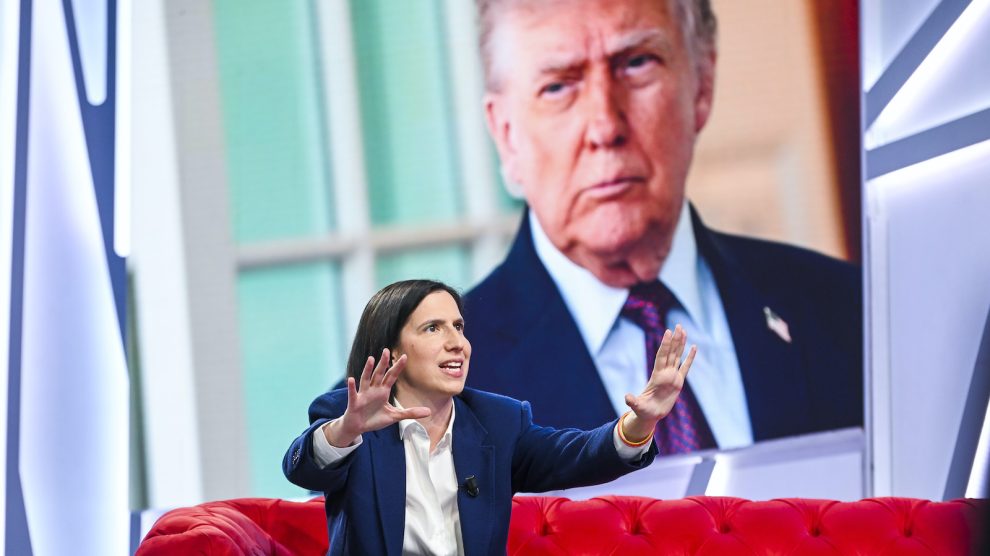
Donald Trump continues to divide, unsettle and polarize. But inside the Democratic Party (PD) headquarters in Rome, some are already thinking about what comes next — trying to rebuild political and cultural ties with that part of America which still sees Europe as a strategic ally.
Beyond Trump. That was the underlying message of the initiative promoted by the Demo foundation, led by Gianni Cuperlo. More than a policy seminar, the event became a broader political reflection on the future of the transatlantic relationship and on the role the Democratic Party intends to play within it.
- Around the table were several senior PD figures, including Peppe Provenzano, Stefano Graziano, Lucia Annunziata and Piero Fassino.
But the lineup of scholars and commentators also revealed the deeper ambitions behind the initiative. Participants included:
-
- Nathalie Tocci, professor of practice at Johns Hopkins University;
- Mario Del Pero, professor of international history at Sciences Po and a leading expert on U.S. foreign policy and transatlantic relations;
- writer and cultural commentator Antonio Monda;
- veteran journalist Giovanna Botteri;
- Alberto Melloni, a prominent historian of Christianity and Catholicism.
The Vatican Dimension. Melloni’s presence also pointed to another direction in the Democratic Party’s ongoing reflection: preserving ties with the Vatican and with Italy’s democratic Catholic tradition as part of a broader redefinition of the West’s political horizon.
- On that front, tensions between Trump and Pope Leo XIV — partially eased following Marco Rubio’s recent visit — have also reinforced the perception that the PD is trying to reconnect with segments of the Catholic electorate that have drifted away from the party in recent years.
Reading Trumpism. The starting point for many within the PD is clear: Trumpism cannot be dismissed as a temporary anomaly in American politics.
- Instead, it is interpreted through the economic and social fractures that emerged after the 2008–2009 financial crisis, when large sections of the American middle class stopped feeling protected by globalization.
- It was in that environment that Trump’s populist narrative took hold, speaking to the “forgotten” and transforming social unease into political consensus.
- At the same time, however, the PD is also looking at signs of resistance emerging across the United States.
- Civic mobilizations, recent Democratic victories in several American states and cities, and difficulties faced by the White House on some congressional issues have all reinforced the idea that a liberal and progressive America still exists — and that stable political ties can be rebuilt with it.
Schlein’s International Strategy. In recent weeks, Elly Schlein took part in the progressive summit in Toronto, an event interpreted within the PD as part of a broader international strategy aimed at strengthening dialogue between European progressives and U.S. Democrats.
- Within that framework, a more defined political line is taking shape: preserving the transatlantic alliance without aligning uncritically with the current U.S. administration.
- Instead, the goal is to build a political axis connecting the Party of European Socialists, Italy’s Democratic Party and the U.S. Democratic Party.
- According to party officials, this is also becoming increasingly important from a geopolitical standpoint.
The Geopolitical Concern. A central concern within the Democratic Party — both in Rome and more broadly across parts of Europe’s center-left — is that a weakening of the Euro-Atlantic bond could open space for pro-Russian or pro-Chinese tendencies inside the European progressive field.
- For that reason, the seminar organized by Demo carried significance well beyond a cultural discussion.
- It also represented an attempt to redefine the PD’s international profile: a party seeking to reaffirm its Western and democratic positioning while distancing itself both from sovereigntist movements and from the neutralist tendencies emerging across parts of European politics.
The Message From Rome. The message emerging from the Nazareno headquarters was ultimately clear: the relationship with the United States remains strategic, but it must be rebuilt on new and more balanced foundations, less dependent on the fluctuations of American domestic politics.
- The underlying conviction within the PD is that the relationship between Europe and democratic America remains one of the pillars of the Western order.
- And that the resilience of liberal democracies — at a time of growing competition with increasingly assertive autocracies — may also depend on the strength of that transatlantic link.