
Italy is pushing for stronger Europe-Gulf economic ties through the India-Middle East-Europe Economic Corridor (IMEC) and new free trade agreements, as tensions around key maritime chokepoints put the connection between security, trade and connectivity increasingly into focus.
The Indo-Mediterranean geostrategic concept is moving towards implementation. Speaking at a Europe-Gulf meeting in New York on Thursday, Italian Foreign Minister Antonio Tajani said Rome is determined to advance IMEC as a link between Europe, the Gulf and Asian markets, while strengthening the EU’s trade architecture with Gulf countries.
Why it matters: Italy’s message brings security and economic connectivity under the same strategic umbrella.
- With crises affecting the Strait of Hormuz and the Red Sea, Tajani reaffirmed Italy’s commitment to freedom of navigation through three EU maritime operations: ASPIDES, the defensive mission protecting commercial shipping in the Red Sea; Atalanta, the counter-piracy and maritime security operation in the western Indian Ocean; and IRINI, which is shifting from embargo enforcement in Lybia to a broader mission focused on maritime awareness, critical infrastructure protection, and European strategic resilience.
- He called on other EU countries to strengthen their contribution to ASPIDES, pointing to its growing importance amid the crisis around the Bab al-Mandab Strait.
- At the same time, Rome wants deeper Europe-Gulf connections across logistics, ports, energy and digital infrastructure — with IMEC providing the wider framework.
The big picture: Tajani was speaking at a meeting on “Promoting Europe-Gulf Partnerships for Regional Security and Prosperity,” held as part of the Europe Gulf Forum launched by Antenna Group and the Atlantic Council.
- The event brought together European and Gulf leaders to discuss practical cooperation, including how to mitigate the repercussions of the Middle East conflict and create conditions for post-conflict projects spanning the economy, energy, infrastructure and security.
- Prime Minister Giorgia Meloni opened the event with a video message, alongside interventions from Qatar’s Prime Minister and Foreign Minister and Finland’s President.
The IMEC angle: Rome has been seeking to move the corridor from the diplomatic to the operational level.
- As Decode39 previously reported, Italian MP Paolo Formentini has argued that Italy wants IMEC to move “from diplomacy to ports”, putting infrastructure and port connectivity at the center of Italy’s approach to the corridor.
- Tajani’s remarks in New York place that ambition within a wider Europe-Gulf framework: stronger logistical, port, energy and digital connections are presented alongside maritime security as components of the same partnership.
Follow the trade: Italy is also pushing, both bilaterally and at EU level, to expand the network of free trade agreements with Gulf countries.
- Tajani pointed to the agreement being negotiated with the United Arab Emirates as a model and said the next EU-Gulf Cooperation Council summit should provide an opportunity to relaunch the long-running negotiations for an agreement between the two blocs.
Zoom out: India. The Gulf push also connects with Rome’s outreach to the other end of IMEC.
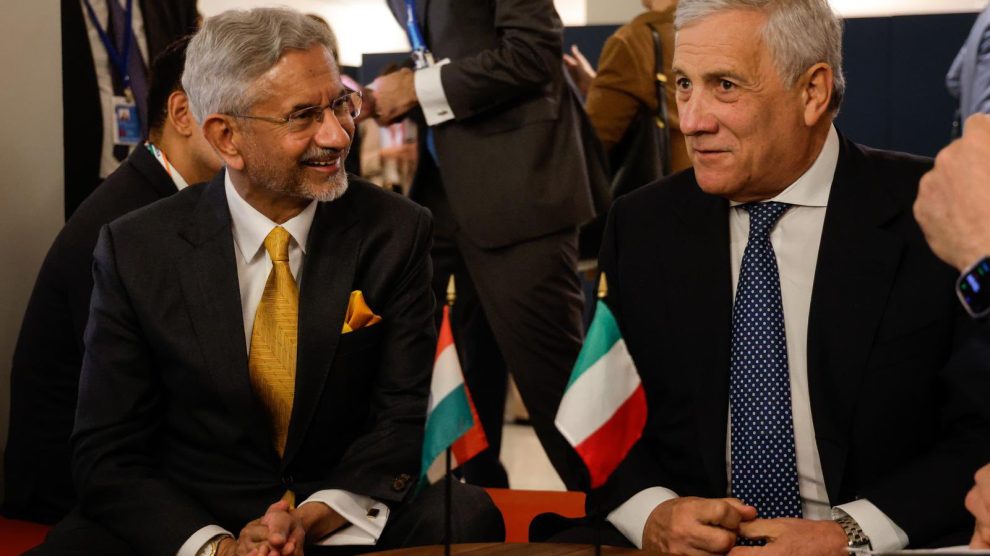
- Tajani met Indian Foreign Minister S. Jaishankar in New York (during the #UNGA81) days before the event with Gulf’s partners, describing India as a key country for Italy’s Export Action Plan and pointing to cooperation spanning defense and security, artificial intelligence, space, critical technologies and energy.
- Rome wants bilateral trade with India to reach €20 billion by 2029, Tajani said, citing both the opportunities offered by the EU-India free trade agreement and the strategic development of IMEC.
- The two ministers also agreed on the importance of freedom of navigation for the security of commercial routes, connectivity and economic growth.
Bottom line: Rome’s approach connects three tracks that are often treated separately: protecting maritime routes, building new physical and digital connections, and reducing trade barriers.
- For Italy, IMEC sits at their intersection — linking its growing partnership with India to deeper economic ties with the Gulf and, ultimately, Europe.
(Photo: X, @Antonio_Tajani)