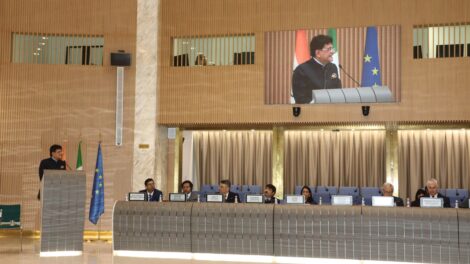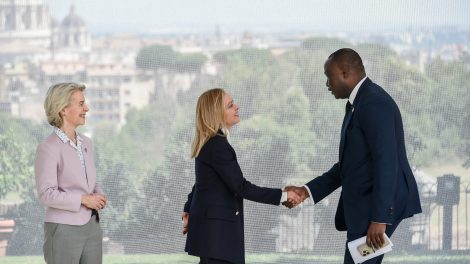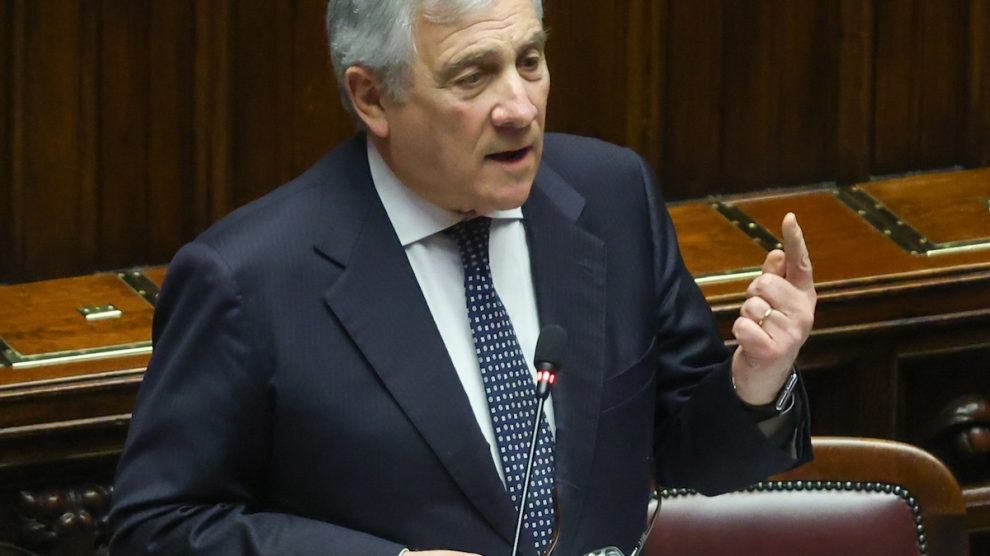
“The Mediterranean must not be a fortress closed in on itself, but a platform for dialogue to find concrete solutions to our common challenges.” With these words, Italian Deputy Prime Minister and Foreign Minister Antonio Tajani outlined Rome’s vision for the wider Mediterranean at the 2026 MED Dialogues in Naples.
His remarks brought together infrastructure connectivity, maritime trade, food security and regional stabilisation, presenting them as interconnected dimensions of Italy’s foreign policy towards the Mediterranean, Africa and the Indo-Pacific.
Why it matters: Tajani’s approach reflects an understanding of Mediterranean security that extends beyond traditional military and diplomatic considerations. The resilience of trade corridors, the availability of essential commodities and the stability of neighbouring regions are increasingly interconnected.
- For Italy, whose geographical position places it at the intersection of European, African and Middle Eastern commercial routes, strengthening connectivity also means reinforcing its role in regional economic security.
The IMEC connection. At the centre of Tajani’s remarks was a proposal to integrate Mediterranean, Middle Eastern and Gulf ports into a commercial network connecting Europe and India through Egypt and the Gulf countries.
- Trieste and Marseille would serve as the principal European gateways, respectively connecting the corridor to Central and Eastern Europe and to Western European markets.
- The initiative would also link up with existing European transport corridors, including Corridor 10 and Corridor 8, which connects the Adriatic to the Black Sea.
- Tajani also identified Naples, Salerno and ports across North Africa, the Middle East and the Gulf as potential beneficiaries of increased trade and tourism flows.
The proposal fits within the broader vision of the India–Middle East–Europe Economic Corridor (IMEC), which Rome and New Delhi increasingly regard as a strategic instrument for strengthening shared economic security through diversified trade routes, infrastructure development and industrial cooperation.
- Tajani said he had discussed the project with representatives of the Indian, Saudi and Egyptian governments, adding that the initiative was beginning to take shape. Its implementation, however, will require further coordination and investment.
- On digital connectivity, the minister also highlighted an agreement with the Gulf Cooperation Council, reinforcing the importance of linking physical infrastructure with digital networks.
Food security as strategic security. Maritime connectivity also featured prominently in Tajani’s discussion of food security. The minister said diplomatic efforts were underway to explore the possibility of using the Black Sea to transport grain towards Africa and Europe. One option under consideration would allow Egyptian vessels to load grain destined for Egypt and European markets.
- No agreement has yet been reached, but the proposal illustrates the importance Rome attaches to maintaining agricultural trade flows despite regional instability.
- Tajani also warned that disruptions to fertiliser shipments through the Strait of Hormuz could aggravate food insecurity, potentially contributing to increased migration pressures towards Europe.
- He referred to the so-called Rome Coalition, involving the EU’s nine Mediterranean member states and countries belonging to the Arab League, as part of efforts to facilitate fertiliser transit in cooperation with international organisations.
Security and diplomacy. The same emphasis on regional stability extends to Italy’s engagement in the Middle East. Tajani highlighted Italy’s leadership of the European Union mission at the Rafah crossing, headed by a Carabinieri colonel, and reiterated Rome’s willingness to train a future Gaza police force should the necessary political conditions emerge.
- On the West Bank, he strongly condemned settler attacks against Palestinian communities, including Christians, and described the establishment of new settlements as “unacceptable” because it undermines the prospect of a two-state solution.
- Looking towards Lebanon, Tajani expressed hope that a new international mission could succeed the United Nations Interim Force in Lebanon (UNIFIL), helping maintain stability along the Israeli border while supporting dialogue between Beirut and Israel. Italy, already militarily engaged in Lebanon, would be prepared to contribute.
The African dimension. Tajani also placed Africa within the same Mediterranean strategic framework, highlighting Italy’s military presence in Niger and calling for greater international attention to the war in Sudan.
- Through the Italy for Sudan initiative, Rome has already delivered 130 tonnes of humanitarian assistance, with additional shipments planned from the United Nations logistics base in Brindisi for civilian populations in Sudan, Ethiopia and Nigeria.
- The broader framework remains the Mattei Plan, through which Italy seeks to expand economic cooperation and development partnerships across Africa.
- Tajani also reaffirmed Italy’s support for Gavi’s efforts to encourage vaccine production on the continent, linking African economic development to Europe’s own prosperity.
The big picture: The Naples speech brings together several strands of Italian foreign policy under a common strategic perspective: the Mediterranean as a space connecting European markets, African development, Middle Eastern stability and Indo-Pacific trade.
- The proposed port network, food-security diplomacy and Italy’s involvement in regional security missions reflect different instruments serving a shared objective: preserving the conditions for economic exchange and political cooperation across an increasingly interconnected region.
The bottom line. Rome’s Mediterranean strategy rests on the assumption that connectivity and stability reinforce one another. Turning that vision into practical results will depend on the development of operational trade corridors, secure maritime routes and sustained diplomatic engagement with regional partners.
- For Italy, the challenge is to ensure that its geographical position translates into a meaningful role in shaping the economic and security architecture of the wider Mediterranean.