The crises in the Strait of Hormuz and the Red Sea are accelerating the reconfiguration of trade routes connecting Asia, the Gulf, the Mediterranean and Europe. As governments and businesses seek more reliable commercial links, customs authorities are becoming increasingly relevant to the security, efficiency and resilience of international supply chains.
Why it matters: The competitiveness of a trade corridor depends on the ability to move goods across borders efficiently and predictably. Customs procedures, advance information-sharing, digital interoperability and cooperation between national administrations influence how quickly shipments can move and how effectively supply chains can respond to disruption.
- For governments seeking to diversify trade routes, customs cooperation is becoming an important component of economic security and international connectivity.
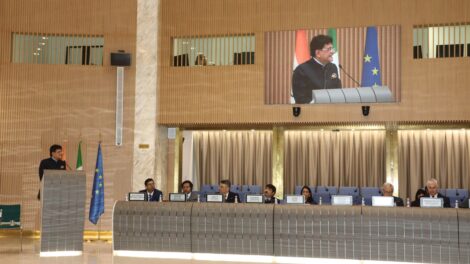
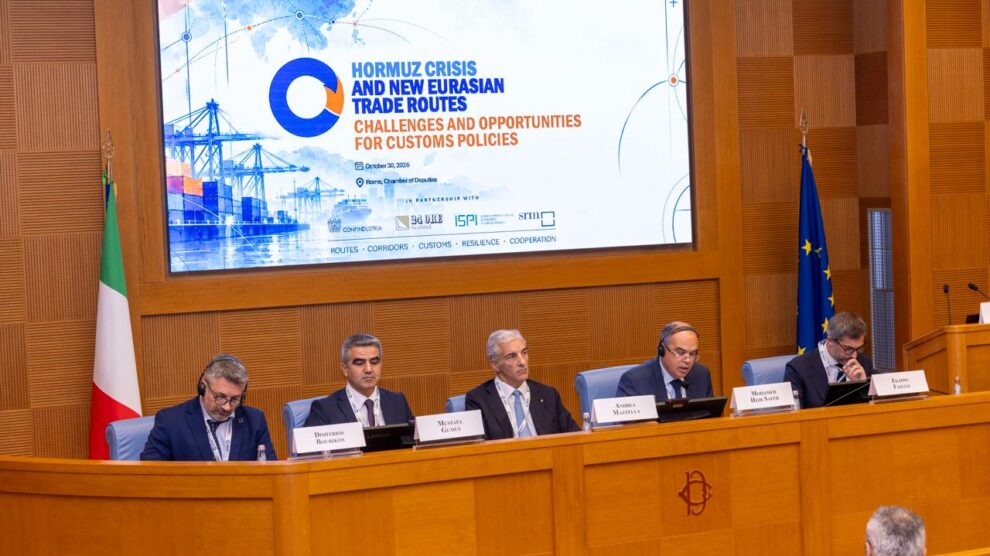
Driving the news: Italy’s Customs and Monopolies Agency (ADM) hosted an international conference on October 30 at the Chamber of Deputies in Rome, titled “The Hormuz Crisis and the New Routes of Eurasian Trade: Challenges and Opportunities for Customs Policies”.
From Italian institutions: Organized in partnership with Confindustria, Italy’s main business association, Il Sole 24 Ore, the Italian Institute for International Political Studies (ISPI), and SRM (a research centre affiliated with the Italian top banking group Intesa Sanpaolo), a research centre affiliated with the Intesa Sanpaolo banking group, the event focused on strengthening international customs cooperation as trade routes between Asia and Europe undergo significant changes.
- The conference opened with remarks by Roberto Alesse, Director-General of ADM, and included a video message from Giancarlo Giorgetti, Italy’s Minister of Economy and Finance, as well as contributions from Edmondo Cirielli, Deputy Minister of Foreign Affairs and International Cooperation, and Edoardo Rixi, Deputy Minister of Infrastructure and Transport. A message from Lorenzo Fontana, President of Italy’s Chamber of Deputies, was also read at the opening.
The international dimension: The gathering brought together senior customs officials from the European Union, the United States, the Gulf and the wider Mediterranean.
- Participants included Gerassimos Thomas, Director-General of the European Commission’s Directorate-General for Taxation and Customs Union (DG TAXUD); Judson Murdock, Deputy Executive Assistant Commissioner for the Office of Field Operations at US Customs and Border Protection (CBP); and Suleiman bin Masoud Al-Ghafri, Executive Director of the Customs Union Authority of the Gulf Cooperation Council (GCC).
- Senior customs representatives from Ireland, Turkey, Tunisia, Greece, Germany, the Netherlands, the United Arab Emirates and Bahrain also took part, alongside representatives from academia, research institutions and the business community.
- The participation reflected the geographical scope of the challenge. Trade corridors linking Europe, the Middle East and Asia cross multiple jurisdictions, making administrative cooperation essential to their reliability and commercial viability.
The big picture: Opening the conference, Alesse highlighted how the Hormuz crisis has accelerated the redrawing of transit corridors, increased logistics and insurance costs, and encouraged the search for safer and more predictable alternatives.
- He argued that the quality of customs procedures is an integral part of the overall quality of a trade route. Even substantial infrastructure investments cannot deliver their full potential without clear rules, accessible information and administrations capable of cooperating along the movement of goods.
- For customs authorities, these challenges coincide with the expansion of e-commerce, rapid technological change and increasingly sophisticated illicit trade networks. The task is to maintain effective controls while ensuring that legitimate commerce continues to move efficiently.
- In his institutional message, Fontana stressed the need for stronger cooperation between countries and greater sharing of knowledge and innovative tools to reinforce supply-chain resilience. He also pointed to Italy’s potential role in facilitating dialogue between Europe, Asia, the Mediterranean and the Gulf.
The infrastructure challenge: Rixi argued that the maritime sector has continued to sustain European supplies despite disruptions along major international shipping routes. Maintaining that resilience, however, requires improvements extending beyond physical port infrastructure.
- He emphasised the need to standardise procedures across Italian ports, expand pre-arrival customs clearance and develop integrated digital systems capable of accelerating cargo processing.
- The distinction is largely one of timing. Expanding ports and transport networks requires years of investment and construction, while administrative simplification and digitalisation can improve the use of existing capacity more quickly.
- Rixi also pointed to cooperation with India and Egypt aimed at facilitating trade connections, alongside proposals to strengthen Italy’s presence in overseas port infrastructure through partnerships with local operators.
Zoom in: The diplomatic implications of customs cooperation emerged in the intervention of Andrea Mazzella, an Italian diplomat with the rank of Minister Plenipotentiary and Director of International Relations at ADM.
- Mazzella described customs administrations as potential channels of dialogue between countries, capable of sustaining commercial connections even during periods of instability. Their traditional responsibilities for inspection, enforcement and security increasingly intersect with efforts to build trust between different economic systems.
- Data-sharing, harmonised procedures and facilitated trade corridors can help preserve connectivity when geopolitical tensions disrupt established routes. Their effectiveness depends on sustained cooperation between the administrations involved.
The European dimension: Mazzella also raised the question of how the European Union engages with external partners on customs matters, pointing to the fragmentation that can arise when national administrations pursue similar objectives separately.
- Stronger European coordination could facilitate operational agreements and improve integration between logistics systems spanning the Mediterranean, the Gulf and Asia.
- The conference also examined the practical instruments available to customs administrations, including digital interoperability, shipment traceability, advance information exchange and mutual recognition of Authorised Economic Operator (AEO) programmes, which allow trusted businesses to benefit from customs simplifications.
- These mechanisms can reduce uncertainty for companies and improve the predictability of cross-border trade. They also provide a practical basis for closer cooperation between customs authorities operating under different regulatory systems.
What we’re watching: The debate is particularly relevant to the future of alternative trade corridors, including the India-Middle East-Europe Economic Corridor (IMEC).
- Italy continues to regard the initiative as an important form of geoeconomic redundancy, as Ambassador Francesco Maria Talò, Italy’s Special Envoy for IMEC, noted during the conference.
- Developing such connections requires investment in ports, railways and logistics infrastructure. Their effectiveness will also depend on compatible customs procedures, information-sharing and coordinated controls across the countries involved.
- In his concluding remarks, Alesse identified the further development of facilitated customs corridors and stronger coordination between administrations during crises as priorities for future cooperation.
The bottom line: For Italy, the issue concerns the competitiveness of its port and logistics system and its position within the wider Mediterranean. For the European Union, it raises a broader question about aligning customs cooperation with economic security and external strategic priorities.
- The conference also highlighted the role of businesses and research institutions in identifying practical forms of cooperation capable of improving trade predictability and supporting economic competitiveness. As geopolitical disruptions reshape international commerce, the ability to coordinate customs procedures and build trust between administrations will increasingly influence the reliability of emerging trade corridors linking Europe, the Middle East and Asia.