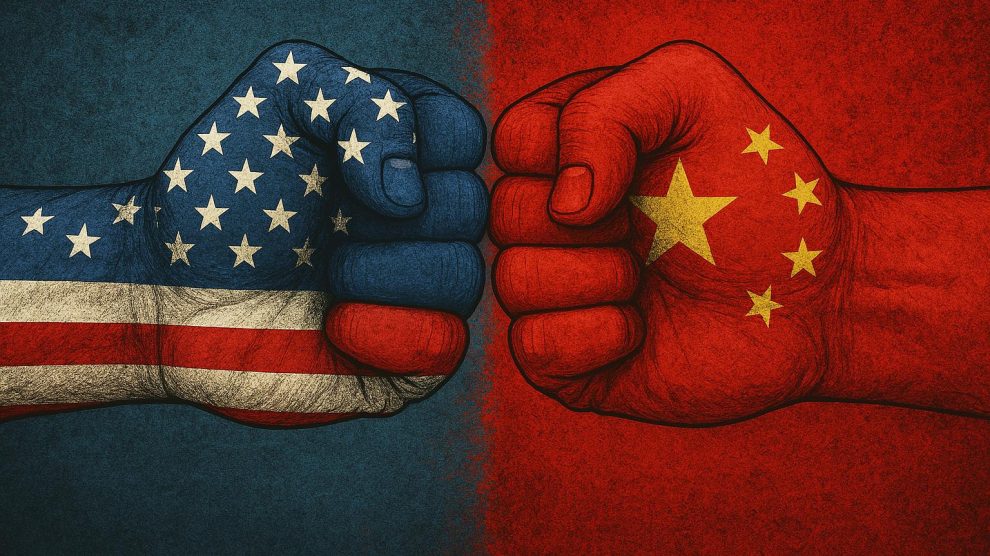
The participation of AgID Director General Mario Nobile in China’s World Artificial Intelligence Conference (WAIC), shortly after Italy joined the U.S.-led Joint Statement on AI Opportunity under the Pax Silica initiative, has sparked a debate in Rome over the country’s strategic positioning on artificial intelligence.
The episode does not necessarily signal a change in Italy’s strategic direction. If anything, prompting questions about whether every part of the Italian state is moving in the same direction. Under Prime Minister Giorgia Meloni, Rome has consistently reduced strategic dependence on China while reinforcing transatlantic cooperation on critical technologies.
-
What is clear is that the episode has opened a broader discussion about the relationship between political strategy and institutional implementation as AI increasingly becomes a matter of national security and geopolitical competition.
To place the Italian debate within this wider strategic context, Decode39 asked Zineb Riboua, Research Fellow at the Hudson Institute, three questions about the shrinking room for ambiguity in AI governance.
Q. As the United States and China increasingly compete to shape the global AI ecosystem, do governments still have meaningful room to engage with both frameworks, or is AI governance becoming an increasingly binary strategic choice?
A: No. The room governments believe they retain is an illusion sustained by the interval between procurement and consequence, and that interval is closing.
- The experience of the United Arab Emirates illustrates this dynamic. Abu Dhabi built much of its telecommunications infrastructure with Huawei. When negotiations over the acquisition of the F-35 advanced, Washington made the removal of Huawei equipment a condition for the transfer. The Emiratis ultimately suspended the purchase, discovering that a commercial decision made years earlier had already constrained a strategic one.
- The lesson extends well beyond one country or one technology. Governments increasingly find that decisions taken in the name of economic flexibility eventually shape their strategic options. As artificial intelligence becomes embedded in critical infrastructure, that space for balancing between competing ecosystems is rapidly disappearing.
Q. How important have standards, governance frameworks and technology partnerships become in today’s AI competition? Are they now as strategically significant as semiconductors and compute capacity?
A: Standards and governance frameworks have become the more durable instrument of competition.
- Compute advantages, however significant today, inevitably diffuse over time. Export controls can delay that process, but they cannot stop it indefinitely. Governance frameworks, by contrast, shape how data are managed, how models are evaluated, how systems interoperate and how public institutions procure and deploy AI.
- These decisions survive electoral cycles, outlast individual hardware generations and become embedded in regulatory practice, procurement rules and the professional training of engineers and public officials.
- Beijing clearly understands this asymmetry. Platforms such as the World Artificial Intelligence Conference and the Global AI Governance Initiative are not simply diplomatic gatherings. They are mechanisms for building long-term coalitions around Chinese approaches to AI governance and technical standards.
Q. Without commenting on the Italian case specifically, what are the strategic risks for a U.S. ally when it sends ambiguous signals about which AI ecosystem it intends to support?
A: Ambiguity creates risks on several levels.
- First, Beijing interprets hedging as an opportunity and tailors its engagement toward governments, ministries and companies that appear most receptive.
- Second, ambiguity weakens the credibility of the very coalitions a country has already joined. Technology partnerships depend on confidence that allies are moving in the same strategic direction. Every visible signal of uncertainty lowers the political cost for others to do the same.
- Finally — and perhaps most importantly — infrastructure decisions taken during periods of ambiguity often outlast the ambiguity itself. Ministries sign contracts, companies integrate technologies and engineers build expertise around particular architectures.
The bottom line: By the time political clarity eventually arrives, those technical choices have already narrowed the government’s strategic options, making reversal significantly more costly.
- As artificial intelligence moves to the centre of geopolitical competition, the question is no longer simply which technologies countries adopt, but which governance ecosystem they choose to become part of.