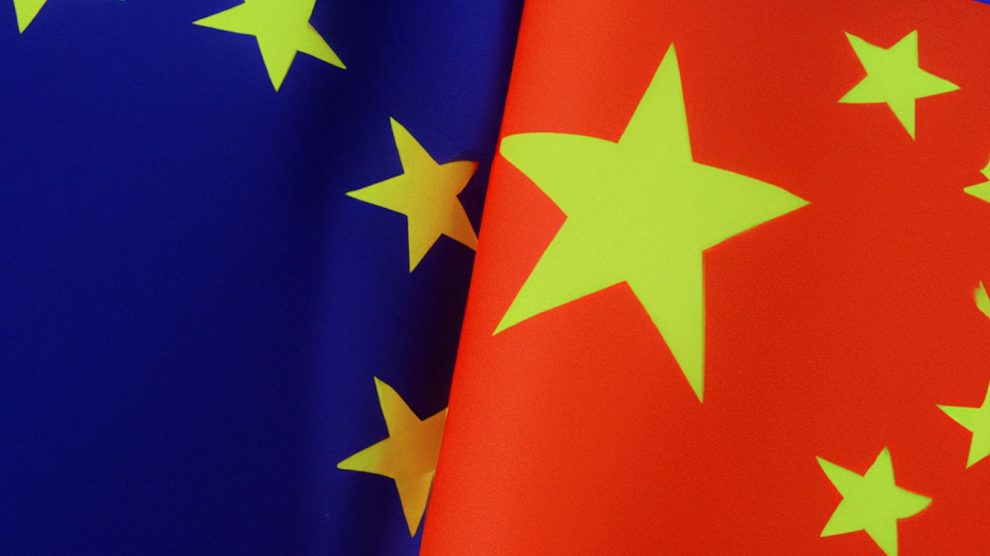
Just as a broader political consensus is taking shape in Brussels around the need for a more assertive European policy toward China, the vote in Strasbourg produced an Italian signal running in the opposite direction: Italy’s Democratic Party (PD) chose to abstain on the European Parliament report on political relations between the European Union and China, following the broader line taken by the Socialists and Democrats (S&D) group.
Why it happened: The decision reflected an attempt to maintain a more balanced posture, S&D explains. While acknowledging concerns over economic imbalances and human rights, these lawmakers sought to avoid fully embracing a more confrontational geopolitical and military approach that they see as potentially counterproductive to Europe’s diplomatic and commercial channels with Beijing.
Yes, but… There was a significant split within the Italian center-left. Elisabetta Gualmini and Irene Tinagli, alongside Pina Picierno of Renew Europe, voted in favor of the report, joining Italian MEPs from ECR and the EPP. Italy’s other opposition forces also divided: AVS abstained, while the Five Star Movement voted against alongside the alt-right political force Futuro Nazionale.
What they voted on. What matters is the nature of the document that the PD declined to support. The report drafted by the European Parliament’s Foreign Affairs Committee (AFET) goes well beyond trade and reflects an approach gaining ground across different European political groups: China should be viewed not only through the prism of economic imbalances and industrial competition, but also as a geopolitical actor whose policies have direct consequences for European security.
- The report brings together several dimensions of the relationship with Beijing: trade imbalances and Chinese industrial overcapacity, Europe’s strategic dependencies, Beijing’s support for Russia — including in the context of its full-scale invasion of Ukraine — and the broader implications of China’s international posture for European security.
Why it matters. Taken in isolation, the PD’s vote could be dismissed as a disagreement over a non-binding parliamentary report. The broader context makes it more politically significant. A wider consensus is emerging in Brussels around the need to complement dialogue with Beijing with a greater European capacity to protect the bloc’s economic interests, security and industrial base.
- Parliament voted just before EU Trade Commissioner Maroš Šefčovič travels to Beijing, where he is expected to meet Chinese Commerce Minister Wang Wentao.
- The vote therefore comes as the EU seeks both to keep channels with the Chinese leadership open and to approach negotiations from a more assertive position.
- It is within this broader context — rather than the formal weight of the resolution itself — that the Italian PD’s abstention becomes noteworthy. All the more so because some lawmakers from the same political area chose a different course.
Gambino’s view. “One is left thinking that in Italy there is a political group that does not care about Europe’s interests, while it does care about China’s,” Alberico Gambino, an MEP from Giorgia Meloni’s Brothers of Italy/ECR, vice-chair of the European Parliament’s Foreign Affairs Committee and a member of its Security and Defence Committee, told Formiche.net.
- “Instead of standing together and showing themselves to be patriots, these parties are working against the interests of Italians in Italy and, in this case, against those of Europe and European industries. It is a drift that clashes sharply with the PD’s repeated claims of responsibility and its portrayal of itself as a responsible party capable of governing Italy: exactly the opposite is true.”
The economic backdrop. Behind the political debate lies an increasingly unbalanced economic relationship. The European Union’s annual trade deficit with China has exceeded €360 billion, while Brussels is reassessing the tools available to protect the European market from distortions caused by Chinese industrial overcapacity and an uneven competitive playing field.
- France and Germany have also called on the European Commission to equip itself with more forceful defensive instruments. Without explicitly naming China, Emmanuel Macron and Friedrich Merz have called for a mechanism capable of enabling a “decisive and systemic response” and, when necessary, even immediate exclusion from the EU’s internal market.
- The aim is to give Brussels the ability to respond rapidly when external distortions threaten Europe’s competitiveness and industrial base.
Dialogue, not dependence. Gambino argues that with China “we obviously need to keep channels of communication and dialogue open at all times, but that does not mean being submissive or remaining silent in the face of rules that apply only to us and that are causing enormous damage to European businesses.”
- He added: “In past years, the EU became absorbed by the Green Deal, putting the interests of European industry to one side. Now we need to make up for lost time, but it will not be easy. We are Europe, and we have shown that we can overcome difficult moments, as the history of the last century demonstrates. We have the talent, the capabilities and the competitive industrial base to do so. Politics will have to support this revival.”
The big picture. The goal, according to the FdI lawmaker, is “not to have a master, but to put ourselves on the same level as the United States and China, so that we can have a seat at the tables that matter while, of course, pursuing the development of our territories across the board.”
- “If we do not provide our industry with the energy it needs, we will lose competitiveness, jobs and our ability to count and carry weight in international forums. This shift in awareness began in 2022, when Prime Minister Giorgia Meloni started making her voice heard in Brussels, saying that we could no longer continue down this path. And today’s shift in the European Parliament fully reflects the points Meloni has repeatedly raised at European Council meetings: the issue of trade imbalances with Beijing.”
Bottom line. The Strasbourg vote reflects a European Parliament increasingly inclined to see China less as an exclusively commercial issue and more as a matter of economic, industrial and geopolitical security.
- In that context — and on the eve of Šefčovič’s mission to Beijing — the abstention by most of Italy’s PD delegation carries greater political weight than the formal status of the resolution itself. The decision by Gualmini, Picierno and Tinagli to vote the other way only makes the divide within the Italian center-left more visible.