
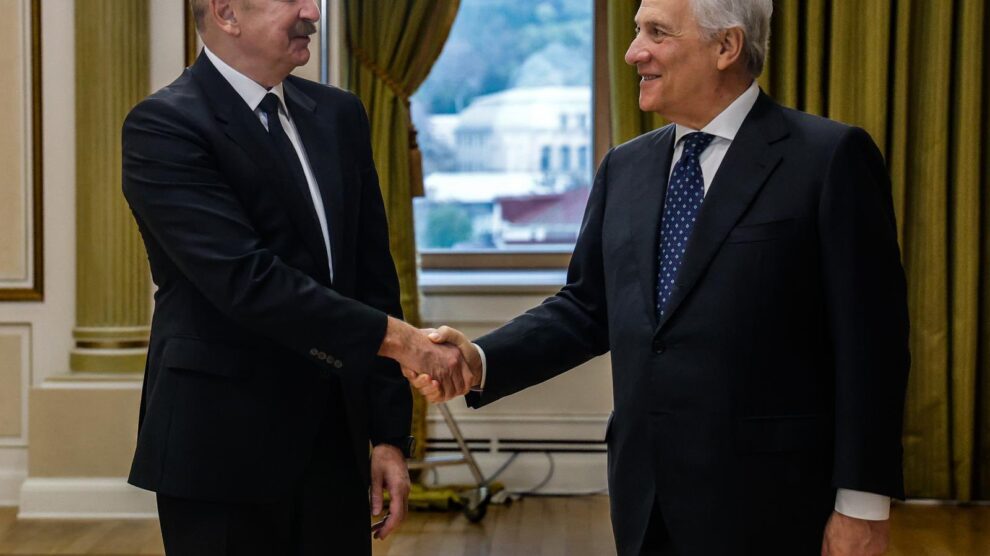
Italian Foreign Minister Antonio Tajani is visiting Azerbaijan on November 23–24, as Rome seeks to expand its strategic partnership with Baku beyond energy. The mission combines high-level diplomatic engagement with an economic agenda focused on critical minerals, advanced technologies, infrastructure and investment.
The Italy-Azerbaijan Business Forum, bringing together more than 240 business representatives, has produced several industrial and financial agreements. The diplomatic agenda also includes talks with President Ilham Aliyev, Foreign Minister Jeyhun Bayramov and Economy Minister Mikayil Jabbarov.
The visit follows Prime Minister Giorgia Meloni’s trip to the South Caucasus in May and President Sergio Mattarella’s visit to Azerbaijan in October 2025.
Why it matters: Azerbaijan is becoming an increasingly important partner in Italy’s economic-security strategy. Its significance extends beyond the hydrocarbons underpinning bilateral relations to include strategic supply chains, industrial development and alternative connections between Europe and Asia.
- The agreements signed in Baku illustrate this evolution, bringing Italian industrial capabilities and financial institutions into sectors that could strengthen the country’s presence across the South Caucasus.
- For Rome, the opportunity is also geopolitical: developing economic partnerships along Eurasian corridors while supporting regional stability and the normalization process between Azerbaijan and Armenia.
Energy security remains the foundation. In an exclusive interview with Trend News Agency published on November 23, Tajani said Azerbaijan accounted for 16% of Italy’s natural gas imports and 13% of its oil imports in the first half of 2026.
- The Trans Adriatic Pipeline (TAP) has strengthened Italy’s supply diversification, particularly since Russia’s invasion of Ukraine. Rome supports expanding its capacity to increase supplies to Italy and Europe, while the Strait of Hormuz crisis has reinforced the strategic value of diversified energy routes.
- The importance of this relationship was already evident in Decode39’s interview with Azerbaijani presidential representative Elchin Amirbayov, which examined the Southern Gas Corridor’s role in European energy security and the broader connectivity framework linking the Caspian, Black Sea and Mediterranean regions.
The relationship has also acquired a domestic economic dimension through SOCAR’s acquisition of Italiana Petroli and the Azerbaijani company’s voluntary fuel-price cap in Italy, which Tajani has publicly welcomed.
- Meanwhile, Italy supports feasibility studies for the Green Energy Corridor and the Trans-Caspian Electric Corridor, initiatives that could connect Central Asia’s renewable resources to European markets through Azerbaijan.
Critical minerals: A partnership reaching beyond the Caucasus. One of the most significant agreements signed during the business forum concerns cooperation in critical raw materials in third countries.
- The memorandum opens the possibility of joint initiatives across mineral supply chains, from extraction and processing to recycling, with potential projects in the Caucasus, Central Asia and Africa.
- The African dimension is particularly relevant. It could create opportunities to connect Italian industrial expertise and the Mattei Plan’s investment ambitions with Azerbaijani capabilities, including regional logistics and mineral processing.
- Azerbaijani Economy Minister Mikayil Jabbarov has highlighted Italy’s expertise in mechanical engineering and metallurgy as a potential contribution to technology transfers, local production and higher-value manufacturing.
- The initiative builds on the industrial dialogue launched in Rome in October, when the two countries identified critical minerals, digital infrastructure and advanced manufacturing as priority sectors.
Follow the money. The Baku forum has also generated agreements involving some of Italy’s leading industrial and financial institutions.
- Leonardo and Azerbaijan’s Ministry of Economy have signed a memorandum on artificial intelligence and high-performance computing. Iveco and local partner Azteximport have formalized cooperation in public transport, while other arrangements involve Baku Steel Company and Italian industrial partners.
- On the financial side, Cassa Depositi e Prestiti and the Azerbaijan Business Development Fund have agreed to promote business and investment cooperation. SIMEST and the Italy-Azerbaijan Chamber of Commerce have also strengthened their partnership to support trade and investment.
- These arrangements are intended to facilitate Italian companies’ access to the Azerbaijani market, particularly for smaller businesses seeking opportunities in infrastructure and industrial development.
- In his interview with Trend, Tajani also identified potential projects involving the Absheron gas field, SOCAR’s planned Sumgayit refinery, Baku’s transport modernization and the Alat Free Economic Zone.
The big picture: Connecting the Mediterranean and Central Asia. As Francesco De Palo explains in Formiche.net, the deepening relationship between Rome and Baku reflects a broader Italian strategy extending its diplomatic and economic reach from the Mediterranean to the Caucasus and Central Asia, with energy cooperation providing the foundation for a more comprehensive political partnership.
- Tajani explicitly linked Italy’s support for the Middle Corridor with the India-Middle East-Europe Economic Corridor (IMEC), presenting both within a broader ambition to make Italy a leading European and Mediterranean connectivity hub.
- The two corridors have different geographies and development trajectories, but they share a strategic rationale: diversifying transport, logistics, energy and digital connections between major economic regions.
- The Middle Corridor could gain further importance as Azerbaijan and Armenia pursue normalization, potentially opening new transport connections across the South Caucasus.
- This geopolitical dimension was already central to Decode39’s analysis of why Baku matters beyond gas, which examined Italy’s efforts to translate economic interdependence into a stronger political presence in the region.
- The wider implications extend to the Black Sea, the Adriatic and the Western Balkans, areas Tajani has identified as priorities for Italian foreign policy.
- The approach also reinforces the diplomatic direction visible during Meloni’s May visits to Armenia and Azerbaijan, when Italy combined energy cooperation with support for regional stability and connectivity.
The bottom line. The agreements emerging from Tajani’s visit are giving greater industrial substance to Italy’s relationship with Azerbaijan. Energy security remains essential, but cooperation on critical minerals, emerging technologies and investment is adding new dimensions to the partnership.
- For Rome, Baku is increasingly both an energy supplier and a partner in its wider Eurasian economic strategy. The next test will be whether the agreements translate into operational projects, sustained investment and stronger connections between Italian industry and regional supply chains.
(Photo: X, @antonio_tajani)