

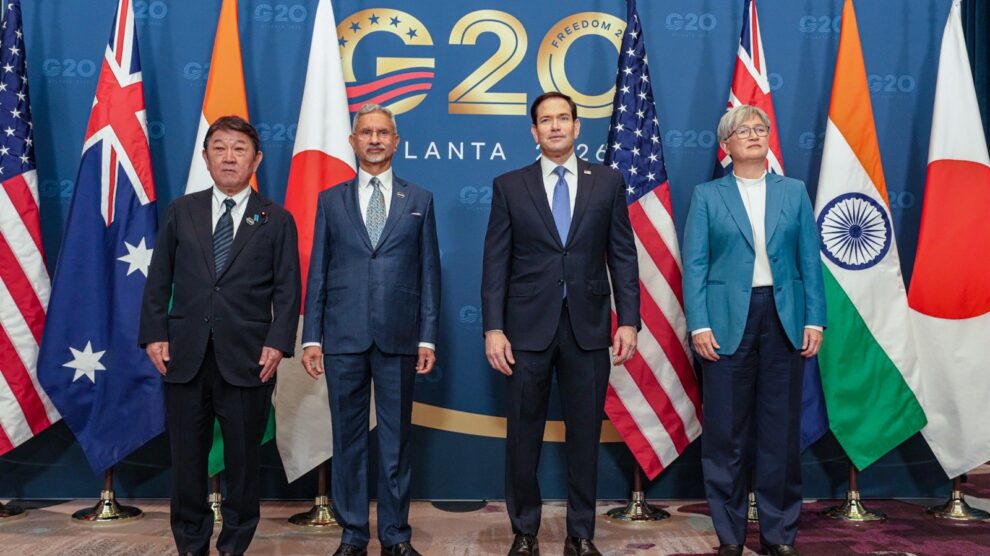
Economic security is becoming a defining priority for the Quad, with implications extending well beyond the Indo-Pacific. Meeting in Atlanta on October 31, the foreign ministers of the United States, India, Japan and Australia reaffirmed their commitment to resilient supply chains, trusted technologies and secure maritime routes, expressing concern over economic coercion, arbitrary export restrictions and industrial overcapacity. Their joint statement also singled out the Strait of Hormuz, the Red Sea and Bab el-Mandeb as waterways where navigational freedoms must be preserved.
For Italy, the significance of these priorities is immediate. The maritime corridors connecting the Indian Ocean to the Mediterranean underpin commercial exchanges between Europe and Asia, while the industrial and technological dependencies identified by the Quad increasingly feature in Rome’s own economic security agenda. The statement therefore offers a useful measure of how closely the strategic priorities of the Indo-Pacific and Euro-Mediterranean regions are becoming aligned.
The Indo-Mediterranean connection. The reference to Hormuz, the Red Sea and Bab el-Mandeb is particularly revealing. Although the Quad remains anchored in the Indo-Pacific, its emphasis on these waterways reflects the importance of maritime connections extending into the Middle East and towards Europe. Disruptions along these routes have implications for energy supplies, commercial shipping and the reliability of international supply chains.
These are also central concerns for Italy, whose strategic outlook increasingly treats the Mediterranean and Indian Ocean as interconnected spaces. The Indo-Mediterranean doctrine discussed by Prime Ministers Giorgia Meloni and Narendra Modi reflects this approach, linking maritime security, connectivity and economic cooperation across the two regions.
- The India-Middle East-Europe Economic Corridor (IMEC) provides a further expression of that ambition. As India’s ambassador to Italy, Vani Rao, has explained, the corridor is intended to strengthen connections between Europe, Asia and Africa, giving the Indo-Mediterranean concept a tangible economic dimension. The resilience of such corridors also depends on customs interoperability and administrative coordination, as a recent Rome discussion on the changing geography of Eurasian trade highlighted.
- Maritime security provides another point of convergence. The Quad is expanding cooperation on maritime domain awareness, information sharing and interoperability, including through joint observer missions and forthcoming surveillance exercises. Italy, meanwhile, has developed its own naval engagement across the Indo-Pacific, alongside European partners and regional navies.
- The recent visit of the Indian Navy’s INS Trishul to Civitavecchia illustrates how maritime cooperation between Rome and New Delhi is acquiring greater operational and diplomatic visibility. These activities do not place Italy within the Quad’s security arrangements, but they reflect overlapping interests in protecting maritime connectivity.
The technology and supply chain dimension. The convergence becomes equally apparent in economic and technological security.
- The Atlanta statement identifies a broad range of strategic sectors: critical minerals, advanced semiconductors, artificial intelligence hardware, 5G and 6G networks, Open RAN architectures, undersea data cables, digital identity standards and cybersecurity. Together, these priorities reflect an effort to reduce vulnerabilities across the industrial inputs, technological infrastructure and communications networks underpinning modern economies.
The statement does not explicitly mention China. Nevertheless, its references to economic coercion, non-market practices and arbitrary export restrictions point towards concerns that have become central to international competition over strategic supply chains. Italy is increasingly involved in several of the same initiatives.
- On advanced connectivity, Rome has aligned itself with the US-led effort to develop secure 6G networks, a choice reflecting its growing emphasis on trusted communications technologies and cooperation with Washington. Italy has also joined the Kyoto Vision initiative, reinforcing its participation in discussions over the technological standards and industrial partnerships expected to shape future communications infrastructure.
- The overlap is especially visible in Pax Silica, which the Quad statement explicitly identifies alongside advanced artificial intelligence as relevant to future economic growth. Italy’s participation in the initiative connects Rome to a broader effort to develop trusted technology ecosystems, encompassing semiconductors, advanced computing and strategic industrial capabilities.
- That relationship has acquired a bilateral dimension through the US-Italy Trusted Tech Accelerator, while Italian engagement with Taiwan’s semiconductor ecosystem illustrates the importance Rome attaches to advanced chip supply chains. As Decode39 has previously examined, these initiatives increasingly connect industrial policy with strategic alignment.
Critical minerals and the geography of partnerships. Critical minerals provide another concrete intersection. Under the framework announced in May, the Quad is strengthening cooperation on recovering strategic materials from electronic waste and industrial scrap, with Washington committing $10 million to support recycling infrastructure in India and ASEAN countries. The objective is to reduce dependence on individual suppliers and develop more resilient processing and recycling networks.
- Italy is pursuing comparable objectives through bilateral industrial partnerships. The new US-Italy cooperation on critical minerals reflects an effort to connect diplomatic alignment with industrial supply chain development.
- Meanwhile, SACE’s agreement with Western Australia illustrates how Rome is engaging directly with one of the Quad’s members to secure access to strategic raw materials.
Japan represents another important connection. The Meloni-Takaichi summit highlighted shared interests in industrial resilience, economic security and the protection of maritime routes. These priorities closely resemble those articulated in Atlanta, suggesting that Italy’s bilateral relationships with Quad members increasingly operate across a common set of strategic concerns.
The convergence. The Quad’s agenda should not be mistaken for a framework into which Italy is formally integrated. Its members retain distinct national priorities, and many of the initiatives announced in Atlanta remain at the planning or implementation stage. Nor does convergence on economic security necessarily imply identical approaches to China or regional security.
- What the statement demonstrates, however, is the growing interdependence of maritime connectivity, industrial resilience and technological security. These challenges extend across the geographical boundaries separating the Indo-Pacific from the Euro-Mediterranean.
- For Rome, the question is therefore less whether Italy should engage with the Quad as an institution than how effectively it can participate in the networks, partnerships and industrial projects developing around similar priorities.
- The Indo-Mediterranean offers a geographical and diplomatic framework for that engagement. Italy’s relationships with Washington, New Delhi, Tokyo and Canberra provide several channels through which it can pursue shared objectives without requiring a new institutional format.
The bottom line: The Atlanta statement ultimately underscores a broader strategic reality: the security of Europe’s southern maritime approaches, the resilience of its industrial supply chains and the future of its technological partnerships are increasingly connected to developments across the Indo-Pacific.
- For Italy, translating that convergence into industrial opportunities, infrastructure investment and sustained diplomatic influence will be the more demanding test.
(Photo: X, @SecRubio)